Key takeaways
- Compare cedar, galvanized steel, vinyl and resin raised bed kits for a vegetable garden, with sizes and materials taken from each Amazon listing.
Choosing a raised bed material is really a decision about how long you want the frame to stay square, how it handles wet soil pressed against it all season, and whether you are comfortable growing food in it. A bed that rots, rusts through, or bows outward after two wet springs costs you a full bed of soil and a lost planting window, not just a replacement frame.

This guide is for vegetable growers setting up one bed or a small row of beds at home. Each kit below stands for a different material, and each was chosen from the name and specifications on its own Amazon product page, so you can compare cedar, galvanized steel, vinyl, and resin on the terms their own listings state.
Quick Picks
As an Amazon Associate we earn from qualifying purchases.
| Product | Best for | Key spec from title |
|---|---|---|
| Greenes Fence Premium Cedar Raised Garden Bed | Growers who want untreated North American cedar for food beds | 4 x 12 ft, 7-10.5 in tall, 3/4 in thick boards |
| FOYUEE Galvanized Raised Garden Bed | A long, low metal bed for a full row of vegetables | 8 x 4 x 1 ft galvanized steel kit |
| Vita Classic Vinyl Raised Modular Garden Bed | A tidy square bed beside a house or fence | 4 x 4 x 11 in white vinyl, model VT17108 |
| Keter Splendor Raised Garden Bed | Raised growing on a patio without bending to ground level | 31.7 gallon, self watering, polypropylene resin |
How to Choose
Decide how the material handles constant soil moisture
Soil in a vegetable bed stays damp for weeks at a time, and that moisture sits directly against the inside face of the frame. Cedar answers that contact with wood the Greenes listing describes as North American cedar, a material growers traditionally accept for food beds, while galvanized steel answers it with a coated metal panel and vinyl and resin answer it by not absorbing water at all. Think about your own plot first: a shaded bed that dries slowly punishes absorbent materials harder than a sunny, free-draining one, so match the material to how wet your beds actually stay between waterings.
Match bed depth and footprint to what you plant
Depth decides which vegetables are realistic, and the listings here state it plainly. The FOYUEE metal kit stands one foot tall, the Vita vinyl bed is eleven inches, and the Greenes cedar kit is listed at seven to ten and a half inches depending on how it is stacked. Shallow-rooted salads and herbs settle happily in the lower frames, while tomatoes, peppers, and carrots want the deeper soil the taller kits hold. Footprint matters just as much: a four-by-twelve cedar bed suits a long row, whereas the four-by-four Vita fits a compact square-foot layout near a door.
Check what assembly and stacking the kit allows
A raised bed kit is boards or panels plus a joining system, and the differences show up on the day you build it and again the day you change your mind. Greenes describes its cedar kits as stackable and expandable with additional kits, which suits a garden that grows bed by bed each spring. The Vita is described as a modular garden bed, again pointing to layouts that can change shape. Panel metal kits such as the FOYUEE go together as a fixed rectangle. Decide now whether you want a permanent footprint or one you can extend, because changing systems later means emptying the soil.
Weigh upkeep against how long you will keep the bed
Every material asks for a different kind of attention. Cedar weathers to grey and eventually softens, so a cedar bed is a good fit if you accept gradual renewal as part of gardening. Galvanized steel asks you to watch panel edges and fixings instead, and to keep an eye on the coating where tools strike it. Vinyl and resin ask the least routine care, since the Vita listing calls its vinyl weather resistant and the Keter bed is a moulded resin planter, but both are fixed mouldings or panels that you replace rather than repair board by board.
The 4 Best Options
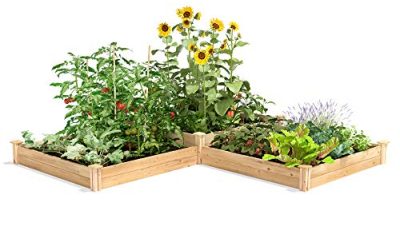
Greenes Fence Premium Cedar Raised Garden Bed
Cedar is the starting point most vegetable growers picture, and this Greenes Fence kit is the clearest example in this group. Its listing names North American cedar, boards three quarters of an inch thick, and a four-by-twelve footprint that can be built seven or ten and a half inches tall. That long, low shape suits a proper vegetable row where you plant in lines and work from both sides. Choose it if you want a wood bed for food growing, made in the USA according to its listing, and you are comfortable with wood ageing naturally outdoors over the seasons.
Specs
- Brand: Greenes Fence
- Material named in listing: North American cedar
- Size from title: 4 x 12 ft, 7-10.5 in tall
- Board thickness from title: 3/4 in
- Origin stated in title: Made in USA
- ASIN listed for this model: B00L1GOGZ2
Best for: A long vegetable row where you want a cedar frame and room to plant in lines.
Watch out for: Cedar is still wood in wet soil, so expect it to weather and soften sooner than the metal, vinyl, or resin frames here.
ASIN: B00L1GOGZ2
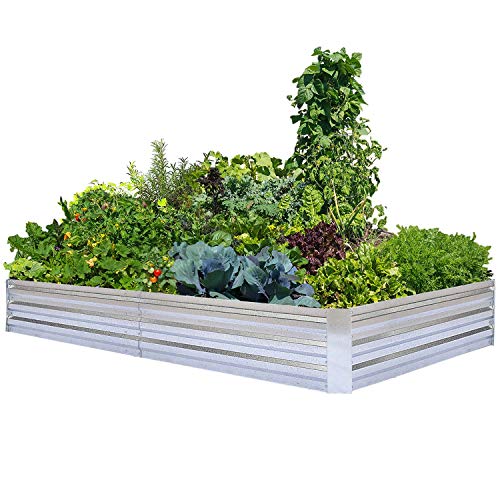
FOYUEE Galvanized Raised Garden Bed
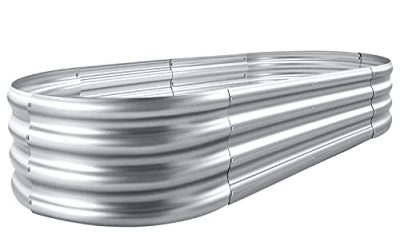
The FOYUEE kit represents galvanized metal, and its listing is direct about the format: a galvanized steel planter kit measuring eight feet by four feet by one foot. That full foot of depth is the deepest ground-level profile in this group, which helps root vegetables and thirsty fruiting plants that want a larger, more stable volume of soil. The wide rectangle also gives you a familiar four-foot reach from either side, so the middle stays within arm’s length. Pick this material if your priority is a rigid panel frame that will not rot in contact with damp soil.
Specs
- Brand: FOYUEE
- Material from title: Galvanized steel
- Size from title: 8 x 4 x 1 ft
- Item model number: HYX-18055-XXL30
- Intended plants named in title: Vegetables, flowers, herbs
- Planter form: Large metal planter box kit
Best for: A deep, full-size vegetable bed on open ground where rot is your main worry.
Watch out for: Metal panels can arrive with sharp edges and the finished bed is a fixed rectangle, so plan the exact spot before you fill it with soil.
ASIN: B07T499RHJ
Vita Classic Vinyl Raised Modular Garden Bed
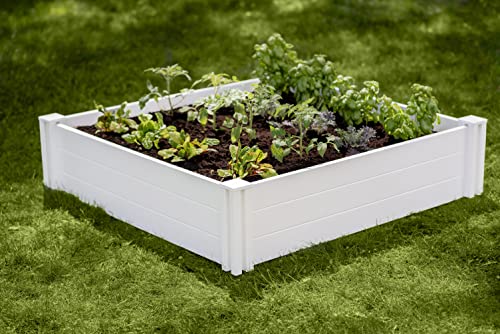
Vinyl is the neat, low-upkeep option, and the Vita Classic shows why some growers prefer it next to a house. The listing gives a four-by-four footprint, eleven inches of height, white vinyl as the material, and describes the bed as modular. It also states the vinyl is BPA and phthalate free and names PVC in the title, which is the detail food growers usually ask about first with plastic frames. The square shape suits intensive planting in a small garden, a side yard, or a sunny corner where a long twelve-foot bed simply would not fit.
Specs
- Brand: Vita
- Material: Vinyl
- Colour: White
- Dimensions: 48 in long x 48 in wide x 11 in high
- Item model number: VT17108
- Special feature listed: Weather Resistant
- Material note from title: PVC, BPA and phthalate free
Best for: A compact square vegetable bed in a visible spot where you want a clean white frame and little upkeep.
Watch out for: Four by four feet fills up quickly with hungry crops, and white vinyl shows soil splashes, so expect regular wiping to keep it looking tidy.
ASIN: B06XPHQD9C
Keter Splendor Raised Garden Bed

The Keter Splendor represents resin, and it changes the shape of the problem because it is an elevated, self-watering planter rather than an open frame sitting on the ground. Its listing states a 31.7 gallon capacity, a self-watering planter box, and a drainage plug, and describes the body as polypropylene resin in a rattan pattern. That makes it the natural pick for a patio, balcony, or paved yard where you cannot place soil directly on the surface. Growers with sore knees or a bad back also gain a bed that lifts the work up away from ground level.
Specs
- Brand: Keter
- Capacity from title: 31.7 gallon
- Material described in listing: Polypropylene resin
- Features from title: Self watering planter box, drainage plug
- Intended plants named in title: Vegetables, flowers, herbs
- Colour named in listing: Brown
- Model name: Splendor 31.7 Gallon Raised Garden
Best for: Growing vegetables and herbs on a patio or paved area, at a raised working height.
Watch out for: A 31.7 gallon planter holds far less soil than the ground beds above, so large or deep-rooted crops will outgrow it quickly.
ASIN: B0B132WWV3
Which One Fits Your Situation
You are building a traditional vegetable plot on soil
Start with the Greenes cedar kit or the FOYUEE galvanized kit, because both are open frames sized for real rows of food. Choose cedar if a natural wood bed matters to you and you accept that it ages; choose the FOYUEE if you would rather have a deeper, rigid metal frame and not think about rot. Either way, set the frame on level ground and fill it once, properly.
Your only sunny space is a patio or balcony
Take the Keter Splendor, since its self-watering resin planter is built to stand on a hard surface and hold its own soil and water. The ground frames in this guide assume open soil underneath, which a balcony does not offer. Keep plant choices modest, favouring herbs, salads, peppers, and compact tomatoes that can thrive in a 31.7 gallon volume of compost.
You have one small square corner near the kitchen door
The Vita Classic fits that spot almost exactly, with a four-by-four white vinyl frame that keeps herbs and salad leaves within a few steps of the house. Its eleven inches of depth handles shallow and medium roots well, and the modular description means a second kit can extend the layout later. It is also the easiest frame here to keep looking smart in a prominent place.
You want the longest-lasting frame with the least fuss
Galvanized steel is the pragmatic answer for most people, so the FOYUEE kit is the one to shortlist first. Vinyl runs it close on upkeep, but the Vita bed is smaller, and resin in the Keter is a planter rather than a full bed. If your garden is a long-term project on open ground, the deep metal rectangle gives you the most growing room for the least ongoing attention.
Common Mistakes
- Choosing a material before checking bed depth, then finding carrots, parsnips, or potatoes have less soil than they need.
- Filling a twelve-foot cedar bed or an eight-by-four metal bed before levelling the ground, which leaves one corner shallow and the frame under uneven pressure.
- Placing an open-bottomed frame on a patio or deck, where soil and water escape underneath, instead of choosing an elevated planter built for hard surfaces.
- Assuming vinyl or resin beds never need attention, and never checking drainage, fixings, or sun-faded panels at the start of a season.
- Mixing materials in one connected layout without checking heights, so adjoining beds end up at different levels and soil migrates between them.
Frequently Asked Questions
Is cedar a good material for a vegetable raised bed?
Yes, cedar is a widely used choice for food beds, and the Greenes kit in this guide is listed as North American cedar with boards three quarters of an inch thick. It will weather and soften over time in wet soil, so treat it as a bed you enjoy for several seasons rather than a permanent structure, and keep the frame off persistently soggy ground where you can.
Does a galvanized metal bed make the soil too hot?
Metal sides warm faster in strong sun than wood or vinyl, which matters most in very hot, exposed gardens and for seedlings at the bed edge. In most home vegetable plots the FOYUEE style of galvanized bed is used without trouble, especially once foliage shades the soil. If your garden bakes all day, plant heat-sensitive crops a little in from the sides and mulch the surface.
Is vinyl safe for growing vegetables?
That is the right question to ask of any plastic frame. The Vita Classic listing states its material as vinyl, names PVC in the title, and describes the bed as BPA and phthalate free, with a weather resistant finish. If those stated details satisfy you, vinyl offers a low-upkeep square bed; if you prefer to avoid plastic altogether, the cedar and galvanized kits in this guide are your alternatives.
How deep should a raised bed be for vegetables?
Eleven to twelve inches, like the Vita and FOYUEE beds here, covers most common vegetables, including peppers, beans, and many tomato plants with support. Shallower stacked cedar at seven inches suits salads and herbs but restricts root crops. Think about the deepest-rooted crop you realistically grow, then buy depth for that crop rather than for the easiest one on your list.