Our Short List of 3
All 4 Picks at a Glance
| Product | Specs | Action |
|---|---|---|
 1. Ooni Halo Pro Spiral Mixer (UU-P31300) | Check price on Amazon | |
| 2. VEVOR Commercial Food Mixer, 8.5Qt Dual Rotating Dough Kneading Machine (BDM8) | Check price on Amazon | |
 3. Garvee Commercial Dough Mixer, 10.5 QT Dual Rotating Spiral Mixer | Check price on Amazon | |
 4. AYLYOTOY Commercial Spiral Dough Mixer Machine, 8KG Tabletop Kneader | Check price on Amazon |
Key takeaways
- The best spiral dough mixers turn the bowl and the spiral hook together for gentle, even kneading. Compare four true spiral machines for bread and pizza dough here.
As an Amazon Associate we earn from qualifying purchases.
A spiral dough mixer is not a stand mixer with a dough hook, and the difference matters every time a stiff batch of pizza or bread dough is in the bowl. In a true spiral machine, the spiral-shaped hook turns in place while the bowl itself rotates, so the dough is folded, stretched, and carried back under the hook in a steady rhythm that closely resembles hand kneading. In a planetary stand mixer, by contrast, the hook travels around a fixed bowl, which works well for batters and softer doughs but tends to push stiff dough around, climb the hook, and warm the batch through friction. Bakers who mix lean, low-hydration dough several times a week feel that difference in the finished crumb and in how long the machine lasts. This guide covers four machines that are genuine spiral mixers, with a rotating bowl and a spiral hook, and explains honestly why the list stops at four instead of padding itself out with planetary models that do not belong here.
Affiliate disclosure: This article contains affiliate links. If you buy through a link on this page, we may earn a commission at no additional cost to you.
Why This Guide Has Four Picks, Not Five
The home and small-shop spiral market on Amazon in the United States is narrow, and pretending otherwise would mean filling the fifth slot with the wrong kind of machine. Most of the high-volume listings sold under mixer searches are planetary stand mixers: the bowl stays still, the head carries the attachment in a circular path, and the box includes a flat beater and a wire whisk alongside the dough hook. Those machines have their place, but they are not spiral dough mixers, and none of them appears in this guide. A second group of listings uses the word spiral in a title while describing a fixed bowl and a set of interchangeable beaters, which is the same planetary design in different clothing. After removing planetary models, listings with no verifiable rotating bowl, and listings showing no featured offer, four machines remained that clearly describe the defining spiral arrangement: a spiral hook, a bowl that rotates, and speeds given separately for the hook and the bowl, or a countertop design built around that same action. Four honest picks serve a buyer better than five with an impostor included.
How a Spiral Mixer Actually Kneads
The mechanics explain the results. The spiral hook stays on a fixed axis near the edge of the bowl and turns at a comparatively high speed, while the bowl rotates slowly in the same direction, feeding fresh dough under the hook with every revolution. A breaker bar or auxiliary rod, fitted on several designs, keeps the dough from simply riding around with the bowl and helps the hook stretch it instead. Because only part of the batch is worked at any moment, friction heat builds more slowly than in a planetary machine of similar size, which helps keep dough temperature in the range bread and pizza recipes assume. The listings for the picks below give the two speeds separately, which is a useful authenticity check: the VEVOR and Garvee machines, for example, list a bowl speed of about 21 revolutions per minute alongside hook speeds well above 100 revolutions per minute. Any machine that lists only one speed and a set of beaters is describing something else.
What to Check Before Buying
Flour capacity, not bowl volume. Bowl size in quarts is the headline number, but the working limit is the weight of flour or finished dough the maker states. A bowl that looks generous can be rated for a surprisingly modest dough load, because stiff dough climbs and stresses the drive. Match the stated maximum dough weight to the batch actually mixed at home, and leave headroom rather than running every batch at the limit.
Single speed, two speeds, or many speeds. Traditional bakery spirals offer one or two speeds: a slow speed to bring flour and water together, and a faster speed to develop gluten. The countertop Ooni design in this guide is the exception, with a wide range of settings aimed at home bakers who also want gentler handling. Neither approach is automatically better; the question is whether the routine is a fixed bakery sequence or varied home baking.
Fixed bowl or removable bowl. Most commercial-style spirals have a fixed bowl, which is strong and simple but means dough is lifted out by hand and the bowl is cleaned in place. The countertop pick below describes a removable bowl, which suits a home kitchen where the machine is stored away and the bowl goes to the sink. Decide which routine fits the kitchen before ordering, because it affects every bake day.
Size, weight, and placement. Even the smaller commercial-style spirals in this guide are heavy floor-or-cart machines by home standards, with listings giving weights that rule out lifting them into a cupboard. Measure the intended spot, including the height needed to open the safety shield and reach into the bowl, and plan for the machine to live where it works.
Safety shield and controls. A guard that cuts power when opened is standard on the commercial-style picks and worth having, since the hook keeps turning with real force. A timer, listed on several picks, lets a batch run its set minutes and stop without the baker standing over it, which is how these machines are used in a working bakery.
How the Picks Were Chosen
Every pick below is a spiral dough mixer in the strict sense: a spiral hook working dough in a bowl that rotates, described that way in its own listing, with no flat beater or whisk set standing in for the mixing action. The four cover the realistic buying range in this narrow market. There is a compact commercial-style VEVOR for a serious home baker or small pizzeria, a larger Garvee in the same dual-rotation family, a countertop Ooni designed specifically for home use, and a smaller tabletop kneader in the 8 kilogram class for noodle and dumpling doughs as well as bread. Details such as motor power, bowl capacity, hook and bowl speeds, and timer ranges are taken from each product listing as checked for this guide, stated in neutral terms, and worth confirming on the current listing before ordering, because sellers revise these machines without changing their names.
The Best Spiral Dough Mixers
1. Ooni Halo Pro Spiral Mixer (UU-P31300)
The Halo Pro is the pick designed from the start for a home counter rather than adapted from a bakery floor machine. The listing describes a 7.3 quart capacity with 58 speed settings, a spiral dough hook, a breaker bar, and additional attachments including a flexible beater and a geared whisk, so this one machine covers dough first and lighter mixing second. The listing for the charcoal grey version identifies the model as UU-P31300, rated at 110 volts and 650 watts, and the maker positions it for batches of up to about 11 pounds of dough, which covers several pizza bases or a couple of large loaves in one mix.
For a home baker, the details that matter are the ones the listing leads with: the bowl is removable for washing and for weighing ingredients directly, the speed range allows a slow bring-together stage before faster kneading, and the footprint is a countertop footprint rather than a cart footprint. The trade-offs follow from the same design. Capacity is well below the commercial-style picks, the extra attachments make it a broader appliance rather than a single-purpose kneader, and anyone running a small shop’s daily volume will outgrow it. For a home kitchen where pizza night and a weekend bread batch are the workload, and where the machine must be lifted, stored, and cleaned like a normal appliance, this is the most natural fit in the guide and the easiest spiral action to live with.
View it on Amazon: https://www.amazon.com/dp/B0F746CZ3L
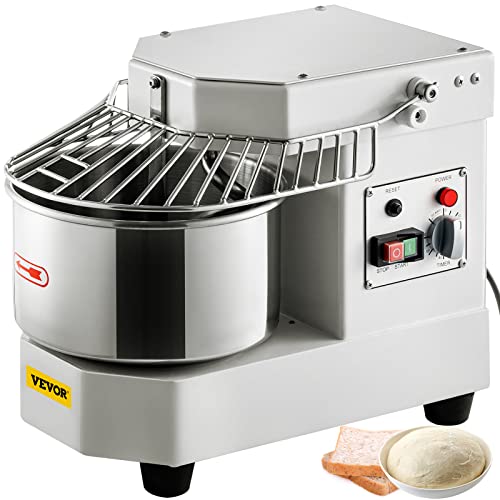
2. VEVOR Commercial Food Mixer, 8.5Qt Dual Rotating Dough Kneading Machine (BDM8)
This VEVOR is the entry point to the commercial style of spiral mixing, and its listing is unusually clear about the mechanics. The listing describes an 8 litre, 8.5 quart stainless steel bowl rated for a maximum of about 3 kilograms, or 6.6 pounds, of dough at one time, with the bowl rotating at 21 revolutions per minute while the hook turns at 159 revolutions per minute, both driven by a 450 watt motor. That dual rotation, bowl and hook turning together, is exactly the action this guide requires, and the listing calls the machine a spiral mixer on that basis.
Supporting details in the listing include a timer with settings up to 60 minutes, a security shield over the bowl, an auxiliary rod to steady the dough, and nonslip feet. The stated product dimensions are roughly 19.5 by 11.9 by 15.2 inches, but the listed weight, above 80 pounds, makes clear this is a machine that stays where it is placed, on a sturdy counter or a cart, rather than one that travels to a shelf. The bowl and hook are described as 304 stainless steel. For a home baker who has outgrown a stand mixer, or a small pizzeria mixing a few batches a day at this scale, this is the straightforward route into true spiral kneading. Buyers should confirm the current listing’s bowl size naming, since the same listing uses both 7.3 quart and 8.5 quart figures in different places for this 8 litre machine.
View it on Amazon: https://www.amazon.com/dp/B09PD9D278
3. Garvee Commercial Dough Mixer, 10.5 QT Dual Rotating Spiral Mixer
The Garvee steps the same dual-rotation formula up a size. The listing describes a 10.5 quart food-grade stainless steel bowl rated for up to about 11 pounds of dough in roughly 10 to 15 minutes, a 650 watt copper motor, and a chain drive that turns the spiral stirring rod and the bowl at the same time, with the bowl at 21 revolutions per minute and the hook at 129 revolutions per minute. A timer knob allows mixing times of up to 60 minutes, according to the listing, and a security shield is fitted, with the machine described as switching off when the shield is not tightly closed.
The listing also notes overload protection, a removable bowl in its feature list, nonslip feet, and an item weight of about 105 pounds, so the same placement advice applies with even more force: this machine needs a permanent home with room to work around it. Against the smaller VEVOR, the Garvee offers a larger stated dough load and a stronger motor for a bakery, restaurant, or pizzeria routine, or for a home baker regularly mixing double batches. Against the countertop Ooni, it is a single-purpose commercial kneader with a fixed routine rather than a flexible home appliance. Check the current listing for the exact configuration, because the feature list and the description differ in small details such as how the bowl is handled for cleaning.
View it on Amazon: https://www.amazon.com/dp/B0DPW6P9PR
4. AYLYOTOY Commercial Spiral Dough Mixer Machine, 8KG Tabletop Kneader
The fourth pick is the smallest and lightest machine in the guide, a tabletop kneader in a different format from the bakery-style units. The listing describes a capacity of 8 kilograms, about 17.6 pounds, a 1500 watt motor turning at 1400 revolutions per minute, dual rotation with clockwise and counterclockwise movement intended to simulate manual kneading, a time setting range of 0 to 30 minutes, and a glass lid so the dough can be watched while it mixes. The body is listed at roughly 13.78 by 10.83 by 9.45 inches for the host machine, with a net weight of about 12.35 kilograms, or 27.2 pounds, which makes it the only pick here that one person can reasonably move on and off a counter.
The listing positions the machine for dumpling, noodle, and breakfast-shop doughs as well as bread, and for home kitchens alongside restaurants and canteens, which matches its scale. The honest cautions are about documentation rather than design: the listing’s brand and manufacturer fields are thin, the stated capacity reads as a basin figure rather than a finished-dough rating, and assembly is listed as required. Buyers who need a compact kneader for frequent noodle and dumpling work, and who are comfortable confirming details with the seller, get a genuinely spiral, dual-rotation machine in a home-manageable size. Anyone wanting established bakery specifications and a stated flour rating should look at the VEVOR or Garvee instead.
View it on Amazon: https://www.amazon.com/dp/B0F7RBQGS6
Side-by-Side Comparison
| Pick | Bowl | Motor from listing | Hook and bowl speeds | Timer |
|---|---|---|---|---|
| Ooni Halo Pro | 7.3 qt, removable | 650W | 58 speed settings, breaker bar | See listing |
| VEVOR 8.5Qt BDM8 | 8L stainless, fixed style | 450W | Hook 159 rpm, bowl 21 rpm | Up to 60 minutes |
| Garvee 10.5 QT | 10.5 qt stainless | 650W | Hook 129 rpm, bowl 21 rpm | Up to 60 minutes |
| AYLYOTOY 8KG | 8 kg basin class | 1500W | Dual rotation, reversible | 0 to 30 minutes |
The table shows the real spread in this narrow category: one purpose-built home countertop machine, two commercial-style dual-rotation kneaders that differ mainly in scale, and one compact tabletop kneader for smaller, more frequent batches.
Getting the Best Dough From a Spiral Mixer
A few habits carry across all four picks. Add flour and water and use the slowest stage first, letting the dough come together before moving to a kneading speed, because a spiral develops gluten quickly and an overworked batch turns slack and warm. Watch total dough temperature on warm days; the spiral action adds less friction heat than a planetary machine, but a long mix on a fast setting still warms the batch, and cold water in summer is the standard correction. Respect the stated dough maximum rather than the bowl volume, especially with low-hydration bagel or pizza dough, which loads the drive hardest. Keep the shield closed while the hook turns, and let the machine stop fully before reaching in, since a spiral hook keeps real momentum. Finally, clean the bowl promptly: dried dough under the hook and around the breaker bar is much harder to remove later, and on fixed-bowl machines the cleaning happens in place with the machine switched off.
What to Avoid
Avoid any machine sold as a spiral mixer whose listing shows a flat beater and a wire whisk as the main attachments and never gives a bowl speed, because that is a planetary stand mixer, and it will not knead the way this guide describes. Avoid judging by bowl quarts alone; a large bowl with a small stated flour rating is a large bowl that must be run partly empty. Avoid placing a commercial-style spiral on a weak counter or a high shelf, given the weights in these listings. Avoid running stiff dough at the highest setting from a dry start, which is the loading pattern most likely to strain a drive. Finally, avoid assuming a listing’s capacity figure means finished dough weight when it may mean basin volume or total ingredient weight; the picks above note where that distinction is unclear, and the current listing or the seller is the place to settle it before ordering.
Verdict
The best spiral dough mixers are a short, honest list. Choose the Ooni Halo Pro for a home counter, a removable bowl, and the widest speed control, the VEVOR 8.5Qt for the clearest entry into commercial-style dual-rotation kneading at a modest batch size, the Garvee 10.5 QT for a larger stated dough load and a stronger motor in the same style, and the AYLYOTOY 8KG where a compact, movable tabletop kneader for noodle, dumpling, and bread dough matters more than bakery documentation. All four turn the bowl and the spiral hook together, which is the whole point of the category, and none of them is a planetary stand mixer wearing a spiral name.