Our Short List of 3

- Best for: Technical drawing courses and studio work with frequent radius changes
- Maximum circle diameter: about 350 mm, extending to about 585 mm with the extension bar
- Adjustment: push-button quick setting with center wheel fine adjustment
- Legs: hinged, with interchangeable needle point and lead part on a 4 mm shank
- Build: metal, compass length about 170 mm

- Best for: Geometry students who want a metal compass that holds its setting
- Maximum circle diameter: 8 inches
- Head: spring bow with center wheel to prevent unintentional leg movement
- Build: all metal with nickel-plated finish
- Lead: 2 mm, with extra lead and an extra needle included

- Best for: School and college students who need more reach than a basic compass
- Maximum circle diameter: 10.25 inches
- Adjustment: quick-set center wheel
- Build: metal with sand-blasted, nickel-plated finish and plastic leg extensions
- Grip: nonslip grooved grip
All 4 Picks at a Glance
| Product | Specs | Action |
|---|---|---|
| Staedtler Mars Comfort 552 Quick-Setting Compass Set |
| Check price on Amazon |
| Mr. Pen Professional Compass for Geometry |
| Check price on Amazon |
| Staedtler Advanced Student Compass 2-Piece Set |
| Check price on Amazon |
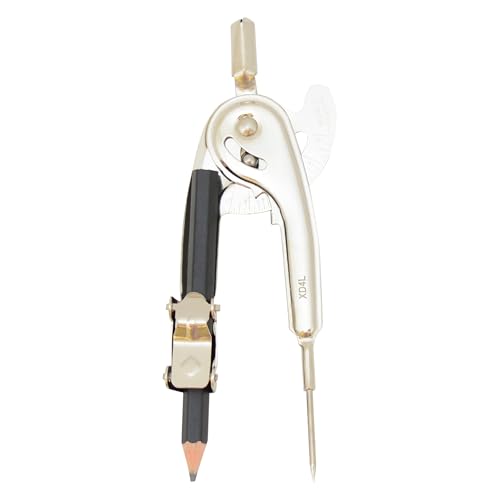 Westcott Nickel-Plated Ball Bearing Compass with Pencil |
| Check price on Amazon |
Key takeaways
- Four drafting compasses compared on circle size, radius control and build, from quick-set Staedtler Mars Comfort 552 to the Westcott ball bearing model.
A drafting compass succeeds or fails on one decision: whether the radius you set is still the radius you get at the end of the circle. Friction hinges wander as you rotate, spring bow heads hold a setting under pressure, and a center wheel lets you nudge a radius by fractions of a millimeter instead of re-opening the legs by hand. Buyers also have to decide how large a circle they genuinely need, because a compact student compass and a quick-set instrument with an extension bar solve very different problems.
This roundup is for technical drawing students, architecture and engineering learners, woodworkers who scribe arcs on stock, and artists who lay out large geometric work. Every pick was chosen from the name and specifications on its Amazon listing, with the maximum circle diameter, adjustment style and included parts carrying the most weight in the comparison.
Quick Picks
As an Amazon Associate we earn from qualifying purchases.
| Product | Best for | Key spec from title |
|---|---|---|
| Staedtler Mars Comfort 552 | Coursework and studio drafting | Draws circles up to 350 mm |
| Mr. Pen Professional Compass | Geometry class and homework | Draws circles up to 8 inches |
| Staedtler Advanced Student Compass | School and college drawing sets | Draws circles up to 10.25 inches |
| Westcott Ball Bearing Compass | Large arcs and first compasses | Draws circles up to 13 inches |
How to Choose
Pick an adjustment style that holds its setting
The adjustment mechanism decides whether a radius survives a full rotation. A plain friction hinge is cheap and simple, but the legs can creep outward as downward pressure changes around the circle. A spring bow head resists that creep, and a center wheel adds fine control: you turn a knurled wheel to move the legs in tiny steps, which matters when a drawing calls for concentric circles spaced a millimeter apart. Push-button quick-set models combine both ideas, jumping to a rough radius with the buttons and trimming it with the wheel, which speeds up sheets full of different circle sizes.
Match the maximum circle to your sheet size
Listings state the largest circle a compass can draw, and the spread is wide: compact bow compasses stop near 8 inches, mid-size student models reach about 10 inches, and full drafting instruments cover 350 mm before an extension bar is fitted. Work out the biggest diameter your paper or workpiece demands, then buy one step above it. A compass stretched to its absolute limit holds the paper at an awkward angle and the needle tends to skate. If you regularly draw beyond 350 mm, look for a model whose listing includes or supports an extension bar rather than forcing the legs wide.
Check what the lead, needle and adapter situation is
Most drafting compasses draw with a 2 mm lead held in a lead part, and the quality of that small clamp matters: a lead that slips mid-circle ruins the line weight and the arc. Confirm the listing includes spare leads and, ideally, a spare needle point, since a bent needle changes the center of every circle. A universal adapter is the other accessory worth having. It replaces the lead part and grips a pen, fineliner or mechanical pencil, which is how one compass covers both pencil construction lines and finished ink work without a second instrument.
Weigh build material and hinge design
All-metal compasses dominate serious listings for a reason: metal legs flex less, threads on the center wheel stay smooth longer, and a nickel-plated finish resists corrosion from handling. Hinge design matters just as much. A ball-bearing hinge rotates with even resistance, so the compass turns without the stick-slip judder that makes lines wobble, while a plain pinned hinge can loosen with use. Plastic appears on some student models as leg extensions or grips, which is acceptable, but the head, wheel and leg pivots should be metal if the compass will see daily coursework or workshop layout duty.
The 4 Best Options
Staedtler Mars Comfort 552 Quick-Setting Compass Set
- Best for: Technical drawing courses and studio work with frequent radius changes
- Maximum circle diameter: about 350 mm, extending to about 585 mm with the extension bar
- Adjustment: push-button quick setting with center wheel fine adjustment
- Legs: hinged, with interchangeable needle point and lead part on a 4 mm shank
- Build: metal, compass length about 170 mm
Technical drawing courses and studio work with frequent radius changes
Confirm the extension bar is in the box if you need circles beyond 350 mm, since set contents vary by listing variant
This is the pick for anyone whose drawing board work mixes many circle sizes in one session. The push-button mechanism opens and closes the legs quickly, then the center wheel trims the radius precisely, so moving between a 40 mm detail circle and a 300 mm layout circle takes seconds rather than a fresh setup. Hinged legs keep the needle and lead vertical on larger diameters, and the universal adapter in the set lets the same instrument carry a pen for inked finals. It suits drafting students, design studios and serious hobbyists who draw several times a week.
Mr. Pen Professional Compass for Geometry
- Best for: Geometry students who want a metal compass that holds its setting
- Maximum circle diameter: 8 inches
- Head: spring bow with center wheel to prevent unintentional leg movement
- Build: all metal with nickel-plated finish
- Lead: 2 mm, with extra lead and an extra needle included
Geometry students who want a metal compass that holds its setting
The 8-inch ceiling is real; larger poster or board work needs a bigger instrument
Mr. Pen’s bow compass covers the core school and college workload in a small, all-metal package. The spring bow head and center wheel work together to stop the legs drifting while you rotate, which is the main failure of the flimsy compasses handed out in classrooms. Its 8-inch maximum circle handles standard homework sheets and notebook geometry comfortably, and the box includes extra lead and a spare needle, so a dropped point does not end a study session. It fits students who need one dependable compass for geometry, basic drafting and occasional layout marking on wood or card.
Staedtler Advanced Student Compass 2-Piece Set
- Best for: School and college students who need more reach than a basic compass
- Maximum circle diameter: 10.25 inches
- Adjustment: quick-set center wheel
- Build: metal with sand-blasted, nickel-plated finish and plastic leg extensions
- Grip: nonslip grooved grip
School and college students who need more reach than a basic compass
The plastic leg extensions are the wear point; check them for play before a term starts
This set sits between a basic school compass and the full Mars Comfort line. The quick-set center wheel gives the fine radius control that plain hinged compasses lack, while the hinged legs and 10.25-inch maximum circle cover larger sheets than most student models manage. The sand-blasted, nickel-plated metal body has a grooved, nonslip grip section, which helps younger users keep the instrument steady through a full rotation. A universal adapter and spare lead round out a kit aimed at advanced school geometry and first-year technical drawing, where one compass has to last several terms of regular use.
Westcott Nickel-Plated Ball Bearing Compass with Pencil
- Best for: Beginners and classrooms that want the largest circle here with pencil simplicity
- Maximum circle diameter: 13 inches
- Hinge: ball-bearing action for smooth, controlled rotation
- Build: nickel-plated metal
- Marking tool: pencil included, clamped in the drawing leg
Beginners and classrooms that want the largest circle here with pencil simplicity
There is no center wheel, so fine radius changes are done by hand and take more care
Westcott takes the simplest route: a pencil clamped in one leg, a needle in the other, and a ball-bearing hinge joining them. That hinge is the reason to pick it, because it rotates with smooth, even resistance instead of the grabbing and releasing of a cheap pinned joint, and smooth rotation is what keeps hand-drawn circles round. The 13-inch maximum circle is the largest here, which makes it useful for posters, classroom displays and rough workshop layout. It suits beginners, teachers buying for a classroom, and anyone who prefers a pencil line over a 2 mm lead.
Which One Fits Your Situation
Daily technical drawing classes
Choose the Staedtler Mars Comfort 552. Coursework sheets stack many radii on one page, and the push-button quick-set with center wheel changes sizes faster and more repeatably than any friction hinge. The adapter also means the same instrument handles pencil construction and inked linework, so one case covers the whole course kit.
Geometry homework on standard paper
The Mr. Pen Professional Compass fits this workload well. Its 8-inch maximum covers notebook and letter-size sheets, the spring bow head holds a setting through repeated exercises, and the included spare lead and needle keep it working when small parts go missing mid-term. It is the straightforward one-compass answer for school bags.
Bigger sheets and display work
Look at the Westcott Ball Bearing Compass or the Staedtler Advanced Student set. The Westcott reaches 13 inches for posters and classroom displays with the simplicity of a clamped pencil, while the Staedtler’s 10.25-inch reach, center wheel and adapter suit students whose larger sheets still need precise, repeatable radii rather than rough layout arcs.
Scribing arcs in the workshop
Woodworkers marking arcs on boards should pick the Mr. Pen for smaller work or the Mars Comfort 552 for larger radii. A center wheel matters here because a scribed line cannot be erased and redone like pencil on paper, and both models hold a setting firmly against the resistance of wood grain while you rotate.
Common Mistakes
- Buying by compass length instead of maximum circle diameter, then finding the instrument cannot reach the radius the work needs.
- Forcing a friction-hinge compass through large circles, which makes the legs creep and produces arcs that never quite close.
- Ignoring the adapter question and later discovering the compass cannot hold the pen or fineliner used for finished work.
- Pressing down hard on the needle leg, which enlarges the center hole and lets the point wander on later circles.
- Leaving spare leads and the spare needle at home, so one dropped point ends the drawing session entirely.
Frequently Asked Questions
What is the difference between a bow compass and a regular school compass?
A bow compass uses a spring bow head, usually with a center wheel, to set and hold the radius, so the legs resist drifting while you draw. A regular school compass relies on a friction hinge that you position by hand. The bow design costs more but holds accuracy through repeated circles, which is why drafting listings favor it.
How large a circle do I need for typical drafting sheets?
Most school and college work stays within 8 to 10 inches of diameter, which the Mr. Pen and Staedtler Advanced Student models cover. Larger boards and poster layouts push past that, where the Westcott’s 13 inches or the Mars Comfort 552 with its extension bar, reaching about 585 mm, become the safer picks.
Can a drafting compass draw with a pen instead of a lead?
Yes, if the compass has a universal adapter or a pencil clamp. The two Staedtler sets include a universal adapter that grips pens and fineliners, and the Westcott clamps a standard pencil directly. Without an adapter, a lead-only compass is limited to its 2 mm lead part, so check the listing contents before buying for ink work.
Why do my circles fail to close at the starting point?
An unclosed circle usually means the radius moved during rotation: the hinge crept, the lead slipped in its clamp, or the needle point shifted in an enlarged center hole. Tighten the lead clamp, use lighter needle pressure, and choose a center wheel or spring bow model if a friction hinge keeps wandering on your current compass.