Key takeaways
- Compare three commercial hot-roll laminators for small businesses, with widths, film thickness, warm-up, controls and safety features explained.
A small business rarely buys a hot-roll laminator because it wants another machine on the bench. It buys one because menus, posters, signs, certificates, teaching aids, or client-facing documents keep coming back creased, damp, faded, or torn, and reprinting them costs more time than protecting them once. The real decision is therefore about throughput and width: how many sheets need sealing in a session, how wide the largest sheet is, and how thick the film must be to survive handling without curling or peeling at the edges.
This guide is written for print shops, schools, offices, cafes, studios, and other small businesses that laminate in batches rather than one pouch at a time. Each machine below was chosen from its Amazon listing name and stated specifications, with the focus kept on roll width, film thickness, warm-up behaviour, controls, and the safety features that matter when heated rollers run for hours.
Quick Picks
As an Amazon Associate we earn from qualifying purchases
| Product | Best for | Key spec from title |
|---|---|---|
| GBC Ultima 65 Thermal Roll Laminator | Wide posters and classroom or office batches | 27-inch maximum width, 10-minute warm-up |
| USI ARL 2700 Thermal Roll Laminator | Thick film and controlled print-shop work | Films up to 27 inches wide and 5 mils thick, UL Listed |
| USI CSL 2700 Thermal Roll Laminator Kit | Starting a wide-format setup with film included | Films up to 27 inches wide and 3 mils thick, includes 4 rolls of film |
How to Choose
Match the width to the largest sheet you laminate
Width is the hardest limit on a roll laminator, because a sheet wider than the machine cannot be fed through at all. A 27-inch machine covers posters, charts, menus, and many signs, while a 12-inch machine suits letter-size handouts and small displays. Measure the widest item you expect to protect, including any border you want sealed around it, and leave a small margin on each side so the film can close fully. If the widest work is only occasional, a wider machine may still be worth the bench space, because it removes the need to trim or split large prints. If every job is letter size, the extra width adds weight, film cost, and storage trouble without a matching benefit.
Choose film thickness for handling, not for appearance alone
Film thickness is stated in mils on the listings in this guide, and it changes how stiff and durable the finished piece feels. Thin film suits documents that will sit in a binder or behind a counter, while thicker film suits menus, signs, and charts that are picked up, wiped, or carried between rooms. Thicker film also places more demand on heat and roller pressure, so the machine must be rated for the thickness you plan to use. Check the stated maximum before ordering film, and test one sheet from each new roll before running a full batch.
Look at warm-up, speed control, and reverse before buying
Warm-up time sets how quickly a laminator is ready, and it matters most when lamination is an occasional task between other jobs. A machine that warms in under ten minutes fits a busy office, while a slower machine still works well if it stays on through a long production run. Speed control matters when the same machine handles thin paper one hour and thicker card the next, because a slower pass gives heat more time to bond the film. A reverse function is equally useful: when a sheet feeds at an angle or film wraps around a roller, reverse can free the material without forcing it through. Treat these controls as workflow features, not extras.
Plan for heat, space, ventilation, and safe operation
A hot-roll laminator is a heated machine, so its placement deserves care. The rollers and nearby surfaces become hot during use, and hands, loose clothing, cords, and paper scraps should stay clear of the feed opening while the machine is running. Give the unit a stable, level surface with clear space at the front and rear, because long sheets need room to enter and exit without bending. Work in a ventilated area and let the machine cool before cleaning, moving it, or changing film. Check the listing for a safety cover, a key lock, a wraparound prevention bar, and an automatic shutoff, and confirm who in the business is trained to load film and clear a jam.
The 3 Best Options
GBC Ultima 65 Thermal Roll Laminator
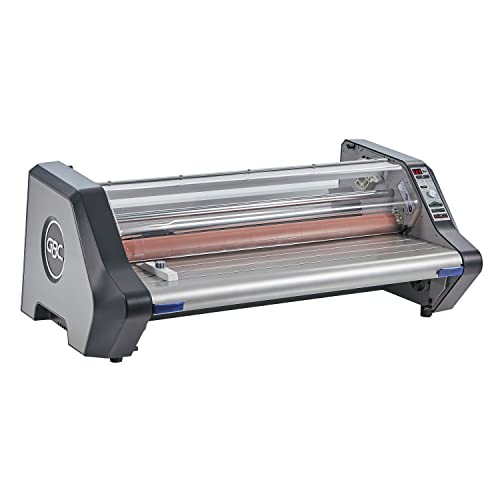
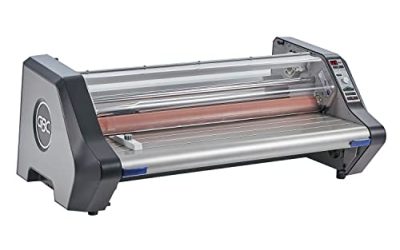
The GBC Ultima 65 suits a school, office, or small print room that laminates posters and teaching aids in regular batches and wants the widest common roll format without stepping into a freestanding industrial unit. Its 27-inch width covers large charts and signs, while the one-touch AutoSpeed feature selects a laminating speed for the document being fed, which reduces the guesswork when staff rotate between jobs. EZLoad technology uses colour-coded end caps to help load film the right way round, and alignment guides help keep documents straight as they enter the rollers. The result is a machine built around repeated, straightforward batch work rather than occasional single sheets.
Specs
- Maximum laminating width: 27 inches
- Warm-up time: less than 10 minutes
- Film loading: EZLoad technology with colour-coded end caps
- Speed control: one-touch AutoSpeed feature
- Alignment: alignment guides to help keep documents straight
- Gross weight stated on the manufacturer datasheet: 122 lb
Best for: Schools and offices laminating posters, charts, and teaching aids in batches.
Watch out for: The machine is heavy and needs a sturdy bench and clear feed and exit space, so measure the work area before ordering.
USI ARL 2700 Thermal Roll Laminator

The USI ARL 2700 suits a print shop or busy office that needs thicker film and finer control over heat and speed. Its listing states films up to 27 inches wide and 5 mils thick on a 1-inch core, for menus, signs, and displays that need a stiffer finish. Adjustable temperature with a digital readout lets the operator match heat to the film in use, while a quiet variable-speed motor and electric reverse help when a sheet needs a slower pass or a jam needs clearing. The wraparound prevention bar, motor key lock, and automatic shutoff after four hours of non-use add practical safeguards for a shared workspace.
Specs
- Maximum laminating width: 27 inches
- Maximum film thickness: 5 mils
- Film core: 1 inch
- Temperature control: adjustable with digital readout
- Motor: quiet variable-speed motor with electric reverse
- Safety features: wraparound prevention bar, motor key lock, automatic shutoff after 4 hours of non-use
- Electrical listing stated on the Amazon title: UL Listed
- Warranty stated on the Amazon title: 2-year warranty
- Item weight stated on the listing: 96 pounds
Best for: Print shops and offices that laminate thick film and need adjustable heat and speed.
Watch out for: The 96-pound weight and 27-inch format need a permanent bench position and help to move, so plan delivery and placement in advance.
USI CSL 2700 Thermal Roll Laminator Kit

The USI CSL 2700 kit suits a small business that wants a wide-format hot-roll setup with film ready to use on arrival. The kit includes four rolls of 27-inch, 3-mil Opti Clear film, which removes the first consumable decision and lets a new operator start with the film type the kit was built around. Its listing states films up to 27 inches wide and 3 mils thick on a 1-inch core, with adjustable temperature, a quiet motor, electric reverse, automatic shutoff, and a wraparound prevention bar. The listing also states UL Listed electrical construction and a 2-year warranty, for a business that wants that documented safety listing and warranty period.
Specs
- Maximum laminating width: 27 inches
- Maximum film thickness: 3 mils
- Film core: 1 inch
- Included film: 4 rolls of 27-inch, 3-mil Opti Clear film
- Temperature control: adjustable
- Motor: quiet motor with electric reverse
- Safety features: wraparound prevention bar and automatic shutoff after 4 hours of non-use
- Electrical listing stated on the Amazon title: UL Listed
- Warranty stated on the Amazon title: 2-year warranty
- Item weight stated on the listing: 131 pounds
Best for: Small businesses starting wide-format lamination with film included in the kit.
Watch out for: The kit is built around 3-mil film, so a business that regularly needs thicker film should check the stated maximum before choosing this model.
Which One Fits Your Situation
You laminate posters and classroom materials in batches
Choose the GBC Ultima 65. Its 27-inch width, short warm-up, EZLoad film loading, and AutoSpeed control fit repeated poster and chart work where different staff members may operate the machine. The alignment guides help with straight feeding, and the wide format means large teaching aids do not need trimming to fit.
You need thick film for menus, signs, and handled displays
Choose the USI ARL 2700. Its stated 5-mil maximum gives the stiffest finish in this guide, and the adjustable temperature with a digital readout helps the operator match heat to thicker film. Electric reverse and the wraparound prevention bar also help when a thick or wide sheet feeds unevenly in daily use.
You want a complete wide-format kit with film included
Choose the USI CSL 2700 kit. The four included rolls of 27-inch, 3-mil film let a small business start laminating without a separate film order, and the adjustable temperature, reverse, and automatic shutoff cover the main controls a new operator needs. It is the simplest starting point when the first jobs are posters, signs, and displays rather than heavy-duty thick-film work.
You share the machine across a team
Choose the USI ARL 2700 or the USI CSL 2700, depending on film thickness. Both list a motor key lock or automatic shutoff features that help in a shared room, and both state UL Listed construction with a 2-year warranty. Write down the temperature and speed settings that work for each film type, and keep the film loading steps beside the machine so every operator follows the same routine.
Common Mistakes
- Buying a machine narrower than the largest poster or sign, then trimming work that should have been sealed whole.
- Ordering thick film before checking the machine’s stated maximum thickness and core size.
- Feeding a sheet at an angle and forcing it through instead of stopping and using reverse.
- Loading film the wrong way round, which wastes material and can cause uneven sealing.
- Placing the laminator where long sheets bend at the exit, which can crease the finished piece.
- Touching hot rollers or reaching into the feed opening while the machine is running or cooling down.
- Skipping a test sheet from a new roll of film before laminating a full batch of printed work.
Frequently Asked Questions
What width should a small business choose for a hot-roll laminator?
A 27-inch machine suits most small businesses that laminate posters, charts, menus, and signs, because it covers the largest common sheet sizes without a freestanding industrial unit. Measure the widest sheet you plan to protect, including the sealed border, and choose a machine that clears it with room to spare.
Can a hot-roll laminator handle thick film?
It depends on the model, so check the stated maximum film thickness before buying film. The USI ARL 2700 in this guide lists films up to 5 mils thick, while the USI CSL 2700 kit lists films up to 3 mils thick. Thicker film needs enough heat and roller pressure to bond evenly.
How long does a commercial hot-roll laminator take to warm up?
Warm-up time varies by model and by the temperature needed for the film in use. The GBC Ultima 65 lists a warm-up of less than 10 minutes, while the USI models in this guide describe adjustable temperature controls without a single warm-up figure in the titles used here. Allow extra time on the first run of the day.
Is a hot-roll laminator safe to use in a shared office?
It can be, when the machine is placed on a stable surface with clear feed and exit space and operators follow the maker’s guidance. Keep hands and loose items away from hot rollers, use the safety cover, key lock, or shutoff features where fitted, and let the machine cool before cleaning or changing film. Train every operator before their first unsupervised run.