Key takeaways
- Find the best shocks for a Jeep Gladiator with a verified Bilstein 5100 JT set and lift-height guidance, plus the Fox, Rancho and Falcon options explained.
The Jeep Gladiator, the JT pickup built from 2020 onward, does not share its shocks with the Wrangler, however tempting the family resemblance makes that assumption. The Gladiator’s longer wheelbase, pickup rear suspension and different shock lengths and valving make JT-specific fitment a hard requirement: a listing must name the Gladiator JT itself, in your lift-height range, before it belongs on your truck. Shocks borrowed from JL Wrangler listings are the classic wrong purchase in this category.
This guide leads with a verified Bilstein 5100 set sold on Amazon US whose listing names the Gladiator and its lift range exactly, then maps the other shock families JT owners choose among, organized by lift height, because lift is the variable that decides which shock your truck can physically use.
Disclosure: As an Amazon Associate, this site may earn from qualifying purchases made through links in this article, at no additional cost to you.
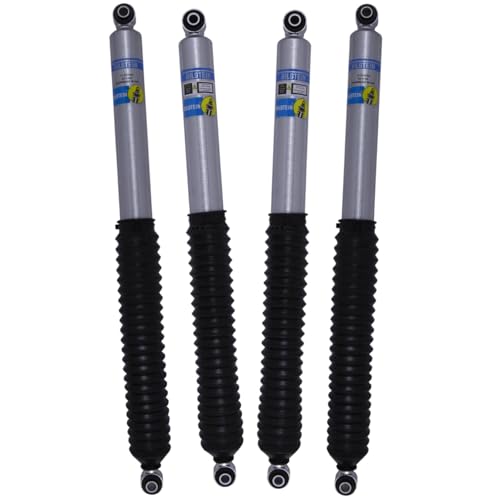
1. TrendsAuto Bilstein 5100 Front and Rear Shock Set, Jeep Gladiator 2020 to 2025, 2 to 3 Inch Front and 1.5 to 2.5 Inch Rear Lift
ASIN: B0DP5CM445
This set is the verified pick because its listing does everything right for this category. It is a complete front and rear package of Bilstein B8 5100 monotube shocks, two front units of part 33-305219 and two rear units of part 33-305288, listed for the 2020 to 2025 Jeep Gladiator with a 2 to 3 inch front lift and 1.5 to 2.5 inch rear lift, and it names its exclusions: the Nighthawk and Mojave trims are not covered. The listing also states that bump stop extensions are required, which is the kind of installation honesty that separates a JT-specific product from a generic Jeep listing.
The 5100 itself is the default upgrade shock for lifted trucks for sound reasons: a 46 millimeter monotube with digressive valving that controls body roll and brake dive without punishing the ride over sharp edges, application-specific tuning for this truck, and zinc-plated bodies that shrug off the trail environment. For the very common Gladiator build, a leveling-to-mild lift on 35 inch tires used daily and trailed on weekends, this set is the balanced answer, firm enough to control the bigger rubber, compliant enough to live with every day.
The lift range is the boundary to respect. This set is not for a stock-height Gladiator and not for a tall build; both cases have their own 5100 applications, covered below. Measure your actual lift, front and rear separately, because Gladiators often sit at different lift figures at each end, exactly as this listing’s split range acknowledges.
Best for: 2020 to 2025 Gladiators, excluding Nighthawk and Mojave, running a mild lift in the stated range, used on road and trail.
Shocks by Lift Height: The JT Map
At stock height to about 1.5 inches of lift, the same Bilstein 5100 family serves the Gladiator in a shorter application, with front shocks such as the 33-304847 listed for 0 to 1.5 inch front lifts and matching rears for 0 to 1 inch, and complete sets in that range are the mild-build standard. Rancho’s RS5000X for the JT is the stock-height value alternative, a twin-tube with a progressive valving character that suits daily-driven trucks, and the RS9000XL adds manual adjustability for owners who alternate between empty commuting and loaded trail work.
In the mid-lift band, the verified pick’s range, Fox’s 2.0 Performance Series IFP shocks for the JT are the other mainstream choice: an internal-floating-piston monotube with a ride quality many owners describe as the plushest of the group, in applications listed for 2 to 3 inch JT lift systems. Above that, the tall-build territory of 3.5 to 4.5 inches belongs to reservoir and adjustable hardware, led by Teraflex’s Falcon SP2 3.3 Fast Adjust piggyback shocks for the JT, whose external adjusters let the damping be set for road, trail and load from the dial rather than by compromise.
The Mojave deserves its own sentence. The Mojave trim ships with Fox internal-bypass reservoir shocks tuned specifically for that truck and its desert brief, and it is excluded from mainstream listings like the verified pick for good reason; Mojave owners should shop Mojave-specific applications and think carefully before replacing the factory setup with anything lesser. Rubicon owners, by contrast, are on the standard JT fitment map.
Choosing and Installing JT Shocks
Decide by lift first, use second, brand last. Stock and mild trucks gain the most from the 5100 class: controlled, durable, honestly priced in effort if not in currency. Trucks that live off-road at speed justify the Fox and Falcon classes. Whatever the class, replace shocks in axle pairs at minimum and all four when the truck’s mileage or a lift change means the old set is mismatched to the new height; a lift fitted on worn stock shocks is the most common reason a fresh build rides worse than before.
Installation on the JT is conventional solid-axle work, shocks external and bolted at both ends, but two details matter. Bump stop extensions, required by the verified listing, are not optional garnish: they keep the longer shock from bottoming on its own body at full compression, which is how new shocks die young. And after any lift-height change, have the alignment checked and the headlights re-aimed, and re-torque the shock hardware after the first hundred miles as the bushings settle.
Watch for the symptom set that says the current shocks are finished: brake dive that pitches the truck, a rear end that keeps bouncing after a bump instead of settling in one motion, cupped tire wear, and a truck that wanders in crosswinds. On a Gladiator worked off-road, also inspect for bent shafts and leaking bodies after trips; a monotube with a dented body is done regardless of mileage.
Reading Your Gladiator’s Current Setup Before Ordering
Gladiators accumulate modifications, and a truck bought used may not sit where its paperwork says. Before ordering any shock, establish three facts about the truck in front of you. Measure the actual lift: compare the hub-to-fender distance against the stock figure for your trim, front and rear separately, because spacer levels, spring lifts and sagging springs all produce different numbers at each end, and the verified pick’s split range, taller at the front than the rear, exists precisely because Gladiators are usually lifted unevenly. Identify the trim, because the Mojave and Nighthawk exclusions in the listing are real boundaries and the Rubicon’s equipment differs from a Sport’s. And inspect the current shocks for the bent shafts, dented bodies and leaking seals that change the job from upgrade to rescue.
Tire size belongs in the same audit. A Gladiator on 37s asks more of its shocks than the same truck on 33s, in unsprung weight the damping must control and in the leverage the taller tire applies. Owners stepping up two tire sizes and a lift in one project should expect to step up a shock class as well; the 5100 class covers the common 35-inch mild-lift build completely, while heavier builds are where the Fox and Falcon classes justify themselves.
Load is the third variable, and the Gladiator’s bed makes it a variable in a way Wranglers never face. A truck that runs empty all week and carries a bed rack, tent and gear all weekend lives two lives, and that is the use case adjustable shocks, the Rancho RS9000XL’s dial and the Falcon 3.3’s fast adjusters, were built for. A truck with a constant load, a work bed or a permanently mounted tent, can be valved once for that weight and forget the question. Match the shock decision to the load pattern you actually have, not the one in the brochure photograph.
The steering stabilizer deserves a mention in any JT shock conversation. It is not a shock absorber for the suspension and it cannot fix wandering caused by alignment or worn joints, but on a lifted Gladiator with larger tires a tired stabilizer lets every road input reach the wheel. If the truck’s shocks are being renewed at lift height, the stabilizer’s condition should be checked in the same job, and some Bilstein sets for this platform bundle one for exactly that reason.
Frequently Asked Questions
Do Wrangler JL shocks fit the Gladiator?
No, not as a rule, and not safely. The JT uses different shock lengths and valving for its pickup chassis. Buy only listings that name the Gladiator JT, like the verified pick here.
What shocks should a stock-height Gladiator run?
The stock-to-mild applications of the same families: the Bilstein 5100 set listed for 0 to 1.5 inch front lift, or Rancho’s JT stock-height lines. The verified pick in this guide is for lifted trucks and should not be fitted at stock height.
Why is the Mojave excluded from so many listings?
The Mojave carries a unique factory Fox internal-bypass setup and different tuning. Mainstream JT shocks are not valved or fitted for it, so listings exclude it; Mojave owners need Mojave-specific parts.
Are bump stop extensions really necessary with new shocks?
With longer shocks for lifted applications, yes, without exception. They prevent the shock from being crushed at full compression, which is a mechanical failure, not a ride-quality preference.
How long do Gladiator shocks last?
It depends on use more than mileage. Daily-driven trucks get long service from quality monotubes; trucks run hard off-road should inspect shocks seasonally and expect a shorter life. Heat is the quiet factor: sustained washboard and trail work fades and ages shocks faster than any road use.
Verdict
For the most common Gladiator build, a mild lift on a 2020 to 2025 truck outside the Mojave and Nighthawk trims, the verified Bilstein 5100 set (ASIN B0DP5CM445) is the pick: JT-specific fitment, an honestly stated lift range and the installation requirements in plain view. Stock-height trucks should take the shorter 5100 application or Rancho’s JT lines, tall builds the Falcon class. The rule that governs all of it is the one this guide opened with: the listing must name the Gladiator JT and your lift height, or it is not a Gladiator shock. Measure the truck as it sits today, trims and tires and load included, and the right shock chooses itself from the map above; fit it with its bump stops, torque it twice, and the JT will ride the way its solid axles were always capable of riding.