Key takeaways
- Compare the best water storage containers for emergencies, from rigid 7-gallon jugs to stackable bricks and collapsible cubes, with specs and capacities.
When a storm knocks out power or a boil-water notice lands, the households that cope best are usually the ones that already have drinking water stored at home. A dedicated container turns that preparation into a simple routine: fill it from the tap while the water is running, cap it, and keep it in a cool, dark spot until it is needed. The challenge is choosing a shape and size that fits your space and how you plan to pour and carry the water.
This guide compares five well-known water storage containers sold for emergency use, covering the three main formats: rigid jugs with spigots, stackable brick-style containers, and collapsible cubes that fold flat when empty. Each pick is described from its published specifications, so you can match a container to a closet, garage shelf, or vehicle kit without guessing.
As an Amazon Associate, we earn from qualifying purchases.
Quick answer
For most households, a rigid jug like the Reliance Aqua-Tainer is the simplest starting point, pairing a 7-gallon capacity with a hideaway spigot for easy dispensing. If floor space is tight, stackable WaterBrick or AquaBrick containers spread the same supply across smaller, lighter units. Apartment dwellers short on storage room are usually better served by collapsible WaterStorageCube containers that fold flat until a storm warning arrives.
Reliance Products Aqua-Tainer 7 Gallon Rigid Water Container

The Aqua-Tainer is the classic rigid emergency water jug, built around a rectangular footprint that sits neatly against a wall or in a garage corner. Its 7-gallon capacity is a practical middle ground: enough to cover one adult for about a week at a gallon a day. A full Aqua-Tainer holds roughly 58 pounds of water, so most owners fill it where it will sit.
The feature that sets it apart from plain jerry cans is the hideaway spigot, which reverses and stores inside the cap opening when not in use, protecting it during transport and letting you dispense water without tipping a heavy jug. The molded contour grip helps with the initial lift, and the rectangular shape stacks when empty. Reliance makes the container from rigid, recyclable, BPA-free polyethylene and backs it with a five-year guarantee against manufacturer defects. Note the maker’s guidance: prolonged direct sunlight degrades the plastic, so this jug belongs in shade or indoors.
Specs
- Capacity: 7 gallons (26.5 liters)
- Material: BPA-free polyethylene, per the maker
- Dimensions: 15.75 in H x 11 in W x 11 in D
- Dispensing: Reversible hideaway spigot
- Warranty: Five-year guarantee against manufacturer defects, per the maker
- Tier: Budget
Scepter 05935 Military Water Container, 5 Gallon, Sand

The Scepter 05935 follows the military water can pattern: a tall, narrow, single-piece can designed to ride in a vehicle or line up in a row without wasted space. At 5 gallons (20 liters), a full can is easier to carry and pour from than a 7-gallon jug, and households often buy two or three to reach their target volume.
Scepter builds the can from high-density polyethylene and describes it as BPA-free and food grade. A large main cap allows fast filling and easier interior cleaning, and a small vent cap helps pouring run smoothly instead of glugging. There is no spigot, so dispensing means tipping the can or fitting an optional spout, which suits vehicle kits and garage storage better than kitchen-counter use. If durability and transport are your priorities and you can live without a tap, this is the rugged pick of the group.
Specs
- Capacity: 5 gallons (20 liters)
- Material: High-density polyethylene, listed as BPA-free and food grade by the maker
- Dimensions: 13.7 in x 6.8 in x 18.8 in, per the listing
- Dispensing: Large fill cap with vent cap; no built-in spigot
- Tier: Mid-range
WaterBrick Water Storage Containers, 6-Pack of Stackable 3.5 Gallon Bricks, STD Blue

WaterBrick takes the opposite approach to a big jug: instead of one heavy container, your supply is split across identical 3.5-gallon bricks that interlock and cross-stack. This six-pack holds 21 gallons in total, and because each filled brick weighs roughly 32 pounds, almost any adult can carry one in a single hand, making rotation and moving water between rooms far easier.
Each brick measures 18 by 9 by 6 inches, a flat shape that slides under many bed frames, stacks in a closet corner, or builds into a low wall along a garage. WaterBrick states the bricks can be cross-stacked two per row up to about four feet high. The wide 3.25-inch lid opening makes filling and scrubbing simpler than narrow-neck jugs. They are molded in the United States from food-grade HDPE that the maker lists as BPA-free. A ventless spigot is sold separately by the maker, since the bricks pour from the lid opening as standard.
Specs
- Capacity: 3.5 gallons per brick; 21 gallons total in the 6-pack
- Material: Food-grade HDPE, listed as BPA-free by the maker
- Dimensions per brick: 18 in L x 9 in W x 6 in H
- Empty weight: 2.52 pounds per brick
- Lid opening: 3.25-inch diameter
- Model number: 1833-0001-6
- Tier: Premium
Sagan Life AquaBrick 3 Gallon Water Storage Container, 6-Pack

The AquaBrick is Sagan Life’s entry in the stackable-brick category, holding 3 gallons per container with the same flat, under-bed-friendly footprint as its main rival. This six-pack totals 18 gallons, split into units of about 27 pounds filled, so they are easy to stage in several rooms.
Sagan Life makes the AquaBrick from BPA-free, high-density, high-impact polyethylene and markets it for long-term water and food storage in harsh conditions. The container works with the brand’s spigot cap fitting for gravity dispensing, and the wide mouth simplifies filling and cleaning. The system is also designed to pair with Sagan Life’s purification products, which matters if your plan includes treating water, not just storing tap water. Each AquaBrick holds half a gallon less than a WaterBrick but comes from a brand ecosystem built around water treatment.
Specs
- Capacity: 3 gallons per container; 18 gallons total in the 6-pack
- Material: BPA-free high-density polyethylene, per the maker
- Dimensions per container: 18 in L x 9 in W x 6 in H
- Empty weight: 2.36 pounds per container
- Dispensing: Compatible with the maker’s spigot cap fitting
- Tier: Premium
WaterStorageCube Collapsible Water Container with Spigot, 5.3 Gallon, 2-Pack
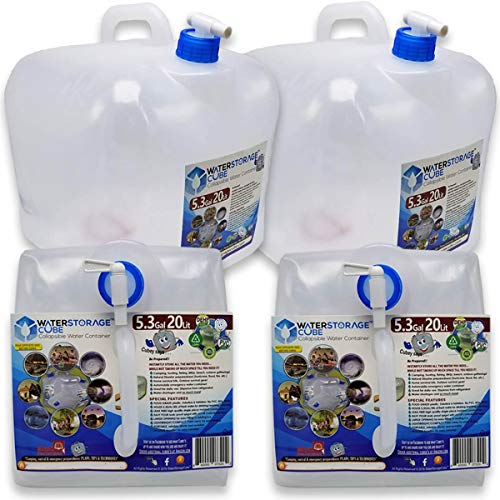
The WaterStorageCube solves a different problem: where to keep a container when there is no emergency yet. Each cube holds 5.3 gallons, and this two-pack gives you 10.6 gallons of capacity, but empty, each container folds down to about 2.5 inches thick and fits in a kitchen drawer. For apartment dwellers, that fold-flat design is often the deciding factor.
The cubes are made from food-grade LDPE plastic that the maker lists as free of BPA, PVC, and DEHP, and each has a built-in spigot for controlled pouring. Opened up, a cube measures about 11.4 by 11.4 by 13.2 inches; filled, it weighs roughly 45 pounds, and because the walls are flexible it bulges as it fills rather than holding a rigid shape. The trade-off for the tiny footprint is durability: a soft-walled cube is not the container to drag across gravel or stack heavy boxes on.
Specs
- Capacity: 5.3 gallons per container; 10.6 gallons total in the 2-pack
- Material: Food-grade LDPE, listed by the maker as free of BPA, PVC, and DEHP
- Open dimensions: 11.4 in x 11.4 in x 13.2 in
- Folded dimensions: 10.2 in x 9.4 in x 2.5 in
- Empty weight: 10.4 ounces per container
- Dispensing: Built-in spigot
- Tier: Budget
How to choose
Start with volume. A common planning figure is one gallon per person per day for drinking and basic sanitation, so a household of four preparing for three days needs about 12 gallons stored. From there, choose the format that fits your space and your strength. Rigid jugs hold the most per container and dispense easily, but a full 7-gallon jug weighs close to 60 pounds, so fill them near where they will live. Stackable bricks spread the same water across units of roughly 27 to 32 pounds filled. Collapsible cubes store almost nothing when empty and suit renters, but their soft walls are the least rugged here.
Check the material statement on any container you buy: look for food-grade plastic described as BPA-free by the maker, and follow the maker’s care guidance, since several brands warn that long sunlight exposure degrades their plastic. Think about dispensing, too: a spigot matters if the container will sit full for months and serve a family daily during an outage, while a plain cap is fine for vehicle kits. Finally, mark the fill date on each container and refresh stored tap water on the schedule your local guidance recommends.
Who should skip
Skip large rigid jugs if you cannot comfortably lift 45 to 60 pounds, or if the container must travel up stairs during an outage; brick systems and smaller cans exist precisely for that case. Skip collapsible cubes if you need storage that survives rough handling, stacking under load, or years of continuous filled service, since soft LDPE walls are the compromise behind the fold-flat design. Skip brick systems if budget is the main constraint and you have a garage corner free, because a single budget-tier jug stores a gallon for far less. And skip every container here if you need bulk storage for a large household over weeks; a dedicated large tank or barrel system is the more sensible format.
FAQ
How long can water stay stored in these containers?
Makers generally advise filling with clean tap water, storing the sealed container in a cool, dark place, and replacing the water periodically; many emergency guides suggest a six-month rotation for untreated tap water. Follow the maker’s instructions and your local health guidance.
Do these containers make water safe to drink?
No. These are storage containers, not purifiers. They hold water that was safe when you filled them, and the makers’ BPA-free, food-grade statements describe the container, not a treatment process. If you need to treat questionable water, pair storage with a dedicated emergency water filter.
Can I stack the Aqua-Tainer or Scepter when full?
Reliance describes the Aqua-Tainer as stacking when empty, so plan floor space for filled jugs. The Scepter can is built for transport and rack storage, not stacking under load. The brick systems are the exception: WaterBrick states its containers can be cross-stacked up to about four feet high.
How do I clean a storage container before filling?
Wash the interior with dish soap and water, rinse thoroughly, and let it dry fully before filling. The wide-mouth brick containers are the easiest to scrub; narrow-neck jugs benefit from a bottle brush.
Final verdict
There is no single best format, only the best match for your space and strength. The Reliance Aqua-Tainer is the straightforward default for a garage or utility room: big capacity, a protected spigot, and a budget tier. The Scepter 05935 is the pick for vehicles and rough transport. WaterBrick and AquaBrick cost more per gallon but turn closets and under-bed space into a real water reserve, while the WaterStorageCube two-pack is the answer when storage space, not water space, is the scarce resource.