Key takeaways
- Compare the best surge protectors for home appliances, from single-outlet taps to high-joule strips, with joule ratings, key specs and buying tips.
- Top Pick: GE UltraPro Single Outlet Surge Protector
- Runner-up: Tripp Lite Isobar ULTRABLOK Surge Protector
- Also consider: APC Performance SurgeArrest P11VNT3 Surge Protector
Storm season is hard on home appliances. When lightning strikes nearby or the utility grid switches loads after an outage, a brief voltage spike can travel through your wiring and reach the control boards inside a refrigerator, washer, freezer or microwave. Those boards are expensive to replace, and the damage often shows up days later as a dead display or a compressor that will not start.
A plug-in surge protector sized for appliances is a simple layer of defense at the outlet. This guide compares five models across three formats: compact single-outlet taps that hide behind one appliance, a heavy-duty two-outlet wall block, and full strips for appliance clusters and laundry rooms. Every pick is rated for standard household circuits and described only from its published specifications.
As an Amazon Associate, we earn from qualifying purchases.
Quick answer
For a single appliance, choose a direct plug-in tap like the GE UltraPro Single Outlet or the Tripp Lite Isobar ULTRABLOK, both built to sit at the wall outlet with no cord. For groups of appliances, the APC SurgeArrest P11VNT3 and Belkin 12-Outlet strip add data-line protection and more outlets, while the Tripp Lite ISOBAR8ULTRA is the premium metal-housing option with the highest joule rating here.
GE UltraPro Single Outlet Surge Protector

The GE UltraPro is a budget-tier single-outlet tap designed for one appliance at a time, such as a garage door opener, microwave or washing machine. It plugs directly into the wall receptacle, so there is no cord to route and nothing sitting on the floor. Its standout feature is an audible alarm rated at 88 decibels that sounds when the protection circuit reaches the end of its service life, so you are not left guessing whether the unit is still doing its job. The listing describes it as a two-pack, which suits homes that want one tap in the garage and one in the laundry room.
Specs
- Outlets: 1 grounded outlet, direct plug-in
- Surge rating: 1,080 joules (maker-stated)
- Electrical rating: 120V AC, 15A, 1,800W
- Maximum spike current: 45,000A (maker-stated)
- End-of-protection alarm: 88 dB audible alarm
- Warranty: lifetime (maker-stated)
Because it serves a single outlet, this tap fits best where one mid-size appliance needs its own point-of-use protection. It is not the right format for a refrigerator plus freezer pairing or a laundry pair; those setups are better served by the two-outlet and strip models below.
Tripp Lite Isobar ULTRABLOK Surge Protector
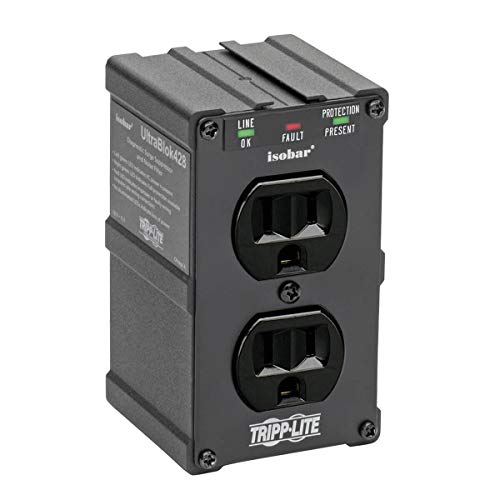
The ULTRABLOK is a mid-range, direct plug-in block from Tripp Lite’s Isobar line, built for garages, workshops and utility rooms where a corded strip would get in the way. It provides two NEMA 5-15R outlets in an all-metal housing that mounts directly on the wall receptacle, with optional mounting hardware included for a permanent fit. Inside, Tripp Lite lists large toroidal chokes, ferrite rod-core inductors and multiple layers of metal oxide varistors for EMI and RFI noise filtering, plus diagnostic LEDs that show power, protection and line fault status at a glance.
Specs
- Outlets: 2 NEMA 5-15R, direct plug-in
- Surge rating: 1,410 joules (maker-stated)
- Housing: all-metal case
- Dimensions: 5.7 x 4 x 2.6 inches
- Weight: 12.8 ounces
- Features: automatic shutoff, diagnostic LEDs, EMI/RFI filtering
The automatic shutoff cuts power to connected equipment if the protection circuit is compromised, which matters for appliances that run unattended. With two outlets, it suits a washer-and-dryer pair or a refrigerator next to a chest freezer, as long as the combined load stays within a standard household circuit.
APC Performance SurgeArrest P11VNT3
The APC P11VNT3 is a mid-range strip built for spots where appliances share space with connected electronics, such as a laundry room with a smart washer or a kitchen counter run. It offers eleven outlets, and it adds protection for phone lines, coaxial cable and Ethernet, which is useful for appliances and entertainment gear that also connect to data lines. APC rates the unit at 3,020 joules and lists EMI and RFI noise rejection of 70 dB across the 100 kHz to 10 MHz range.
Specs
- Outlets: 11 NEMA 5-15R
- Surge rating: 3,020 joules (maker-stated)
- Input: 120V, 15A
- Cord length: 6 ft
- Data-line protection: phone (RJ-11 splitter), coaxial, Ethernet
- Noise rejection: 70 dB (maker-stated)
- Certifications: UL 1449, UL 1363, CSA, NOM
- Warranty: lifetime (maker-stated)
Several outlets are spaced for bulky transformer plugs, and sliding safety covers keep unused sockets closed. For a utility room powering a washer, a freezer and a network-connected appliance or two, the outlet count and data-line coverage make it a practical single purchase.
Belkin 12-Outlet Surge Protector (BE112230-08)
Belkin’s BE112230-08 is a mid-range twelve-outlet strip aimed at appliance clusters and home workshops. Six of its outlets use Belkin’s BlockSpace layout, which leaves room for large power bricks without blocking neighboring sockets. The Amazon listing rates it at 3,940 joules, the highest figure in this guide alongside the Isobar strip, and it adds telephone and coaxial protection for connected equipment. An eight-foot cord with a right-angle plug helps it reach behind refrigerators, freezers and laundry pairs.
Specs
- Outlets: 12 AC outlets, 6 of them BlockSpace
- Surge rating: 3,940 joules (listing figure)
- Cord length: 8 ft, right-angle plug, 14 AWG
- Electrical rating: 15A, 125V
- Clamping voltage: UL 1449 500V (maker-stated)
- Maximum spike current: 75,000A (maker-stated)
- Data-line protection: telephone and coaxial
- Noise filtration: up to 75 dB reduction (maker-stated)
- Warranty: lifetime limited (maker-stated)
Indicator lights report protected and grounded status, and a detachable cord management clip keeps cords from tangling behind the strip. It suits a garage wall where a freezer, a workbench charger and a second refrigerator all draw from one protected strip.
Tripp Lite ISOBAR8ULTRA Surge Protector
The ISOBAR8ULTRA is the premium pick in this roundup: an eight-outlet strip in a metal housing with the Isobar line’s isolated filter banks. Tripp Lite rates it at 3,840 joules and divides the outlets into three isolated filter banks that limit noise interference between connected devices, blocking up to 80 dB of EMI and RFI line noise. That filtering suits homes where appliance motors and sensitive electronics share a circuit run. Diagnostic LEDs report power, protection and line fault status, and an automatic shutoff cuts power if the protection circuit fails.
Specs
- Outlets: 8 NEMA 5-15R, widely spaced
- Surge rating: 3,840 joules (maker-stated)
- Cord length: 12 ft, right-angle plug
- Housing: all-metal case with keyhole mounting slots
- Filter banks: 3 isolated banks, up to 80 dB EMI/RFI attenuation (maker-stated)
- Circuit breaker: 12A resettable (listing figure)
- Features: automatic shutoff, diagnostic LEDs, lighted switch, outlet safety covers
- Certifications: UL 1449, UL 1283, UL 1363, IEEE 587 Category A and B
- Warranty: lifetime limited (maker-stated)
The twelve-foot cord is the longest here, which helps when the only grounded outlet sits across a laundry room or garage bay. For storm-prone homes that want one durable strip guarding a freezer, a dehumidifier and workshop electronics, this is the strongest specification sheet of the five.
How to choose
Start with format. A single appliance on its own outlet is best served by a direct plug-in tap, which adds no cord and keeps the protection at the receptacle. Two appliances side by side call for a two-outlet wall block or a short strip. Clusters of three or more belong on a full strip with widely spaced or BlockSpace outlets so transformer bricks do not crowd out sockets.
Next, compare the joule rating as a maker-stated label figure. Higher ratings generally indicate more surge energy the unit is designed to absorb over its service life, and homes in lightning-prone regions usually favor the higher end of the range. Clamping voltage matters too: a lower UL 1449 rating, such as 400V to 500V, means the unit is designed to start limiting voltage sooner. Treat all of these as published specifications rather than guarantees, since no plug-in device can stop a direct lightning strike.
Check the electrical rating against your appliance. Standard models here are rated 15A on a 120V circuit, which matches most household appliance outlets; large appliances on dedicated circuits should stay on those circuits, with the protector added at the outlet only if the appliance maker allows it. Cord length and plug shape decide whether the strip can sit safely out of walkways, and diagnostic LEDs, protected-status lights and end-of-protection alarms tell you when a unit needs replacing. If your appliances also connect to cable, phone or network lines, a model with data-line protection closes that second path for surges.
Who should skip
Skip plug-in protectors entirely if your home already has a quality whole-house surge protective device at the panel and your appliances sit on dedicated circuits; in that case, point-of-use units add little. Skip strips for refrigerators or freezers that the manufacturer requires to plug directly into a wall outlet with no intermediate device; follow the appliance manual first. Skip the single-outlet taps if you need to cover several appliances in one room, and skip any surge protector as a substitute for fixing a faulty outlet, a missing ground or repeated breaker trips, which are jobs for a licensed electrician. Finally, if you need backup power during outages rather than spike protection, look at a generator or battery system instead; a surge protector does nothing when the power is out.
FAQ
Can I plug a refrigerator into a surge protector strip?
Many homeowners do, but check the refrigerator manual first, because some makers require a direct wall connection. If a protector is used, choose a model rated 15A with a joule rating in the range of these picks, keep the strip off the floor and away from moisture, and never chain two strips together.
What joule rating do home appliances need?
There is no single required figure. As a maker-stated label, ratings around 1,000 joules suit single smaller appliances, while ratings above 3,000 joules are common on strips guarding several larger appliances. Homes with frequent storms often choose the higher end, and any unit should be replaced after a major surge event or when its protection indicator goes out.
How is a surge protector different from a power strip?
A plain power strip only adds outlets and may include a basic breaker. A surge protector adds suppression components, a published joule rating and a UL 1449 clamping voltage listing. If the packaging shows no joule rating, treat it as a plain strip and do not rely on it for appliance protection.
When should I replace a surge protector?
Replace it when the protected indicator light goes out, when an end-of-protection alarm sounds, or after a known major surge such as a nearby lightning strike. Suppression components wear down a little with every event they absorb, so an older unit in a storm-prone area deserves a scheduled replacement even if its light still glows.
Final verdict
For most homes, the APC P11VNT3 is the balanced choice: a high maker-stated joule rating, eleven outlets and data-line protection in one mid-range strip. If you only need to guard one appliance, the GE UltraPro tap and its end-of-protection alarm are the simplest fit, and the ULTRABLOK adds a rugged metal two-outlet option for garages and laundry pairs. The Belkin BE112230-08 covers big clusters with its twelve BlockSpace-friendly outlets, while the Tripp Lite ISOBAR8ULTRA is the premium pick for storm-prone homes that want metal construction, isolated filter banks and the longest cord. Match the format to the appliance first, then compare the published ratings.