Our Short List of 3

- Evidence level: CANDIDATE — the ASIN comes from an indexed Amazon US listing for this model; a live product page read was blocked, so confirm stock and the exact variant before buying. Note that an older ASIN also circulates for the Schwinn 270 name, so check the model year on the live listing.
- Resistance as listed: 25 levels of magnetic resistance
- Programmes as listed: 29 preset workout programmes
- Weight capacity as listed: 300 pounds

- Evidence level: CANDIDATE — the ASIN comes from an indexed Amazon US listing for the current model-year Schwinn 230; a live product page read was blocked, so confirm stock and the exact variant before buying. An older ASIN also circulates for the Schwinn 230 name, so check the model year on the live listing.
- Resistance as listed: 16 levels of magnetic resistance
- Programmes as listed: 13 preset workout programmes
- Display as listed: 5.5-inch LCD
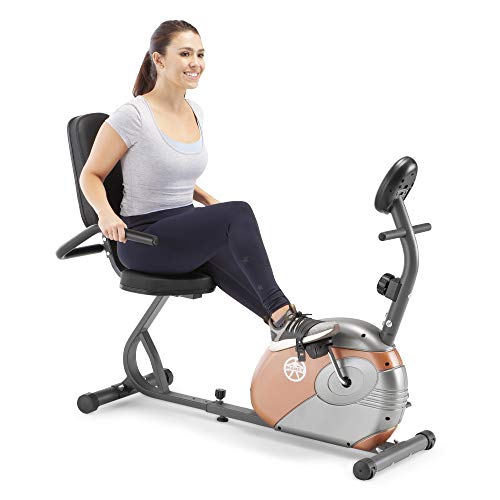
- Evidence level: CANDIDATE — the ASIN comes from an indexed Amazon US listing for the ME-709; a live product page read was blocked, so confirm stock and the exact variant before buying. A product tracker recorded this listing as in stock and sold by Amazon in late November 2026, which is the freshest availability signal we found for any pick in this guide.
- Resistance as listed: 8 levels of magnetic resistance
- Display as listed: LCD showing distance, calories burned, time, speed, and heart rate
- Weight capacity as listed: 300 pounds
All 3 Picks at a Glance
| Product | Specs | Action |
|---|---|---|
| 1. Schwinn 270 Recumbent Bike — the most complete back-friendly package |
| Check price on Amazon |
| 2. Schwinn 230 Recumbent Bike — the same posture, a simpler package |
| Check price on Amazon |
| 3. Marcy ME-709 Recumbent Bike — the simple, budget-friendly starter |
| Check price on Amazon |
Key takeaways
- Compare the best stationary bikes for sciatica: recumbent models from Schwinn and Marcy with reclined seating, wide cushioned seats and gentle magnetic resistance for low-impact indoor cycling.
As an Amazon Associate we earn from qualifying purchases.
Affiliate Disclosure: This article contains affiliate links. If you buy through a link on this page, we may earn a commission at no extra cost to you. Product specifications are taken from the manufacturers’ Amazon US listings, and we have not personally tested any of these bikes.
Sciatica is not a single injury. It is the name for pain that follows the path of the sciatic nerve, usually from the lower back down through the hip and leg, and it can be caused by a herniated disc, spinal narrowing, muscle tightness, or a combination of those. That variety is exactly why choosing a stationary bike for sciatica takes more care than choosing one for general fitness. A bike that forces you to lean forward over the handlebars, perch on a narrow saddle, or push hard against heavy resistance can aggravate the very nerve you are trying to calm. A bike that lets you sit back, keeps your spine supported, and lets you start at almost no resistance can give you gentle movement, better circulation, and stronger supporting muscles without the jarring impact of running or the deep forward fold of some other machines.
The three bikes in this guide are all recumbent exercise bikes. That is a deliberate choice. A recumbent bike places the seat low and reclined, with the pedals out in front of you rather than underneath you, so your back rests against a backrest, your weight spreads across a wide seat, and your hips stay open instead of folded. For many people living with sciatic pain, that posture is the difference between a workout that helps and one that hurts. Every pick below is a recumbent model sold on Amazon US, with a wide seat, a backrest, and magnetic resistance that starts light.
One evidence note belongs up front. Attempts to re-open the live Amazon US product pages for these picks were blocked by the retailer’s access controls during our check, so every ASIN in this guide is recorded at candidate level: each code comes from an indexed Amazon US listing or a product source that reproduces that listing, with the model name and specifications matching, but current stock and the featured offer were not confirmed in a live page read. Confirm the exact variant and the availability on the live listing before you order. Two picks also carry a note about a second, older ASIN that circulates for the same model name; the code given here is the one tied to the current model-year listing, and the live page is the place to settle which variant you are buying.
How to choose a stationary bike when you have sciatica
Start with posture, because it decides everything else. A recumbent bike keeps your torso reclined and your lower back against a backrest, which reduces the compressive load on the lumbar discs compared with an upright bike that asks you to hinge forward. Look for a backrest that is wide, padded, and ideally ventilated, so it supports the natural curve of your lower back without trapping heat during a longer session. A seat that slides along a rail matters too: you need to set the distance to the pedals so your knee keeps a slight bend at the far end of the stroke, never locking straight and never staying deeply bent at the top. Both Schwinn picks in this guide slide their seats on a rail, and the Marcy adjusts the same way.
The second criterion is the seat itself. A narrow racing saddle concentrates your weight on a small area and can press on tissues that are already irritated. A wide, cushioned seat spreads the load across your sitting bones and lets you ride longer without shifting around to find relief. All three picks here have oversized, padded seats rather than slim saddles.
The third criterion is resistance that starts genuinely light. Magnetic resistance is the right system for sciatica because it changes in small, smooth steps with no jerky grabbing, and because the lowest levels are light enough for a warm-up ride that barely loads the back at all. A bike with many resistance levels gives you finer control as you progress: the Schwinn 230 offers sixteen levels, the Schwinn 270 offers twenty-five, and the Marcy ME-709 offers eight. Eight is enough for gentle riding, but if you want room to progress over months without jumping between levels that feel too far apart, more levels help.
The fourth criterion is ease of getting on and off. A recumbent bike sits low, and some designs ask you to step over a high frame rail to reach the seat. Look for a walk-through or step-through frame, or at least a low front section, so you can sit down without twisting your spine or lifting a leg high. The Marcy ME-709 has a compact step-through style frame, and the Schwinn models use a low-profile frame that keeps the entry point close to the seat.
The fifth criterion is stability and weight capacity. A bike that wobbles when you pedal will make your back brace defensively, which is the opposite of what you want. All three picks here are rated to support riders up to 300 pounds, with heavy steel frames, and the Schwinn models add a perimeter-weighted flywheel that keeps the pedal stroke smooth instead of choppy. Check the listed weight capacity against your own weight before you buy, and place the bike on a flat, firm surface rather than thick carpet.
Quick comparison
| Pick | Seat and backrest | Resistance levels | Programmes as listed | Weight capacity as listed |
|---|---|---|---|---|
| Schwinn 270 Recumbent Bike | Ventilated padded seat with lumbar-supporting backrest | 25 magnetic levels | 29 preset programmes | 300 pounds |
| Schwinn 230 Recumbent Bike | Wide cushioned seat with backrest, sliding rail | 16 magnetic levels | 13 preset programmes | 300 pounds |
| Marcy ME-709 Recumbent Bike | Wide padded seat with backrest, adjustable position | 8 magnetic levels | No preset programmes listed | 300 pounds |
1. Schwinn 270 Recumbent Bike — the most complete back-friendly package
- Evidence level: CANDIDATE — the ASIN comes from an indexed Amazon US listing for this model; a live product page read was blocked, so confirm stock and the exact variant before buying. Note that an older ASIN also circulates for the Schwinn 270 name, so check the model year on the live listing.
- Resistance as listed: 25 levels of magnetic resistance
- Programmes as listed: 29 preset workout programmes
- Weight capacity as listed: 300 pounds
The Schwinn 270 is the most fully featured bike in this guide, and it earns the top spot because it is the one that gives you the most control over the two things that matter most with sciatica: how gently you start, and how gradually you progress. Twenty-five magnetic resistance levels mean the gap between one level and the next is small, so you can nudge the effort up by a fraction instead of jumping from easy to noticeably hard. Twenty-nine preset programmes give you structured sessions that vary the resistance for you, including gentle recovery-style rides, which is useful on days when you want guidance rather than having to manage the intensity yourself.
The seat is the other reason this bike leads the list. Schwinn describes it as a ventilated seat with a backrest that supports the lumbar region, and the seat slides along a rail so you can set the leg extension precisely. The pedal stroke is driven by a perimeter-weighted flywheel, which keeps the motion smooth and even through the whole circle rather than surging at the top of each stroke. A smooth stroke matters when a nerve is irritated, because a jerky pedal motion sends small shocks through the hip and lower back with every revolution.
The console is a dual-track display that shows your workout data on two screens at once, and Bluetooth connects the bike to the Schwinn training app and other compatible fitness apps. The bike also carries pulse sensors in the handlebars; treat those readings as approximate, but they are handy for keeping your effort in a comfortable zone.
Choose the Schwinn 270 if you want the widest range of resistance, the most programme variety, and the most supportive seat in this guide, and you are willing to give it the floor space a full-size recumbent needs. Skip it if you want the simplest possible machine, because the Marcy below does the same basic job with far fewer controls to learn.
2. Schwinn 230 Recumbent Bike — the same posture, a simpler package
- Evidence level: CANDIDATE — the ASIN comes from an indexed Amazon US listing for the current model-year Schwinn 230; a live product page read was blocked, so confirm stock and the exact variant before buying. An older ASIN also circulates for the Schwinn 230 name, so check the model year on the live listing.
- Resistance as listed: 16 levels of magnetic resistance
- Programmes as listed: 13 preset workout programmes
- Display as listed: 5.5-inch LCD
The Schwinn 230 is the 270’s smaller sibling, and it keeps the parts of the design that matter most for sciatica while trimming the extras. You still get a reclined recumbent seat with a backrest, a sliding rail for leg position, and smooth magnetic resistance. Sixteen levels is fewer than the 270’s twenty-five, but it is still a fine-grained range: the lowest levels are genuinely light, and the steps between them are small enough for gradual progression over weeks and months.
Thirteen preset programmes cover the useful ground, from gentle steady rides to interval-style sessions, and the 5.5-inch LCD display shows time, speed, distance, calories, and heart rate data clearly without demanding that you learn a complicated menu. Bluetooth is included, so you can still track workouts in an app if you want to, but the bike works perfectly well as a standalone machine with no phone involved. The 300-pound weight capacity matches the 270, and the frame is the same heavy steel construction, so stability is not something you give up by choosing the simpler model.
3. Marcy ME-709 Recumbent Bike — the simple, budget-friendly starter
- Evidence level: CANDIDATE — the ASIN comes from an indexed Amazon US listing for the ME-709; a live product page read was blocked, so confirm stock and the exact variant before buying. A product tracker recorded this listing as in stock and sold by Amazon in late November 2026, which is the freshest availability signal we found for any pick in this guide.
- Resistance as listed: 8 levels of magnetic resistance
- Display as listed: LCD showing distance, calories burned, time, speed, and heart rate
- Weight capacity as listed: 300 pounds
The Marcy ME-709 is the simplest bike in this guide, and for many people with sciatica that simplicity is a genuine advantage. There are no preset programmes to learn, no app to connect, and no long menu to navigate: you sit down, set one of eight magnetic resistance levels, and pedal. The lowest level is light enough for a gentle warm-up, and the magnetic system keeps the pedalling smooth. The wide padded seat and backrest support the lower back in the same reclined posture as the Schwinn models, and the seat adjusts forwards and backwards so you can find the leg position that keeps your knee slightly bent at full extension.
At 61 pounds the Marcy is lighter than the Schwinn bikes, and it has transport wheels so you can roll it into a corner when it is not in use, which matters in a small room. The LCD display covers the basics: distance, calories, time, speed, and heart rate from the grip sensors. Eight resistance levels is the narrowest range in this guide, so if you progress well over several months you may find the top level easy, but for gentle, consistent riding at low intensity that is not a problem. This is the pick for someone who wants to start riding this week with the least fuss and the least to learn.
Choose the Marcy ME-709 if you want the simplest, most compact recumbent here and you are happy to manage your own sessions without preset programmes. Skip it if you want guided workouts, app tracking, or the finest resistance steps, because those belong to the Schwinn picks above.
How to ride with sciatica without making it worse
This guide is about equipment, not medical advice. If your pain is new, severe, or comes with numbness, weakness, or bladder or bowel changes, talk to a clinician before starting any exercise programme.
Keep the first week short. Ten to fifteen minutes at the lowest resistance, three or four times a week, is a sensible start, and you can add a few minutes at a time only when the previous session leaves no lingering pain the next morning. Warm up for two or three minutes at the lightest setting before raising the resistance at all, and cool down the same way. Sit tall against the backrest rather than slumping to one side, and keep your feet flat on the pedals with the ball of the foot over the pedal axle. If you catch yourself gripping the handlebars hard or holding your breath, the resistance is too high.
Stop and rest if pain shoots down the leg, if numbness or tingling increases, or if the pain is clearly worse than when you started. Mild, dull discomfort that fades quickly after the session is common when you are getting used to a new activity, but sharp or radiating pain is a signal to stop, not to push through.
Position matters as much as effort. Before your first ride, slide the seat so that your knee keeps a slight bend when the pedal is farthest away, and check that your hips stay level rather than rocking from side to side. A rocking hip usually means the seat is too far back. Small adjustments here make a large difference over a twenty-minute ride.
Frequently asked questions
Is a recumbent bike better than an upright bike for sciatica?
For most people, yes, because the reclined seat and backrest support the lower back and keep the hips open, while an upright bike asks you to lean forward and places more load on the lumbar discs. If you are buying specifically for sciatica, a recumbent is the safer starting point.
Can cycling make sciatica worse?
It can, if the resistance is too high, the session is too long, or the seat position forces your spine into a twist or a deep fold. Start light, keep sessions short, stop when pain radiates down the leg, and check with a clinician if symptoms change or worsen.
How long should a session be?
Begin with ten to fifteen minutes at low resistance and add a few minutes at a time over weeks, only when the previous session caused no lingering pain. Many people settle into twenty to thirty-minute sessions, but the right length is the one your back tolerates, not a number from a chart.
Do I need the programmes and Bluetooth, or is a basic bike enough?
A basic bike is enough for gentle riding. Programmes and app tracking help if you like structure and want to progress gradually without deciding the intensity yourself. The Marcy covers the basic case well; the Schwinn models add the structure.
What if none of these bikes feels right?
Seat comfort is personal, and back pain varies too much for one guide to cover every case. If a recumbent still aggravates your symptoms, stop riding and talk to a physiotherapist, who can check your posture and suggest alternatives such as walking or swimming.
The verdict
If you want the most complete package for riding with sciatica, choose the Schwinn 270: the widest resistance range, the most programmes, and the most supportive seat in this guide. If you want the same reclined comfort with a simpler setup, the Schwinn 230 gives you sixteen resistance levels and thirteen programmes in a proven design. And if you want the simplest possible start, the Marcy ME-709 is a sturdy, compact recumbent that does the essential job — a supported seat, a backrest, and light magnetic resistance — with nothing extra to learn. Whichever you choose, start gently, keep sessions short, and let your symptoms decide how fast you progress.