Key takeaways
- Compare the best space heaters for home winter use, from ceramic towers to whole-room vortex models, with wattage, coverage and safety features explained.
A space heater earns its place in a winter readiness plan when the furnace struggles to keep one room comfortable, or when you want to warm the room you are using instead of the whole house. The five electric models below cover the main shapes worth considering: oscillating ceramic towers, a compact heater for a desk or nightstand, and whole-room designs that circulate warm air instead of blasting one hot spot.
Every pick here runs on standard household power and tops out around 1,500 watts, the practical ceiling for a plug-in heater on a typical home circuit. What separates them is how they deliver that heat, how precisely you can control it, and which maker-stated safety features come built in, such as tip-over switches and overheat shutoff. Treat every coverage figure as the manufacturer’s own published number rather than a promise.
As an Amazon Associate, we earn from qualifying purchases.
Quick answer
For most homes, start with an oscillating ceramic tower such as the Lasko 755320 or the PELONIS 30-inch tower, which pair 1,500-watt output with a thermostat, timer and remote. Choose the Vornado AVH10 for even whole-room warmth, the Honeywell HeatGenius for zoned heat settings, and the Dreo DR-HSH003 as a compact option for bedrooms and offices.
Lasko 755320 Oscillating Digital Ceramic Tower Heater

The Lasko 755320 is the long-running benchmark in this category: a 23-inch ceramic tower that oscillates to spread warm air across a room instead of heating a single line in front of the grille. Lasko rates its heating coverage at 150 square feet on the listing, a sensible fit for bedrooms, home offices and smaller living rooms.
Controls are the strong point: a digital display and programmable thermostat, a remote for changes from the sofa, and an 8-hour timer for evening use. Two heat settings give you full power for fast warm-up and a lower setting for maintaining temperature.
Specs
- Heat output: 1,500 watts on high, 900 watts on low
- Heating element: ceramic, fan-forced
- Coverage: 150 square feet, as stated by Lasko on the listing
- Oscillation: widespread oscillation
- Controls: digital display, programmable thermostat, remote control
- Timer: 8 hours
- Safety features: overheat protection, cool-touch housing; ETL listed, as stated by Lasko
- Size: 23 inches tall
One honest limitation: Lasko’s own comparison data does not list a tip-over switch for this model, so households that need that feature should look at the PELONIS, Dreo or Honeywell picks instead. In the mid-range tier, the 755320 remains the straightforward tower most buyers picture.
Dreo Space Heater (DR-HSH003)
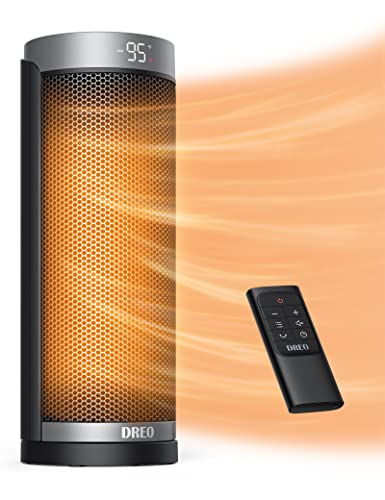
The Dreo DR-HSH003 takes the same ceramic formula and shrinks it into a 16-inch unit aimed at bedrooms and offices where a tall tower would crowd the floor. It is built around a PTC ceramic element rated at 1,500 watts, with lower power steps for gentler, sustained heat once a room is warm.
A 70-degree oscillation arc moves the warmth around rather than parking it in front of the unit, and the remote plus digital thermostat keep adjustments simple from a desk or bed. Its footprint is closer to a desktop fan than a tower.
Specs
- Heat output: 1,500 watts maximum, PTC ceramic element
- Height: 16 inches
- Oscillation: 70 degrees
- Controls: remote control and digital thermostat
- Safety features: overheat protection and tip-over protection, as stated by Dreo
- Intended rooms: bedrooms and offices, per Dreo
This is the pick for buyers who want tower-style features in a shorter body that fits beside a desk. It sits in the mid-range tier and suits single-room supplemental heat rather than open-plan spaces, where a taller tower or whole-room circulator feels more effective.
PELONIS 30-Inch Ceramic Tower Heater (PHF15RSAPH30)
At 30 inches, the PELONIS PHF15RSAPH30 is the tallest heater in this roundup, aimed squarely at larger rooms. The maker states coverage of up to 280 square feet, paired with 75-degree oscillation to push warm air into corners a shorter tower can miss. Treat that figure as the manufacturer’s own rating, as with every heater here.
The control set is generous for the tier: a digital panel with single-degree temperature adjustment, a remote, an ECO mode that moderates output to hold a set temperature, and a 12-hour timer, the longest in this group. PELONIS also states a noise level under 55 decibels in its listing copy, which matters for bedroom use.
Specs
- Heat output: 1,500 watts, ceramic PTC element
- Coverage: up to 280 square feet, as stated by PELONIS
- Height: 30 inches
- Oscillation: 75 degrees
- Modes: High, Low, ECO and Fan
- Timer: 12 hours
- Safety features: tip-over switch and overheat protection, as stated by PELONIS
- Controls: digital panel and remote control
Choose this tower if the room is a primary living space and you want the widest stated coverage plus a long timer. It is a mid-range tower with a premium-sized feature list, though its height means checking it fits your space.
Vornado AVH10 Vortex Whole Room Heater
Vornado takes a different approach from the towers. Instead of aiming hot air at whoever sits in front of it, the AVH10 uses Vortex Action airflow to circulate heated air around the whole room, bouncing it off walls and ceilings so the far side warms up too. Vornado publishes no square-foot coverage figure for this model, so judge it by its design intent rather than a coverage number.
This 2025-generation model adds auto climate control: set a target temperature and the heater adjusts output to hold it, rather than cycling bluntly between full blast and off. Two heat settings plus a fan-only mode cover shoulder-season use.
Specs
- Heat output: 1,500 watts maximum, as published by Vornado
- Heat settings: 2, plus a fan-only mode
- Airflow: Vortex Action whole-room circulation
- Controls: digital display, adjustable thermostat, auto climate control
- Safety features: automatic safety shut-off features, as stated by Vornado
The AVH10 is the premium pick for people who dislike the hot-spot, cold-corner pattern of directional heaters and want a room that feels evenly warm. Skip it if you want direct, personal heat aimed at one chair or desk, because gentle circulation is exactly what it trades away.
Honeywell HeatGenius Ceramic Heater (HCE840B)
The HeatGenius is the control freak of this group, with six customized heat settings that direct warmth from the upper zone, the lower zone or both, so you can send heat down toward cold feet or out at seated height. The HeatPhase timer gradually steps heat down over its cycle before switching off, instead of cutting from full power to nothing.
Honeywell’s manual for the HCE840 series lists a maximum of 1,575 watts and 5,118 BTU, with a 12.5-amp draw on a 120-volt circuit. The unit is compact for its feature set at about 17 inches tall.
Specs
- Heat output: up to 1,575 watts maximum, per Honeywell’s manual
- Heat settings: 6 customized settings, upper, lower or combined zones
- Controls: digital controls, programmable thermostat, Quiet Mode
- Timer: HeatPhase timer that steps heat down before shutoff
- Safety features: tip-over and overheat protection, as stated by Honeywell
- Size: about 10.2 by 5.6 by 17.3 inches
Pick the HeatGenius if you want heat aimed low at floor level or split between two zones. It is a premium-tier compact heater, so buyers who only need simple on-and-warm operation will find the towers above easier to live with.
How to choose
Start with room size and the maker’s stated coverage. Small bedrooms and offices suit compact models, while living rooms match better with an oscillating tower or a whole-room circulator. Nearly every plug-in heater tops out at 1,500 watts, so a bigger stated coverage figure reflects airflow design as much as raw power.
Next, decide how the heat should move. Directional ceramic towers warm the people in front of them quickly. Whole-room designs like the Vornado circulate air for even temperatures but feel gentler up close. Oscillation widens the warm zone for shared spaces, and zoned models like the HeatGenius let you aim heat high or low.
Then check the controls you will actually use. A programmable thermostat prevents the roasting-and-freezing cycle of basic dial heaters, timers suit evening routines, and remotes matter more than expected once the heater lives across the room.
Finally, confirm the safety features the maker states for the exact model: a tip-over switch, overheat shutoff, a cool-touch housing, and a safety listing such as ETL where the maker publishes one. Not every model includes every feature, as the Lasko 755320 shows. Plug any heater directly into a wall outlet, keep it clear of bedding and curtains, and never run one unattended.
Who should skip
Skip space heaters entirely if your goal is to heat a whole house or large open-plan area; a 1,500-watt plug-in unit is supplemental heat for one room, and your central system will do that job better. Skip them if your wiring is old or the circuit already carries heavy loads, since a heater draws near the maximum a standard outlet should supply.
Also skip these models for bathroom heating, because none is bathroom-rated, or for outdoor and garage use, where a heater rated for that environment is the right tool. During an outage, electric heaters need household power, so they are a comfort tool for normal winter days, not backup heat when the grid is down.
FAQ
How much area can a 1,500-watt space heater warm?
Makers position 1,500-watt heaters for a single room, and stated coverage in this roundup runs from 150 square feet for the Lasko 755320 to up to 280 square feet for the PELONIS tower. Insulation and ceiling height change real results, so treat those numbers as the manufacturers’ own guidance.
Are space heaters safe to run in a bedroom?
They can be, when you follow the maker’s instructions: place the heater on a flat, clear surface away from bedding, plug it directly into a wall outlet rather than an extension cord, and choose a model whose maker states tip-over and overheat protection. A timer is a sensible extra. No heater should be left running completely unattended.
What is the difference between a tower heater and a whole-room heater?
A tower heater blows heated air in one direction, often with oscillation, so warmth arrives fast where it points. A whole-room heater such as the Vornado AVH10 circulates heated air around the entire room for a more even temperature, which feels less intense up close but avoids cold corners.
Do space heaters use a lot of electricity?
A heater on high draws about 1,500 watts, similar to a hair dryer, and running it for hours daily will show up on a winter bill. Lower settings, ECO modes and a thermostat that cycles the heater off at your target temperature all reduce run time. Heating only the room you occupy, instead of raising the thermostat for the whole house, is where the savings usually come from.
Final verdict
For a dependable all-rounder, the Lasko 755320 sets the pattern: honest specs, a thermostat and a remote in a mid-range tower. The PELONIS 30-inch tower is the better call for larger living rooms, with its wider stated coverage and 12-hour timer. Choose the Vornado AVH10 for even, whole-room warmth, the Honeywell HeatGenius for zoned control, and the compact Dreo DR-HSH003 where floor space is tight. Match the heater to the room, respect the maker’s stated clearances, and any of these five will take the edge off winter.