Key takeaways
- Compare the best smoke detectors for homes, from hardwired and 10-year battery alarms to wireless interconnected and smart models with app alerts.
- Top Pick: Kidde i9010 10-Year Sealed Battery Smoke Alarm
- Runner-up: Kidde PI9010 Dual Sensor Smoke Alarm
- Also consider: Google Nest Protect Smoke and CO Alarm, Battery Operated
Smoke alarms are one of the few home safety devices that building codes and fire authorities treat as non-negotiable, and storm season is a practical time to audit yours. Power surges, generator use, candles during outages, and space heaters all raise the stakes, yet many homes still run alarms that are expired, missing batteries, or the wrong sensor type for the room. Replacing a dated alarm is a small job: alarms are generally replaced ten years from their manufacture date.
This guide compares five smoke detectors covering the main ways homes are protected today: a hardwired model with battery backup, a sealed 10-year battery alarm, a dual-sensor battery alarm, a wireless interconnected combination pack, and a smart alarm with voice and phone alerts. Each pick is described from its published specifications: sensor type, power source, interconnect options, and the standards the maker lists.
As an Amazon Associate, we earn from qualifying purchases.
Quick answer
For most homes, a sealed 10-year battery alarm such as the Kidde i9010 is the simplest upgrade: no wiring, no annual battery swaps, and an ionization sensor suited to fast-flaming fires. Homes with existing alarm wiring should keep hardwired units like the First Alert 9120B, larger homes benefit from interconnected sets, and smart-home households can step up to the Nest Protect for voice and phone alerts.
First Alert 9120B Hardwired Smoke Alarm with Battery Backup
The 9120B is the long-running contractor staple from First Alert and BRK, built for homes that already have 120-volt alarm wiring in the ceiling. It runs on household current with a 9-volt battery backup in a side-load drawer, so the alarm keeps working during an outage and the battery can be swapped without taking the unit off its bracket. Its ionization sensor is the type makers position for fast-flaming fires, and the listing states the alarm meets the UL 217 standard and carries a 10-year limited warranty.
Because it is a wired interconnect model, one 9120B can be linked with up to 12 other compatible First Alert or BRK alarms, plus compatible devices such as bells and repeaters, so every alarm in the chain sounds when one triggers. A latching indicator identifies which unit started the alarm. This is a budget-tier pick for wired homes and whole-house replacements where junction boxes already exist.
Specs
- Sensor type: Ionization
- Power source: 120-volt AC hardwired with 9-volt battery backup
- Alarm volume: 85 decibels, per the maker
- Interconnect: Wired, up to 12 compatible alarms plus 6 compatible devices
- Standards listed: UL 217
- Dimensions: 5.6 x 5.6 x 2.2 inches
- Warranty: 10-year limited
Kidde i9010 10-Year Sealed Battery Smoke Alarm
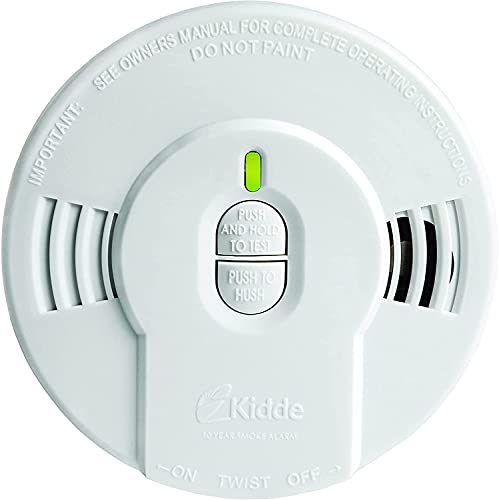
The Kidde i9010 removes the two most common maintenance failures in one step: its lithium battery is sealed inside the unit and rated to power the alarm for its full 10-year service life, so there are no annual battery changes and no battery to remove during a nuisance chirp. The alarm activates automatically when twisted onto its mounting bracket, and an end-of-life alert chirps every 40 to 45 seconds when the unit reaches replacement age.
Kidde fits the i9010 with an ionization sensor, an 85-decibel horn, LED indicators for power and alarm status, and a combined test and hush button. Its Smart Hush feature temporarily quiets nuisance alarms from cooking or shower steam, and an alarm memory function flags which unit was triggered. The product information states the alarm is UL certified and meets UL 217 requirements. It suits bedrooms, hallways, and apartments where running new wire is impractical.
Specs
- Sensor type: Ionization
- Power source: Sealed 10-year lithium battery, non-replaceable
- Alarm volume: 85 decibels, per the maker
- Interconnect: None, standalone unit
- Standards listed: UL 217
- Dimensions: 5.6 x 5.6 x 1.55 inches
- Warranty: 10-year limited
Kidde PI9010 Dual Sensor Smoke Alarm

The PI9010 takes a different approach to sensor coverage: instead of asking the buyer to choose between technologies, Kidde combines a photoelectric sensor and an ionization sensor in one housing. Maker documentation explains the pairing plainly: ionization sensors respond to the smaller particles typical of flaming fires, while photoelectric sensors respond to the larger particles typical of smoldering fires, and fire authorities cited by Kidde recommend having both technologies in a home.
Power comes from a replaceable 9-volt battery, which keeps installation wire-free but adds periodic battery changes back into the routine. The trademarked Hush button desensitizes the alarm for roughly seven minutes during a nuisance event, with a reminder chirp every 30 to 40 seconds, and the red LED flashes on the same interval to show the unit is operating. The listing states the alarm is UL listed and backed by a 10-year limited warranty.
Specs
- Sensor type: Photoelectric and ionization, dual sensor
- Power source: Replaceable 9-volt battery
- Interconnect: None, standalone unit
- Standards listed: UL listed, per the maker
- Dimensions: 5.75 inches diameter x 1.8 inches deep
- Warranty: 10-year limited
X-Sense SC06-W Wireless Interconnected Smoke and CO Alarm, 6-Pack
The SC06-W is sold as a pre-linked six-pack of combination alarms, each detecting smoke through a photoelectric sensor and carbon monoxide through an electrochemical sensor. The units talk over a radio-frequency network using X-Sense Link+ technology, so when one sounds, all six sound; the source unit flashes red while the others alternate red and green, identifying the room where the event started. Silencing one unit quiets the network, and more Link+ alarms can be added later.
Each alarm runs on a built-in lithium battery rated for 10 years, so one purchase covers a typical two-story home without wiring or battery shopping. The maker states that each unit self-checks its battery, sensors, and circuits every 60 seconds, and the horn is rated at 85 decibels. This mid-range pack suits homes with no wired interconnect system that still want the whole house to respond at once.
Specs
- Sensor type: Photoelectric smoke sensor and electrochemical CO sensor
- Power source: Built-in 10-year lithium battery, non-replaceable
- Alarm volume: 85 decibels, per the maker
- Interconnect: Wireless RF, pre-linked pack, expandable with Link+ devices
- Standards listed: Not stated in the listing data
- Dimensions: 5.7 x 5.7 x 2 inches per unit
Google Nest Protect Smoke and CO Alarm, Battery Operated

The Nest Protect is the smart option in this roundup, pairing a split-spectrum photoelectric smoke sensor with a carbon monoxide sensor in a Wi-Fi-connected housing. Instead of opening with a horn blast, it gives an early voice warning that names the room, sends alerts to a phone or tablet through the app, and runs automatic self-tests of its sensors and batteries. Multiple Protect units interconnect wirelessly, so an alert in one room is echoed by the others.
The battery version runs on six AA lithium batteries, which Google specifies as Energizer Ultimate Lithium cells, and the sensors carry a 10-year service life with a printed replace-by date, after which the whole unit is retired. A hardwired version also exists. This is the premium tier: it fits households already using Google Home or Nest devices that want alerts when nobody is home, and anyone who prefers a spoken room name over hunting for a chirping unit at night.
Specs
- Sensor type: Split-spectrum photoelectric smoke sensor and CO sensor
- Power source: 6 AA lithium batteries, included
- Interconnect: Wireless, with other Nest Protect units
- Standards listed: UL 217 and UL 2034 compliance stated by the maker
- Dimensions: 5.3 x 5.3 x 1.5 inches
How to choose
Start with sensor type. Ionization alarms such as the 9120B and i9010 are positioned by their makers for fast-flaming fires, photoelectric alarms respond to smoldering fires, and dual-sensor or split-spectrum models cover both patterns in one unit. Many fire authorities recommend having both technologies represented in the home.
Next, match the power source to the house. If your ceilings already have alarm wiring and junction boxes, hardwired alarms with battery backup keep the system on household power and preserve wired interconnection. If not, sealed 10-year battery alarms remove the wiring question entirely and eliminate battery swaps for the life of the unit.
Then decide on interconnection. In a multi-story home, a fire starting in a closed basement or garage may not be heard from a bedroom through a single standalone alarm. Wired interconnect, wireless RF packs like the SC06-W, and smart systems like the Nest Protect all solve that by sounding every unit together. Finally, count the rooms before you buy: the standard placement guidance is an alarm inside every bedroom, outside each sleeping area, and on every level of the home.
Who should skip
Skip the hardwired 9120B if your home has no existing alarm wiring and you are not hiring an electrician, since a sealed battery alarm covers the same rooms without opening junction boxes. Skip single-sensor ionization models as your only protection if slow, smoldering fires are your main concern; look at dual-sensor or photoelectric options instead. Skip the smart premium tier if you do not want another app account or your Wi-Fi is unreliable, because the Nest Protect’s headline features depend on that connection. And skip every model here if your local code requires a specific listed type; alarm rules vary by jurisdiction.
FAQ
What is the difference between ionization and photoelectric smoke detectors?
Ionization sensors react to the small, less visible particles produced by fast-flaming fires, while photoelectric sensors react to the larger particles produced by smoldering fires. Makers and fire authorities recommend covering both fire types, which is why dual-sensor alarms like the PI9010 and split-spectrum designs like the Nest Protect exist.
How many smoke detectors does a home need?
The widely published placement guidance is one alarm inside every bedroom, one outside each sleeping area, and at least one on every level, including the basement. Interconnected systems are preferred in that guidance because an alarm sounding in a closed room may not be audible from another floor.
How often do smoke detectors need to be replaced?
Alarms are generally replaced ten years from the manufacture date printed on the back of the unit, regardless of battery type. Sealed 10-year models like the i9010 and SC06-W are built around that cycle: when the end-of-life alert chirps, the entire alarm is replaced rather than re-batteried.
Are hardwired smoke detectors better than battery models?
Neither type detects smoke better by default; the difference is power and interconnection. Hardwired alarms run on household power with battery backup and can share a wired interconnect signal, while battery models install anywhere and keep working through outages. What matters most is a recognized listing, correct placement, and replacement on schedule.
Final verdict
For a wired home, the First Alert 9120B remains the default replacement: it interconnects with the installed base of BRK and First Alert alarms and keeps a battery backup for outages. For everyone else, the Kidde i9010 is the easiest recommendation here, since its sealed 10-year battery removes the maintenance step that most often leaves an alarm dead on the ceiling. Choose the PI9010 for both sensor technologies in a simple battery unit, the SC06-W pack for whole-house interconnection without wiring, and the Nest Protect for voice and phone alerts. Whichever route you take, check the date codes on your existing alarms first; replacing expired units matters more than which of these five you pick.