Key takeaways
- The best rechargeable batteries for emergency kits: AA NiMH picks and a charger combo compared by maker-rated capacity, cycle life and shelf life.
Almost every piece of emergency gear in a home kit runs on loose AA or AAA cells: flashlights, headlamps, weather radios, and lanterns all depend on them. The problem with stocking disposable alkalines is that they quietly drain in a drawer, and the set you counted on during a storm may be flat when you need it. A dead flashlight in a blackout is usually a battery problem, not a flashlight problem.
Rechargeable NiMH cells solve that readiness problem. Modern low self-discharge batteries arrive pre-charged, hold most of their charge in storage for years, and can be topped off on a schedule so your kit stays ready. This guide compares five real options, from premium Japanese-made cells to bulk packs and a charger combo, using only the figures the makers themselves publish.
As an Amazon Associate, we earn from qualifying purchases.
Quick answer
For most emergency kits, start with the Panasonic eneloop AA 4-pack: it pairs a maker-rated 2,100-cycle life with a 10-year storage claim. Choose eneloop pro AA cells for high-drain gear, Amazon Basics or POWEROWL bulk packs to stock many devices on a budget or mid-range tier, and the EBL combo if you need a charger included.
Panasonic eneloop AA Rechargeable Batteries, 4-Pack

The standard eneloop AA is the benchmark low self-discharge cell, and it earns its place at the top of an emergency kit because storage life matters more there than raw capacity. Panasonic rates these cells for up to 2,100 recharge cycles, the highest figure in this roundup, and states they maintain 70 percent of their charge for up to 10 years in storage. For batteries sitting in a go bag between storm seasons, that combination is exactly what readiness requires.
The cells are made in Japan and arrive pre-charged at the factory using solar-generated power, ready to use out of the package. Panasonic also rates them for temperatures down to minus 4 degrees Fahrenheit, suiting car kits and unheated garages. Capacity sits in the 2,000 mAh class, so heavy users will swap them more often. As a premium-tier starting point you can forget about for years, this 4-pack is the reference pick.
Specs
- Pack configuration: 4 AA cells (model BK-3MCCA4BA)
- Chemistry: NiMH, low self-discharge; 1.2 volts
- Capacity: up to 2,100 mAh; cycle life: up to 2,100 recharges (maker-rated)
- Storage: maintains 70 percent of charge for up to 10 years
- Pre-charged using solar power; made in Japan; rated down to minus 4 degrees Fahrenheit
Panasonic eneloop pro AA Rechargeable Batteries, 4-Pack
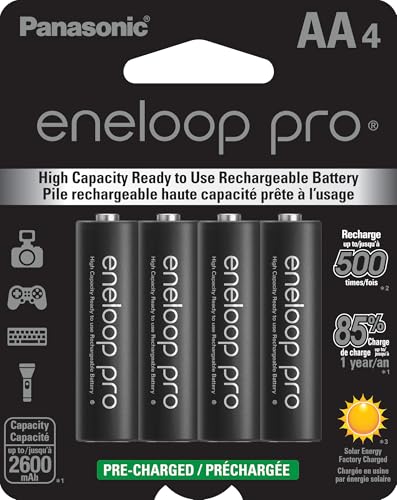
Eneloop pro is Panasonic’s high-capacity line, built for devices that drain batteries quickly. Where the standard eneloop trades capacity for longevity, the pro cells push capacity up to a maker-rated 2,600 mAh. That extra capacity is what camera flashes, powerful flashlights, and game controllers actually consume, making the pro the natural pick for the hardest-working devices in and around an emergency kit.
The trade-off is cycle life and storage. Panasonic rates eneloop pro for up to 500 recharges rather than 2,100, and states the cells hold 85 percent of their charge for up to one year, a much shorter window than the standard line. In practice, pro cells belong in gear you use and recharge regularly, while standard eneloop cells cover long-storage roles. Like the standard line, they are made in Japan and pre-charged with solar power: the premium-tier choice when runtime matters more than years on a shelf.
Specs
- Pack configuration: 4 AA cells (model BK-3HCCA4BA)
- Chemistry: NiMH, low self-discharge; 1.2 volts
- Capacity: up to 2,600 mAh; cycle life: up to 500 recharges (maker-rated)
- Storage: holds 85 percent of charge for up to one year
- Pre-charged using solar power; made in Japan; rated down to minus 4 degrees Fahrenheit
Amazon Basics AA High-Capacity Rechargeable Batteries, 24-Pack

When the goal is to convert a whole household away from disposables, pack size drives the decision, and this 24-pack of Amazon Basics high-capacity AA cells is the bulk option here. Each cell is rated at 2,400 mAh, between standard eneloop and eneloop pro on capacity, and Amazon rates the cells for up to 400 recharges: a sensible mid-range balance for stocking a whole household at once.
The cells are low self-discharge NiMH and arrive pre-charged. Amazon’s listing states they maintain 50 percent of their capacity after one year, a shorter retention claim than the eneloop lines publish, so a twice-a-year top-off routine matters more here. No charger is included, so plan on a separate NiMH charger if you do not own one.
Specs
- Pack configuration: 24 AA cells (model 240AAHCB)
- Chemistry: NiMH, low self-discharge; 1.2 volts
- Capacity: 2,400 mAh; cycle life: up to 400 recharges (maker-rated)
- Storage: maintains 50 percent of capacity for one year
- Pre-charged; charger not included
POWEROWL AA Rechargeable Batteries, 16-Pack
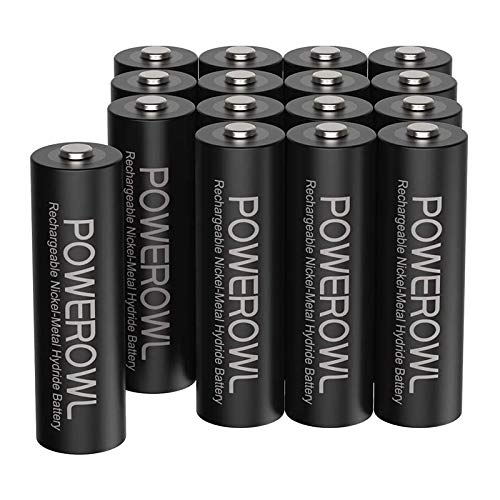
POWEROWL’s 16-pack leads this roundup on stated capacity: the maker rates each AA cell at 2,800 mAh, above even eneloop pro, and rates the cells for up to 1,200 recharge cycles. That pairing suits households that cycle batteries constantly through garden lights, electronics, and remotes: the high-capacity mid-range option here.
The cells are low self-discharge NiMH, and POWEROWL states they are pre-charged at the factory using wind-generated energy and reach top performance after three to five full charge cycles. One caution: recent listing crawls showed no featured offer on this exact pack, so confirm current availability before counting on it for a kit refresh. No charger is included.
Specs
- Pack configuration: 16 AA cells
- Chemistry: NiMH, low self-discharge; 1.2 volts
- Capacity: 2,800 mAh; cycle life: up to 1,200 recharges (maker-rated)
- Pre-charged using wind energy; reaches top performance after 3 to 5 full cycles
- Charger not included
EBL Rechargeable Batteries and 8-Bay Charger Combo, 4 AA and 4 AAA

Every other pick in this guide assumes you already own a charger. The EBL combo removes that assumption: the box pairs an 8-bay smart charger (model C9041UW) with four AA cells rated at 2,800 mAh and four AAA cells rated at 1,100 mAh, covering the two sizes flashlights, headlamps, and radios use most.
The charger accepts one to eight AA or AAA NiMH or Ni-CD cells and charges each slot independently, with a minus delta-V cut-off that switches to trickle charging to prevent overcharge, plus short-circuit and reverse-polarity protection, all as the maker describes them. Two USB outputs rated at 5 volts and 2 amps can charge a phone or tablet while cells charge. One flag: recent listing crawls of this combo showed no featured offer, so verify availability before ordering.
Specs
- Pack configuration: 4 AA plus 4 AAA cells, with 8-bay charger (model C9041UW)
- AA capacity: 2,800 mAh; AAA capacity: 1,100 mAh (maker-rated)
- Chemistry: NiMH cells; charger also supports Ni-CD
- Charger: 8 independent slots; input 100 to 240 volts AC
- Output: 1.2 volts at 1,000 mA (AA) and 500 mA (AAA), plus two USB outputs at 5 volts, 2 amps; minus delta-V cut-off
How to choose
Start with the two numbers makers publish for every cell: capacity and cycle life. Capacity, in milliamp hours, describes how much energy a cell holds per charge, so higher figures suit high-drain devices. Cycle life describes how many times the maker rates the cell to be recharged. The two figures trade against each other, and a kit usually wants both: long-cycle cells for stored gear, high-capacity cells for weekly gear.
Next, look for the words low self-discharge. Standard NiMH cells can lose their charge in months on a shelf, defeating the purpose of a stored kit. Low self-discharge cells are rated to hold most of their charge for a year or far longer, and every pick here is that type. Check the storage figure the maker publishes, then set a top-off schedule shorter than it.
Charging matters as much as the cells. An individual-channel smart charger, like the one in the EBL combo, charges each cell on its own circuit and cuts off per cell, treating mixed sets better than a basic timer charger. If you buy cells alone, confirm your charger supports NiMH. Finally, mind voltage: NiMH cells are 1.2 volts, slightly below a fresh alkaline’s 1.5 volts, and a few devices with strict cut-offs may report low battery early. Name the exact pack configuration when you order, because each pack size carries its own listing.
Who should skip
Skip rechargeables for smoke and carbon monoxide alarms. Those devices are designed around sealed 10-year batteries or specific alkaline cells, and should be left exactly as the alarm maker specifies. The same caution applies to any device whose manual names a required battery type.
Skip NiMH if your gear genuinely needs a full 1.5 volts to run correctly. A small number of devices shut down early on 1.2-volt cells; for those, constant-voltage 1.5-volt lithium rechargeables exist, but they need a dedicated charger and are a different purchase.
Skip bulk packs if you only run two or three devices. A 24-pack that sits unused for years wastes the format’s advantage; a single 4-pack of long-storage cells plus a small charger is the better kit. And skip every pick here if you will not keep a charging routine at all: households that never top off are better served by long-dated disposable lithium cells.
FAQ
Can I use these NiMH batteries in any device that takes AA batteries?
Almost any device that accepts AA cells will run on 1.2-volt NiMH, including flashlights, radios, remotes, and toys. A few devices with strict voltage thresholds may show a low-battery warning early. Follow the device manual where it specifies a battery type, and never substitute cells in smoke or carbon monoxide alarms.
How often should I recharge batteries stored in an emergency kit?
Follow the storage figure the maker publishes for your cells and top off well inside it. For long-retention cells such as standard eneloop, a check once or twice a year is a practical routine; for packs with a one-year retention claim, top off at least twice a year so cells are never near empty when a storm arrives.
Do I need a special charger for these batteries?
You need a charger made for NiMH cells in the sizes you own. A smart charger with independent channels and per-cell cut-off is the better choice for mixed sets, and it is the type included in the EBL combo here. Never charge NiMH cells on a lithium-only charger, and never try to recharge disposable alkaline batteries.
Why do some packs claim 2,100 cycles and others only 400?
Each maker’s rating method differs, and the two figures trade against each other: cells built for maximum cycles usually carry moderate capacity, while high-capacity cells are rated for fewer cycles. Treat the figures as a guide to each product’s intended role.
Final verdict
For a set-and-forget emergency kit, the standard Panasonic eneloop AA 4-pack is the safest foundation: its maker-rated 2,100 cycles and 10-year storage claim are unmatched here. Add eneloop pro cells for high-drain gear you use every week, and choose the Amazon Basics 24-pack or POWEROWL 16-pack when the job is stocking many devices at a mid-range or budget tier. If you own no charger yet, the EBL 8-bay combo is the one-box answer covering AA and AAA together. Label the purchase date on the pack and set a twice-yearly top-off reminder, and your lights and radios will be ready when the power goes out.