Key takeaways
- Find the best rated electric start generators for home backup and RV use, with push-button and remote start, dual-fuel choice, and transfer-switch outlets.
The best rated electric start generators remove the hardest part of backup power: getting the engine going. Instead of pulling a recoil cord in the dark, in cold weather, or with a sore shoulder, you press a button or use a remote key fob and the engine turns over on its own. That difference matters most during a storm outage, at a remote job site, or at a campsite after a long drive.


The quick answer is that the Westinghouse WGen9500DF is the strongest all-round choice for most homes, because it pairs remote electric start with dual-fuel operation, a 50-amp outlet, and transfer-switch readiness. If you want quieter inverter power for sensitive electronics, the Champion 201407 is the better fit. If you want the largest output and the longest listed run time here, the DuroMax XP12000HX leads on both. The right pick depends on how much power you need, which fuels you can store, and whether you plan to connect through a transfer switch or run extension cords.
Every generator in this guide has electric start as a core feature, plus a recoil backup, so a flat battery does not leave you without power. All five are fuel-powered portable generators built for home backup, RV use, or work sites, and every one is listed on Amazon US.
Quick Picks
Our Short List of 3
All 5 Picks at a Glance
| Product | Specs | Action |
|---|---|---|
| 1. Westinghouse WGen9500DF (B07Q1DLKBG) | Check price on Amazon | |
| 2. Champion 201302 Dual Fuel Generator with CO Shield (B0DLQ63Y6S) | Check price on Amazon | |
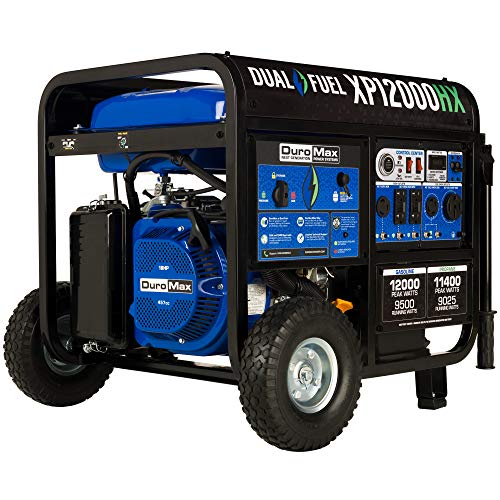 3. DuroMax XP12000HX Dual Fuel Portable Generator (B086Z49LJ5) | Check price on Amazon | |
 4. Westinghouse WGen9500TFc Tri-Fuel Portable Generator (B0BVGSFCPG) | Check price on Amazon | |
 5. Champion 201407 11,000-Watt Inverter Generator with CO Shield (B0CYR4XHLY) | Check price on Amazon |
How to Choose
Starting Watts and Running Watts
Starting watts are the short surge a generator can supply when a motor starts, such as a refrigerator compressor, a well pump, or an air conditioner. Running watts are what it can sustain. A generator that looks large enough on running watts alone can still stall if several motors start at the same time.
Add up the running watts of the appliances you plan to run together, then add the largest starting surge on top. Leave a margin, and remember that a generator should not run at full load for hours on end. In this roundup, the mid-size models suit a fridge, a freezer, lights, a sump pump, and small electronics, while the larger models leave room for a well pump or a window air conditioner as well.
Push-Button Start, Remote Start, and Recoil Backup
Push-button start means a button on the control panel, with a battery doing the cranking. Remote start adds a key fob, so you can start or stop the generator from inside the house without walking out in bad weather.
Every model here also keeps a recoil pull cord as a backup. That matters because the electric start battery needs to stay charged, and a battery can lose charge during months in storage. Keep the battery on a maintenance charge between outages, and learn where the recoil cord is before you need it.
Fuel Type and Run Time
Gasoline is widely available and gives the highest listed output on most dual-fuel models, but it goes stale in storage and needs stabilizer or rotation. Propane stores for years without degrading, but it usually produces slightly lower output than gasoline on the same generator. Natural gas, where a home has a gas line, removes refueling altogether, but it gives the lowest output of the three fuels on a tri-fuel model.
Run time figures are listed at a stated load, usually a quarter or half load. Plan your fuel around an overnight outage at minimum. If you expect outages lasting days, a dual-fuel or tri-fuel model gives you more options when one fuel runs low.
Inverter Power or Conventional Power
Conventional open-frame generators, which make up most of this roundup, are built for raw output and transfer-switch home backup. They are louder and heavier than inverter models. Inverter generators, such as the Champion 201407 in this guide, produce cleaner power that is better suited to sensitive electronics, laptops, and medical devices, and they are usually quieter at light loads.
Outlets and Transfer-Switch Readiness
Household duplex outlets handle extension cords and small appliances. An RV-ready outlet fits a camper power cord directly. A twist-lock outlet, usually labelled L14-30R for 30 amps or 14-50R for 50 amps, connects to a transfer switch or an inlet box, which is how a portable generator safely powers chosen circuits in a house.
If you plan to use a transfer switch, match the generator outlet to the switch or inlet rating, and have the switch installed by a licensed electrician. Never connect a generator directly to home wiring without a transfer switch or an approved interlock, and never backfeed through a household outlet. If you plan to run only extension cords, count the outlets and confirm that the total load stays within the generator running watts.
Noise Level and Weight
Noise is measured in decibels from a set distance, commonly 23 feet. Open-frame models in this roundup are listed around 74 decibels, which is comparable to a vacuum cleaner and is audible across a yard. Inverter models are listed lower, around 64 decibels for the Champion inverter here, which is noticeably quieter and easier to live with overnight.
Weight matters because these are not carry-style generators. The models here weigh roughly 209 to 222 pounds, so they rely on wheel kits and handles rather than lifting. Check that the wheel kit is included and that you have a clear path from storage to the spot where you will run the generator.
Carbon Monoxide Safety and Automatic Shutdown
Every fuel-powered generator produces carbon monoxide, a gas that cannot be seen or smelled and can be deadly in an enclosed space. Run a generator outdoors only, at least 20 feet from any occupied building, with the exhaust pointed away from doors, windows, and vents. Never run one in a garage, a shed, or a basement, even with the door open.
Several models in this guide include a carbon monoxide sensor or shutdown system, such as CO Shield on the Champion models or a CO sensor on the Westinghouse tri-fuel model. These systems shut the engine down if carbon monoxide builds up near the unit, but they are not a substitute for safe placement.
The Best Rated Electric Start Generators Reviewed
1. Westinghouse WGen9500DF (B07Q1DLKBG)
The Westinghouse WGen9500DF is the best overall pick for home backup because it combines remote electric start, dual-fuel operation, transfer-switch readiness, and enough output for a fridge, a freezer, lights, a sump pump, and more at the same time. On gasoline it produces 12,500 starting watts and 9,500 running watts, and on propane it produces 11,200 starting watts and 8,500 running watts. The 457cc four-stroke engine runs for up to 12 hours on a 6.6-gallon fuel tank.
Starting is a push button on the panel or a remote key fob, with a recoil cord as backup. The panel includes two GFCI household outlets, a transfer-switch-ready L14-30R 30-amp outlet, and an RV-ready 14-50R 50-amp outlet, all with rubber covers. A digital display shows voltage, frequency, and lifetime hours, and the unit has automatic low oil shutdown. The included wheel kit and handle help move a unit that weighs about 210 pounds, and the listed sound level is 74 decibels.
Who it suits: homeowners who want a single generator for outage backup through a transfer switch, with the option to run on propane when gasoline is hard to find. Who should skip it: anyone who needs quiet inverter power for sensitive electronics, or who wants natural gas operation.
2. Champion 201302 Dual Fuel Generator with CO Shield (B0DLQ63Y6S)
The Champion 201302 is a strong dual-fuel alternative to the Westinghouse pick, with a similar output range and a carbon monoxide shutdown system built in. On gasoline, the 459cc engine produces 11,500 starting watts and 9,200 running watts, and it runs for up to 10 hours at half load on a 7.7-gallon tank. On propane, it produces 10,350 starting watts and 8,280 running watts, running for up to 5 hours at half load on a 20-pound propane tank.
Electric start uses a rocker switch on the panel, with a battery included and Cold Start Technology for easier starts in cold weather. The Intelligauge display tracks voltage, frequency, and run-time hours. Outlets include a 120/240V 30-amp locking outlet, a 120/240V 38-amp outlet, and two GFCI household duplex outlets, all with covers. The unit weighs about 209 pounds with a wheel kit included.
Who it suits: households that want dual-fuel flexibility and a built-in carbon monoxide shutdown system, with cold-weather starting help. Who should skip it: buyers who want remote start from inside the house, because this model starts from the panel rather than from a key fob.
3. DuroMax XP12000HX Dual Fuel Portable Generator (B086Z49LJ5)
The DuroMax XP12000HX is the largest-output model in this roundup and the best choice when the load list is long. It produces 12,000 starting watts and 9,500 running watts on gasoline, with a 460cc engine and an 8.3-gallon tank. The listed run time reaches up to 19 hours, the longest in this guide, and the front-facing panel lets you change fuel type in seconds. It runs on gasoline or propane, with CO Alert protection.
Starting is a push button, with recoil backup, and the battery is included. The power panel includes four GFCI household outlets, a 120V 30-amp outlet, a 120/240V 30-amp twist-lock outlet, and a heavy-duty 120/240V 50-amp outlet, making it transfer-switch ready. The unit has a digital display, a foldable handle, and a wheel kit, and it weighs about 222 pounds. DuroMax backs it with a 5-year manufacturer warranty, the longest in this roundup.
Who it suits: larger homes and workshops, and anyone who needs to run a well pump, central air conditioning, or several large appliances during an outage. Who should skip it: buyers who need a quiet generator for a campsite or a small RV, because this is a large open-frame unit.
4. Westinghouse WGen9500TFc Tri-Fuel Portable Generator (B0BVGSFCPG)
The Westinghouse WGen9500TFc takes the same 9,500 running-watt platform as the WGen9500DF and adds a third fuel: natural gas. On gasoline it produces 12,500 starting watts and 9,500 running watts, on propane 11,200 starting watts and 8,500 running watts, and on natural gas 9,500 starting watts and 7,500 running watts. The 457cc engine runs for up to 12 hours on a 6.6-gallon gasoline tank.
Remote electric start comes from a push button or the included key fob, with recoil backup. The panel includes two GFCI household outlets, a transfer-switch-ready L14-30R outlet, and an RV-ready 14-50R outlet. A carbon monoxide shutdown system, automatic low oil shutdown, and a digital hour meter are included, and the unit has a 3-year limited warranty. The package includes a propane hose, a natural gas hose with adapter, oil, a funnel, a tool kit, and a battery charger.
Who it suits: homeowners with a natural gas line who want the longest possible outage coverage without refueling. Who should skip it: buyers who do not have a natural gas connection, because the dual-fuel version covers the same gasoline and propane output more simply.
5. Champion 201407 11,000-Watt Inverter Generator with CO Shield (B0CYR4XHLY)
The Champion 201407 is the quiet inverter pick in this roundup, and the best choice when noise and clean power matter as much as output. The 459cc engine with electric start and an included battery produces 11,000 starting watts and 9,000 running watts, with up to 15 hours of run time on a full tank of gasoline. The listed sound level is 64 decibels from 23 feet, noticeably quieter than the open-frame models here.
Starting is by push button or wireless remote, using the included remote key fob, so you can start the generator from inside an RV or a house without stepping outside. Cold Start Technology helps in cold weather. As an inverter generator, it produces power suited to sensitive electronics, and CO Shield monitors carbon monoxide and shuts the engine down if levels rise. The unit is built for home backup and RV use, with a wheel kit and a handle.
Who it suits: RV owners, campers, and homeowners who run laptops, televisions, and other sensitive electronics during an outage. Who should skip it: buyers who need a 50-amp transfer-switch outlet as the main connection for whole-home backup, or who need the highest surge output for a large central air conditioner.
What to Check Before You Buy
Start with a load list, not with a wattage headline. Write down every appliance you expect to run at the same time, note the running watts and the starting watts for each motor-driven appliance, and compare the total with the running watts of the generator. If the total is close to the limit, step up a size or stagger loads.
Next, check the fuel you can actually store and buy. Gasoline needs rotation and stabilizer, propane needs tanks and a regulator hose, and natural gas needs a proper line connection. A tri-fuel model is only useful if you can use all three fuels safely, and a dual-fuel model is only useful if you keep both fuels on hand.
Check the outlets against your plugs and your transfer switch, and buy extension cords rated for outdoor use and for the load they will carry. Confirm that the generator includes a wheel kit, a battery, a battery charger, oil, and a funnel, or budget for the items that are not included. Run the unit briefly every few months so the battery stays charged.
Finally, plan the running location before the outage. Choose a flat outdoor spot at least 20 feet from the house, away from doors, windows, and vents, with the exhaust pointed away from people and buildings. Store the generator in a dry place, and make sure everyone in the household knows never to run it indoors.
FAQ
Do electric start generators still have a pull cord?
Yes, every model in this guide has a recoil pull cord as well as electric start. The pull cord is a backup for a flat or disconnected battery, and it is worth learning how to use it before an outage. Keep the battery charged with the included charger, and check the battery connection when you do a regular start-up check.
How long can an electric start generator run on one tank?
Run time depends on tank size, engine size, and load. The models here list run times from up to 10 hours at half load to up to 19 hours on a full tank, with smaller loads lasting longer than larger loads. Plan fuel for the load you actually run and keep extra fuel safely stored.
Can I run an electric start generator on propane only?
Dual-fuel and tri-fuel models can run on propane, and propane is a good choice for long storage because it does not go stale the way gasoline does. Output on propane is usually slightly lower than on gasoline, so check the propane running watts before you size a load.
Is an inverter generator better than a conventional generator?
It depends on the use. Inverter generators are quieter and produce power better suited to sensitive electronics, which makes them a good fit for RV use, camping, and running laptops and televisions. Conventional open-frame generators give more output for the size and are better suited to whole-home backup through a transfer switch.
Do I need a transfer switch for an electric start generator?
You need a transfer switch or an approved interlock if you want the generator to power circuits in your home wiring. Extension cords alone do not need a transfer switch, but they only power the appliances plugged into them. Have a transfer switch installed by a licensed electrician, and never connect a generator to home wiring without one.
Bottom Line
The best rated electric start generators in this guide all start with a button or a remote, and all keep a pull cord as backup, so the choice comes down to output, fuel, noise, and outlets. Choose the Westinghouse WGen9500DF for the best all-round home backup, the Champion 201302 for dual-fuel value with carbon monoxide shutdown, the DuroMax XP12000HX for the largest loads and the longest listed run time, the Westinghouse WGen9500TFc if you have a natural gas line, or the Champion 201407 inverter if quiet operation and clean power matter most. Whichever model you choose, size it from a real load list, keep its battery charged, store fuel safely, and run it outdoors only, at least 20 feet from the house.
Disclosure: As an Amazon Associate, we may earn from qualifying purchases.