Key takeaways
- Compare the best kerosene heaters for power outages, with maker-stated BTU output, tank size, runtime and safety features for small and large rooms.
- Top Pick: Sengoku HeatMate HMN-110
- Runner-up: Sengoku HeatMate HMC-23K
- Also consider: Dyna-Glo WK95C8
When winter storms cut the power, a wick-style kerosene heater keeps working with no outlet, no gas line and no batteries beyond a small igniter pack. That independence is why these heaters remain a staple of outage kits. This guide compares five current models: a compact radiant heater for one room, three large convection heaters for open living areas, and one forced-air unit built for ventilated work spaces rather than living rooms.
Every output, tank size, runtime and coverage figure below is the maker’s own published number, taken from product pages and owner’s manuals, and each figure is labeled as maker-stated. Kerosene heaters are unvented combustion appliances, so the manuals matter as much as the specs: they require fresh air while running, water-clear or red-dyed 1-K kerosene only, and a carbon monoxide detector in the space. Some jurisdictions restrict or prohibit indoor kerosene heater use, so check your local rules before buying.
As an Amazon Associate, we earn from qualifying purchases.
Quick answer
For most homes, the Sengoku HeatMate HMN-110 is the easiest outage heater to live with: 10,000 BTU of radiant heat, a lift-out 1.2-gallon tank and up to 14 hours per fill, per Sengoku. For a large open room, step up to a 23,000 to 23,800 BTU convection model from Sengoku or Dyna-Glo. The Mr. Heater forced-air unit suits ventilated workshops only and needs electricity.
Sengoku HeatMate HMN-110

The HMN-110 is the budget-tier pick and the smallest heater here. It is a radiant design, so instead of warming a whole room evenly it projects heat forward from a reflector, which suits one occupied room during an outage. Sengoku rates it at 10,000 BTU per hour for areas up to 400 square feet. Its 1.2-gallon tank lifts out of the cabinet, so you carry only the tank outside to fill it, which matches the refueling routine the manual describes. Sengoku’s product page gives up to 14 hours of heat per tank, while the owner’s manual lists 14.5 to 16 hours of continuous combustion; either way, it is the longest-running heater in this group relative to its size. Lighting is push-button, with a battery igniter, so it starts without matches or power. This is the model to shortlist for a bedroom or den you plan to shelter in, provided the room meets the manual’s fresh-air rule.
Specs
- Heat output: 10,000 BTU per hour (maker-stated)
- Type: Radiant wick heater with reflector
- Tank capacity: 1.2 gallons, removable cartridge style
- Runtime: Up to 14 hours per tank (maker’s product page); manual lists 14.5 to 16 hours
- Coverage: Up to 400 square feet (maker-stated)
- Ignition: Push-button battery igniter; manual lists four C batteries
- Safety features: Automatic shut-off and tip-over switch, per the maker; UL listed per the maker
Sengoku HeatMate HMC-23K
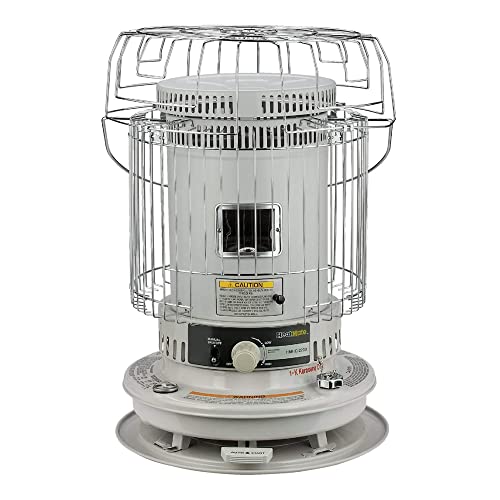
The HMC-23K is Sengoku’s premium-tier convection model and the output leader among the wick heaters here. Sengoku rates it at 23,500 BTU per hour for areas up to 1,000 square feet, with heat radiating in a full circle from the round burner, which makes it better suited to an open-plan living area than the directional HMN-110. The 1.9-gallon tank and a maker-stated runtime of about 12 hours mean fewer trips outside to refuel during a long outage. It uses automatic battery ignition and carries an automatic shut-off, per Sengoku. Some retailer listings describe this class with a 900-square-foot figure, so treat coverage as a headline rating, not a promise for a drafty space. If your outage plan is to keep one big room livable rather than heat a single small room, this is the Sengoku to compare against the two Dyna-Glo models below.
Specs
- Heat output: 23,500 BTU per hour (maker-stated)
- Type: Convection wick heater, 360-degree heat pattern
- Tank capacity: 1.9 gallons
- Runtime: About 12 hours per tank (maker-stated)
- Coverage: Up to 1,000 square feet (maker-stated)
- Ignition: Automatic battery ignition
- Safety features: Automatic shut-off, per the maker
Dyna-Glo WK95C8

The WK95C8 is Dyna-Glo’s mid-range convection entry, rated by the maker at 23,800 BTU per hour for areas up to 1,000 square feet. Like the HMC-23K it heats in a 360-degree pattern from a 1.9-gallon tank, and GHP Group, which makes Dyna-Glo, gives a burn time of 8 to 12 hours per tank depending on wick setting. It adds convenience features the Sengoku big heater does not emphasize: automatic ignition, a one-touch shutoff, a tip-over shutoff and a fuel gauge, all maker-stated. One caution: the listing title uses 23,800 BTU while some maker detail text rounds the same heater to 23,000 BTU per hour, so treat it as a peer of the other big convection models, not a step up. For buyers who want the large-room class with a fuel gauge and one-touch shutoff, this is the natural alternative to the HMC-23K.
Specs
- Heat output: 23,800 BTU per hour (maker-stated)
- Type: Convection wick heater, 360-degree heat pattern
- Tank capacity: 1.9 gallons, removable
- Runtime: 8 to 12 hours per tank (maker-stated)
- Coverage: Up to 1,000 square feet (maker-stated)
- Ignition: Automatic ignition
- Safety features: Tip-over shutoff, one-touch shutoff and fuel gauge, per the maker
Dyna-Glo RMC-95C6B

The RMC-95C6B is the second Dyna-Glo convection heater here, in a boxy cabinet format rather than the round WK95C8 profile. GHP Group’s manual rates it at a maximum of 23,000 BTU per hour, with an integral 1.9-gallon tank, maximum fuel consumption of 0.167 gallons per hour and approximately 8 to 12 hours of continuous combustion per fill. The maker rates it for areas up to 1,000 square feet. Its distinguishing features are a cool-touch exterior and tip-over protection, both maker-stated, which may matter in a busy room where people pass close to the heater. Ignition is an automatic battery system; the listing data notes two C batteries for the igniter. In tier terms it sits in the mid-range alongside the WK95C8, and the choice between the two Dyna-Glo models comes down to cabinet style and the WK95C8’s extra gauge and shutoff features rather than any real difference in heat.
Specs
- Heat output: 23,000 BTU per hour maximum (maker-stated)
- Type: Convection wick heater
- Tank capacity: 1.9 gallons, integral
- Runtime: Approximately 8 to 12 hours per tank (manual-stated)
- Coverage: Up to 1,000 square feet (maker-stated)
- Ignition: Automatic battery ignition
- Safety features: Tip-over protection and cool-touch exterior, per the maker
Mr. Heater MH75KTR
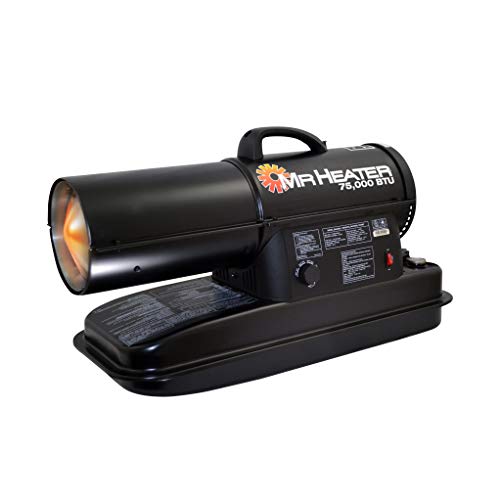
The MH75KTR, sold under stock number F270270, is a different class of appliance: a direct-fired forced-air heater rated at 75,000 BTU per hour for up to 1,875 square feet, per Mr. Heater. Its 6-gallon tank and stated burn rate of 0.55 gallons per hour give a maker-stated runtime of approximately 11 hours. Two limits define it. First, it needs 115-volt electricity for its fan and direct-spark ignition, so it is useless in an outage unless a generator is running. Second, Mr. Heater states the intended use is temporary heating of buildings under construction, alteration or repair, and the manual requires ventilation openings near the floor and ceiling. Treat it as a premium-tier workshop, barn or job-site heater for storm cleanup and frozen-pipe work in ventilated spaces, never as a living-room outage heater.
Specs
- Heat output: 75,000 BTU per hour (maker-stated)
- Type: Forced-air, direct-fired; requires 115-volt power
- Tank capacity: 6 gallons
- Runtime: Approximately 11 hours per tank (maker-stated)
- Coverage: Up to 1,875 square feet (maker-stated)
- Ignition: Direct spark, continuous, with solid-state safety control
- Safety features: Solid-state safety control, per the maker; manual requires dedicated ventilation openings
How to choose
Start with heater type. Radiant models like the HMN-110 aim heat at people and suit one small room. Convection models heat air in a full circle and suit open living areas. Forced-air models move a lot of heat fast but are loud, need electricity and belong in ventilated work spaces.
Size by the maker’s coverage rating, then check the manual’s air rule before you commit: the manuals for these heaters call for at least 200 cubic feet of room air for each 1,000 BTU per hour of output, and if the room is smaller than that, the door to the next room stays open or a window is opened at least an inch. A heater that is too large for the room is a ventilation problem, not a bonus.
Plan fuel honestly. Runtime figures are maker-stated at typical settings, and a multi-day outage can burn several gallons. Store kerosene only in a clearly marked container made for kerosene, outside living areas, and refuel only outdoors, only when the heater is off and cool, exactly as every manual here directs. Finally, budget for the unglamorous parts: a carbon monoxide detector for the room, spare wicks, and the igniter batteries each model lists.
Who should skip
Skip kerosene entirely if your city, state, lease or insurer prohibits indoor kerosene heaters; several jurisdictions do, and no heater in this guide overrides those rules. Skip it if you cannot store fuel properly, will not run a carbon monoxide detector, or want heat you can leave running while you sleep, since the manuals say never to leave an operating heater unattended. Small sealed rooms and bathrooms are also out, per the manuals. And if your space is a finished living area with no tolerance for combustion odor at startup and shutdown, a different heat source will suit you better.
FAQ
Can a kerosene heater run overnight while I sleep?
The manuals say no. Every maker here instructs users never to leave an operating heater unattended, and federal safety guidance gives the same advice. Run the heater while you are awake and in the room, keep the required fresh air coming in, and keep a carbon monoxide detector in the space.
What fuel do these heaters actually need?
Water-clear or red-dyed 1-K kerosene only, per the manuals. Never substitute gasoline, diesel, paint thinner or any other fuel in a wick heater; the manuals warn that the wrong fuel can cause fire or explosion. The Mr. Heater manual names additional approved fuels for its forced-air line, but its certification is for 1-K kerosene, so follow the manual for the exact model you own.
How much ventilation does a kerosene heater need?
The wick-heater manuals use the same rule: at least 200 cubic feet of room air per 1,000 BTU per hour, with a door to an adjoining room open or a window opened at least an inch when the room falls short. The Mr. Heater manual separately requires openings near the floor and near the ceiling to the outdoors. These are maker-stated minimums, not guarantees; a carbon monoxide detector is still required equipment.
Do these heaters work during a power outage?
The four wick heaters do: they burn without electricity and light from small battery igniters. The Mr. Heater MH75KTR does not, because its fan and ignition run on 115-volt power. If outage use is the whole point, choose a wick model and keep spare igniter batteries with it.
Final verdict
For a typical outage kit, the Sengoku HeatMate HMN-110 is the sensible default: modest output, the longest stated runtime per gallon, and a lift-out tank that makes safe refueling easy. Households sheltering in one large room should compare the Sengoku HMC-23K with the Dyna-Glo WK95C8 and RMC-95C6B, which trade blows on features rather than output. Reserve the Mr. Heater MH75KTR for ventilated work spaces with power available. Whichever model you choose, the manual’s rules on fuel, fresh air and supervision are part of the product, and they are not optional.