Key takeaways
- Compare five hard-sided coolers for power outages, with maker-stated ice retention, capacity, and the features that keep food cold for days.
- Top Pick: YETI Tundra 45 Cooler, White
- Runner-up: RTIC 52 Quart Ultra-Light Wheeled Cooler, White and Grey
- Also consider: Igloo BMX 52 Quart Cooler, Carbonite Gray and Blue
When a storm knocks out electricity, the refrigerator clock starts ticking. USDA-style food safety guidance says a closed refrigerator holds safe temperatures for roughly four hours; after that, perishable food needs another cold home. A well-insulated hard-sided cooler loaded with ice is the simplest backup: no fuel, no power draw, and no moving parts to fail during a multi-day outage.
The five coolers below were chosen for outage duty specifically, not beach trips: thick insulation, lids that seal tightly, drains that manage meltwater without dumping the cold, and capacity for several days of household food. Ice-retention figures are maker-stated claims gathered under each brand’s own conditions, so treat them as planning estimates rather than promises, and confirm food temperatures with an inexpensive cooler thermometer.
As an Amazon Associate, we earn from qualifying purchases.
Quick answer
For most households, the Igloo BMX 52 Quart is the outage sweet spot: thick foam walls, a maker-stated five days of ice retention, and an empty weight one person can carry. The YETI Tundra 45 is the premium pick for the longest, roughest outages, while the Coleman 70 Quart Xtreme 5 is the budget choice when sheer capacity matters most.
1. YETI Tundra 45 Cooler, White
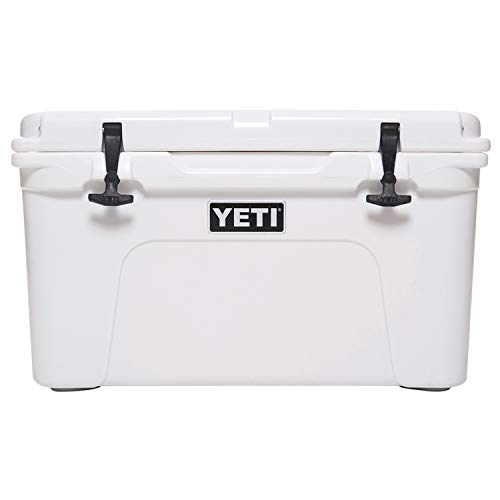
The Tundra 45 is the premium benchmark in this group. Its rotomolded shell is built like a kayak hull, and the walls carry up to three inches of pressure-injected polyurethane foam, with a freezer-style gasket that seals the lid against warm air. For outage use, that construction means the box tolerates being dragged around a garage, sat on, and opened repeatedly without the lid warping or the seal giving up.
YETI notably does not publish a day-count ice-retention claim for the Tundra line, so there is no headline number to quote here. What the maker does state is the insulation thickness and the recommended two-to-one ice-to-contents ratio: fill it correctly and it is designed to hold ice for days. The trade-offs are weight and tier. At 23 pounds empty, it is heavy before any ice goes in, and its usable volume runs smaller than the 45-quart name suggests once ice is loaded.
Specs
- Capacity: 45 quarts; up to 26 cans with a two-to-one ice-to-contents ratio (maker-stated)
- Insulation: PermaFrost pressure-injected polyurethane foam, up to 3 inches in walls and lid
- Ice retention: no day count published by the maker
- Dimensions: 25.75 x 16.13 x 15.38 inches
- Weight: 23 pounds empty
- Drain and latches: Vortex screw-in drain plug; T-Rex heavy-duty rubber lid latches; ColdLock freezer-style gasket
2. RTIC 52 Quart Ultra-Light Wheeled Cooler, White and Grey

RTIC takes the opposite approach to YETI: instead of rotomolding, the Ultra-Light series is injection-molded around closed-cell foam insulation up to two and a half inches thick. RTIC states the design is more than thirty percent lighter than a rotomolded cooler of similar capacity, which matters when a loaded cooler has to move from garage to kitchen during an outage. The wheeled version adds all-terrain wheels and a tow handle, so one person can move 52 quarts of food and ice without a dead lift.
The maker states up to six days of ice retention for this wheeled model, again under the brand’s own test conditions. Silicone T-latches pull the lid down onto its gasket, and molded tie-down slots let you strap the cooler in a truck bed if you are evacuating rather than sheltering in place.
Specs
- Capacity: 52 quarts; 78 cans (maker-stated)
- Insulation: closed-cell foam, up to 2.5 inches, in an injection-molded body
- Ice retention: up to 6 days (maker-stated)
- Dimensions: 29 x 18.75 x 18.25 inches
- Weight: 28.5 pounds empty
- Drain and latches: drain plug; silicone T-latches; all-terrain wheels with tow handle
3. Igloo BMX 52 Quart Cooler, Carbonite Gray and Blue
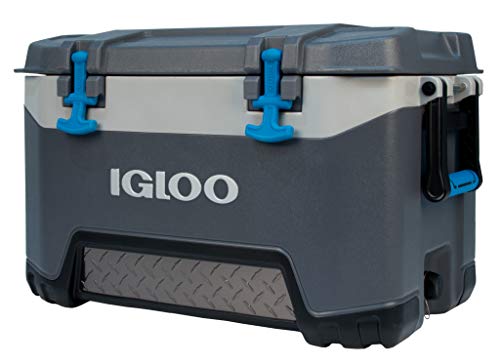
The BMX 52 is the mid-range workhorse of this roundup. Igloo blow-molds the body with a reinforced base, fills the walls with extra-thick foam, and adds an insulated lid, a combination the maker rates at up to five days of ice retention. The Cool Riser base lifts the box off hot ground so heat does not conduct straight through the floor during a summer outage.
At just over 16 pounds empty, it is the lightest full-size pick here, yet it still gets the details right for outage duty: rubberized T-latches that genuinely compress the seal, stainless hardware that will not rust in a damp basement, and a threaded drain plug that accepts a garden hose so you can drain meltwater without tipping a loaded box. For a household buying one cooler primarily as outage insurance, this is the easiest recommendation in the group.
Specs
- Capacity: 52 quarts; 83 cans (maker-stated)
- Insulation: extra-thick foam walls and insulated lid in a blow-molded body
- Ice retention: up to 5 days (maker-stated)
- Dimensions: 26.57 x 16.93 x 16.93 inches
- Weight: 16.34 pounds empty
- Drain and latches: threaded, garden-hose-compatible drain plug with tethered cap; rubberized T-latches; Cool Riser elevated base
4. Lifetime 90820 55 Quart High Performance Cooler, Grey

Lifetime’s 90820 is the quiet overachiever: a blow-molded polyethylene body with urethane foam insulation that the maker rates for up to seven days of ice retention, the longest claim in this group. That rating comes from Lifetime’s own testing, so real results vary with ambient heat and lid openings, but the thick walls and latches that compress the gasket are the right hardware for the job.
For outage storage, the useful touches are the drain spout for controlled meltwater removal and the rope handles with foam grips that stay manageable when the box is loaded. The 55-quart size splits the difference between the 45-quart YETI and the 70-quart Coleman, holding several days of refrigerated food for a small family without taking over a room. It sits in the mid-range tier, and its maker-stated retention makes it worth a close look if your outages tend to stretch toward a week.
Specs
- Capacity: 55 quarts; can count not published in the maker’s listing data
- Insulation: urethane foam in a blow-molded polyethylene body
- Ice retention: up to 7 days (maker-stated)
- Dimensions: not stated in the listing data reviewed
- Weight: not stated in the listing data reviewed
- Drain and latches: drain spout; rope handles with foam grips; gasket-sealed lid
5. Coleman 70 Quart Xtreme 5 Cooler

The Coleman Xtreme 5 is the budget pick and the biggest box here. Seventy quarts swallows the contents of most refrigerators, and Coleman states it holds up to 100 cans and keeps ice up to five days in temperatures as high as 90 degrees Fahrenheit. The insulation is polyurethane foam through the walls and lid, which Coleman markets as its Xtreme technology; the lid doubles as a seat, with a maker-stated support rating of up to 250 pounds.
There are compromises at this tier. The lid is hinged rather than latched, so it does not compress a gasket the way the T-latch models above do, and long outages demand disciplined ice management and minimal opening. A leak-resistant channel drain sheds meltwater without losing the cold mass of ice. If your typical outage lasts a day or two and capacity is the priority, this is the sensible spend; households facing week-long outages should step up to a latched, thicker-walled model.
Specs
- Capacity: 70 quarts; up to 100 cans (maker-stated)
- Insulation: Xtreme polyurethane foam in walls and insulated lid
- Ice retention: up to 5 days at temperatures up to 90 degrees Fahrenheit (maker-stated)
- Dimensions: not stated in the listing data reviewed
- Weight: not stated in the listing data reviewed
- Drain and latches: leak-resistant channel drain; hinged lid without latches; lid rated by the maker to support up to 250 pounds
How to choose
Start with capacity. A 45- to 55-quart cooler holds roughly three to five days of refrigerated essentials for a family of four once ice takes its share; the 70-quart Coleman suits larger households. Remember that ice displaces food: makers recommend a two-to-one ice-to-contents ratio for maximum retention, so buy a size up from your first instinct.
Next, weigh construction against your outage pattern. Rotomolded and thick foam-walled coolers with latching, gasketed lids hold ice longest and survive rough handling, which suits multi-day storm outages. Lighter designs trade some retention for carry weight, a fair exchange if local outages usually end within two days. Whatever the build, pre-chill the cooler with a sacrificial bag of ice, load food already cold, prefer block ice, and keep a thermometer inside. USDA-style guidance treats 40 degrees Fahrenheit or below as the safe zone for perishables, and the thermometer is the only way to know you are actually there.
Who should skip
Skip the cooler upgrade if your outages rarely outlast a few hours; an unopened refrigerator protects food for about four hours on its own, and a basic cooler you already own covers the rest. Skip these large models if you have no reliable ice supply or freezer space to make your own blocks, because retention claims assume a full ice load. Anyone storing temperature-sensitive medication should not rely on a passive cooler alone and should follow the medication maker’s storage guidance and their pharmacist’s advice instead. If you cannot lift 30 to 50 pounds, choose the wheeled RTIC or the light BMX and load the cooler where it will sit.
FAQ
How long does food stay safe in a cooler during an outage?
USDA-style public guidance says perishable food should be kept at 40 degrees Fahrenheit or below, and food held above that temperature for more than two hours should be discarded. A full, well-iced cooler opened sparingly can hold safe temperatures for days, but only a thermometer inside confirms it. When in doubt, throw it out; no cooler guarantees food safety.
How much ice should I put in?
Makers such as YETI recommend a two-to-one ice-to-contents ratio by volume for maximum retention. Block ice melts more slowly than cubes, so a practical mix is blocks or frozen water bottles on the bottom with cubes filling the gaps. Pre-chilling the cooler and the food before loading also helps the ice last longer.
Should I drain the meltwater or leave it?
Leave most of it. Cold meltwater surrounds the food, keeps temperatures even, and insulates better than the air that would replace it. Drain only when the water warms, when food packaging sits submerged, or when you need room for fresh ice, which is where a drain plug earns its place.
Is a bigger cooler always better for an outage?
No. Extra air space is the enemy of ice retention, because every opening exchanges cold air for warm. A half-empty 70-quart cooler can lose ice faster than a full 45-quart one. Match the size to the food you need to protect, and fill leftover space with extra ice or frozen bottles.
Final verdict
For outage insurance, buy for insulation and seal quality first, capacity second. The Igloo BMX 52 is the best all-around choice for most homes, pairing a maker-stated five days of ice with a weight anyone can manage. The YETI Tundra 45 is the premium pick for long, rough outages, the RTIC wheeled 52 suits anyone who cannot dead-lift a loaded box, the Lifetime 90820 offers the longest maker-stated retention in the mid-range, and the Coleman Xtreme 5 remains the budget answer when maximum capacity is the priority.