Key takeaways
- Computer chairs for lower back comfort compared: adjustable lumbar support, an inflatable bladder and breathable mesh builds from SIHOO, COLAMY and GABRYLLY.
Lower back discomfort at a desk usually builds quietly: hours in one position, a chair back that meets your spine in the wrong place, and support that cannot be moved to where your back actually curves. A chair cannot fix a back, and this guide makes no medical claims. What the right chair can do is mechanical — hold the natural curve of your lower spine instead of flattening it, let you shift position through the day, and be adjusted to your body rather than to an average one. The three chairs below were chosen because each takes a different, genuinely adjustable approach to lumbar support, and each was verified as a current Amazon US listing.


What lower back support actually means in a chair
The lumbar region of the spine curves inward, and a chair back that is flat or convex pushes against that curve in the wrong direction. Support means a pad, cushion or shaped section that fills the inward curve so your back rests against the chair instead of bracing itself. The mechanism matters more than the marketing word. The strongest designs let you change the support: move it up or down to meet your curve, change how firmly it presses, or both. A fixed moulded shape helps only the bodies it happens to match.
Beyond the lumbar mechanism, four adjustments decide how a chair treats your back across a working day. Seat height sets whether your feet rest flat with knees near a right angle. Seat depth decides whether the cushion edge presses behind your knees or leaves a small gap. Tilt with a lock lets you recline slightly and fix the angle, which changes the load on your lower back instead of holding one posture for hours. And armrests at the right height — or armrests that move out of the way — stop raised shoulders from feeding tension down into the back. Judge every chair, including these three, against that checklist.
The picks
SIHOO M18 Ergonomic Office Chair (ASIN: B07GNDDNMW)
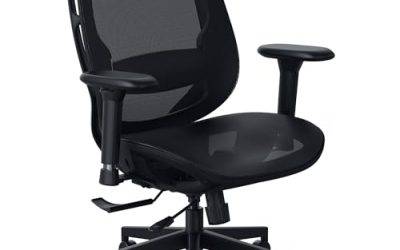
The SIHOO M18 is the mesh pick, and its lumbar support is built into the backrest as an adjustable pad you position against your own curve rather than a loose cushion that migrates during the day. The headrest adjusts for height and angle, the seat height adjusts to your desk, and the maker’s published description frames the chair as a four-point support design covering head, back, hips and arms, rated for users up to 150 kilograms.
Mesh changes the long-session equation in two ways. The backrest flexes slightly as you move, so support follows small shifts in posture instead of resisting them, and it does not trap heat the way padded upholstery does across a full workday. The trade-offs are the familiar mesh ones: the seat cushion is firmer than a padded executive chair, and armrest adjustment is basic. Set the lumbar pad to the curve of your lower back when you first sit down, then re-check it after a week of use — small height changes make a real difference to whether support feels like support. For most desk workers, this is the balanced default: adjustable where it counts, breathable, and sized for long days.
COLAMY High Back Executive Office Chair, Model 2822 (ASIN: B0BD7Z94ZQ)
The COLAMY 2822 brings the one lumbar mechanism neither mesh chair can copy: an inflatable bladder inside the backrest. You pump it up or let air out to change how firmly the support presses into your lower back, which means you tune pressure itself, not just position — and you can change it between morning and afternoon, when a tired back often wants something different from a fresh one.
Around that bladder, the 2822 is a padded executive chair: leather upholstery, a thick seat cushion, padded flip-up arms, and an adjustable tilt lock on a swivel base. The flip-up arms matter more than they look; they swing clear so you can sit close to the desk without the armrests dictating your posture. The honest trade-offs are heat and simplicity — leather traps more warmth than mesh, and the adjustment range outside the bladder is simpler than the SIHOO’s. Choose the COLAMY if mesh seats feel too firm, if your room suits an executive profile, or if the idea of dialling lumbar pressure up and down through the day is exactly what you have been missing.
GABRYLLY Ergonomic Office Chair (ASIN: B08PBP21RW)
The GABRYLLY is the big-and-tall option in this group, built around a wide seat cushion and a tall mesh back with an adjustable headrest. Its published specification covers the back-comfort checklist directly: integrated lumbar support in the backrest, a tilt range of 90 to 120 degrees with a tilt lock so you can fix a slightly reclined working angle instead of holding it with your legs, and flip-up armrests that park out of the way when you want to sit closer in.
The wide cushion suits larger frames, and it also suits anyone who changes position often, because there is room to shift without the seat edges dictating posture. Flip-up arms deserve the same mention here as on the COLAMY: fixed armrests at the wrong height are a common cause of raised shoulders and neck tension that refers downward, and arms that move clear remove that variable entirely. Assembly is the standard home-office process, and the mesh keeps the chair cooler than the leather option. Choose the GABRYLLY if you are tall or broad, if your current chair’s seat feels like it was sized for someone else, or if you want mesh breathability with a proper recline lock.
How the three compare
The cleanest way to choose is by the lumbar question you most want answered. If your question is “can I put the support exactly where my back curves, and leave it there”, the SIHOO M18 answers it with a positioned pad inside a breathable mesh back, and adds the coolest seat for long, warm days. If your question is “can I change how hard the support pushes as the day wears on”, only the COLAMY 2822 answers it, because its inflatable bladder adjusts pressure itself; it trades away breathability and some positional adjustment to do so. If your question is “will the chair fit me at all”, the GABRYLLY answers it with the wide seat, tall back and recline lock of a big-and-tall build, with integrated lumbar support shaped into the backrest.
Body size sorts the group further. Petite users sometimes find big-and-tall chairs leave the lumbar section sitting too high and the seat too deep, and are usually best served by the M18’s adjustability. Taller and broader users run into the opposite problem in standard chairs — a seat that ends mid-thigh and a backrest that stops at the shoulder blades — and the GABRYLLY is built precisely for them. The COLAMY sits between the two on size, and its padded build suits anyone who spends part of the day on calls, leaning back, rather than typing upright throughout.
Budget language needs care in this category, so in words only: all three sit in the accessible-to-middle part of the computer chair segment, well below the flagship ergonomic chairs whose names dominate office fit-outs. What the extra money buys at the top of the segment is finer adjustment — sliding seats, four-way arms, dynamic backs — not a different category of support. For most home desks, the adjustment that matters is the lumbar one, and each chair here spends its money there first.
Setting the chair up once it arrives
The best lumbar mechanism in this guide does nothing if the chair is set up by guesswork. Start with seat height: feet flat on the floor, knees at roughly a right angle, thighs level. Then set the lumbar support — pad height on the SIHOO and GABRYLLY, pressure on the COLAMY — so it meets the inward curve just above your belt line; if it pushes at your shoulder blades or your pelvis, it is in the wrong place. Adjust the armrests so your shoulders hang relaxed with elbows near a right angle, or flip them away if they force a shrug. Finally, unlock the tilt, lean back to a slight recline for reading and calls, and return upright for typing; a chair that lets you move is doing half the work.
Habits matter as much as hardware. Stand up and walk briefly every half hour or so, keep your screen at a height that lets your head sit level rather than tilted down, and keep your feet supported — a footrest if your desk height leaves them dangling. If back pain persists, worsens, or comes with numbness or weakness, that is a conversation for a clinician, not for a chair listing.
Frequently asked questions
Mesh or padded for lower back comfort? Both work when the lumbar support adjusts. Mesh breathes and flexes with movement; padded chairs feel softer at first contact. The COLAMY’s inflatable bladder is the strongest argument for the padded route.
What weight capacity should I look for? A capacity figure comfortably above your weight. The SIHOO M18 is rated to 150 kilograms, and the GABRYLLY is built as a big-and-tall chair; check the figure on any listing you consider.
Can a chair help an existing back problem? A chair can support posture and reduce the strain of long sitting, but it is furniture, not treatment. Persistent pain needs professional assessment.
How long does assembly take? All three chairs arrive flat-packed for home assembly with the standard bolt-together process; a second pair of hands makes the backrest step easier on every model in this class. Allow an unhurried hour, and keep the bolts only finger-tight until the backrest is aligned — the commonest cause of a chair that feels subtly twisted is one side of the back frame pulled fully tight before the other side is seated.
Verdict
Choose the SIHOO M18 for adjustable lumbar support in a breathable mesh chair that suits most bodies and most desks. Choose the COLAMY 2822 if you want to tune lumbar pressure itself with its inflatable bladder, in a padded executive build. Choose the GABRYLLY if you need the wide seat and tall back of a big-and-tall design with a proper tilt lock. All three were verified as current Amazon US listings at the time of writing; confirm the colour and configuration on the product page before ordering.
Disclosure: As an Amazon Associate, this site may earn from qualifying purchases made through links in this article, at no additional cost to you.