Our Short List of 3
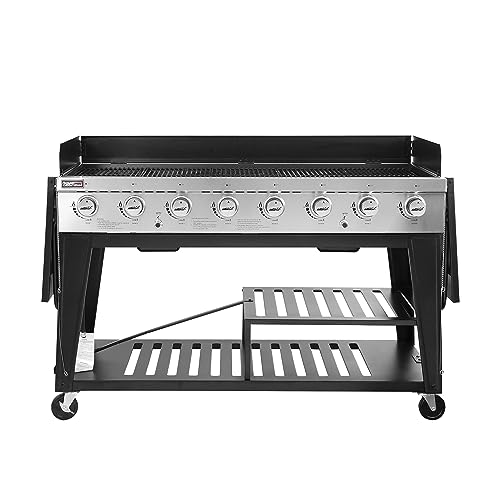
- Best for: Caterers and event crews who cook outdoors for large groups.
- 8 stainless steel tube burners, 13,000 BTU each
- 104,000 BTU total output
- 969 sq in cooking surface (product information)
- Liquid propane, dual independent gas systems
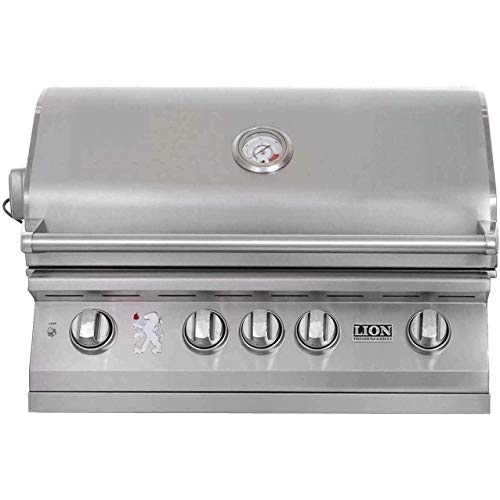
- Best for: Restaurant patios and outdoor kitchens with a natural gas line already run.
- 4 cast stainless steel burners
- 75,000 BTU total output
- 830 sq in cooking surface
- 304 stainless steel construction, 16 gauge

- Best for: Island kitchens that want rotisserie cooking without buying the kit separately.
- 4 cast stainless steel burners, 60,000 BTU on the main grates
- 15,000 BTU infrared back burner, 75,000 BTU total
- 810 sq in total cooking area, including 210 sq in warming rack
- 304 stainless steel construction
All 5 Picks at a Glance
| Product | Specs | Action |
|---|---|---|
| Royal Gourmet 8-Burner Event Grill GB8001-B |
| Check price on Amazon |
| Lion Premium Grills L75623 32-Inch Natural Gas Grill |
| Check price on Amazon |
| Bull Angus 30-Inch Built-In Grill BG-47629 |
| Check price on Amazon |
 Spire 30-Inch Built-In Grill Head 740-0788P |
| Check price on Amazon |
 Blaze Prelude LBM 32-Inch Built-In Propane Grill |
| Check price on Amazon |
Key takeaways
- Five commercial grills compared on burners, BTU and cooking area: an 8-burner event grill plus 304 stainless built-in heads for restaurants and caterers.
Buying a commercial grill is really a decision about throughput: how many covers the line can push out per hour before the grill becomes the bottleneck. A unit that runs out of surface or heat recovery at the Friday rush costs more than its sticker, so the real choice is format first — a mobile event grill that rolls to the job, or a built-in head plumbed into an island — and only then burners and output.
This guide is for caterers, food truck operators, restaurant patios and outdoor kitchen builders who cook for paying crowds. Every pick below was chosen from its Amazon listing name and the figures in that listing’s own product information: burner count, total BTU and cooking area, with the spec table winning whenever a listing disagreed with itself.
Quick Picks
As an Amazon Associate we earn from qualifying purchases.
| Product | Best for | Key spec from title |
|---|---|---|
| Royal Gourmet 8-Burner Event Grill | Catering crews cooking outdoors in bulk | 8 burners, 104,000 BTU total |
| Lion Premium Grills L75623 32-Inch | Restaurant patios with a natural gas line | 830 sq in, 75,000 BTU total |
| Bull Angus 30-Inch Built-In Grill | Islands that need a rotisserie kit in the box | 810 sq in, rear infrared burner |
| Spire 30-Inch Built-In Grill Head | Smaller islands that need dual fuel | 5 burners plus 13,000 BTU rear burner |
| Blaze Prelude LBM 32-Inch | Propane islands wanting zone control | 4 burners, 56,000 BTU total |
How to Choose
Start With the Format Your Operation Actually Runs
A freestanding event grill and a built-in grill head solve different problems, and picking the wrong format wastes the whole purchase. The event grill rolls on casters, runs off propane tanks and folds its side tables down for transport, which suits caterers and rental crews. A built-in head is a permanent island fixture: it needs a measured cutout, a fixed gas line and a structure built around it. Restaurants with a patio line usually want the built-in; mobile operators should not buy a head they cannot mount.
Count Burners and Total BTU, Not Just Grill Size
Burner count decides how many temperature zones a cook can hold at once, and total BTU decides how fast the grates recover after a tray of cold burgers lands. Four burners is the working minimum for a mixed menu, because it lets one zone sear while another holds finished food. Compare the BTU figure the listing prints for the whole grill, and check whether a rear rotisserie burner is included in that total or added on top of the main burners, because brands count it both ways.
Read the Cooking Area From the Spec Table
Cooking area is where listings most often disagree with themselves: a headline number may count the warming rack, a second figure in the same listing may not, and the product information table may print a third. Use the product information figure and treat it as total area including the rack unless the listing splits the two. For volume work, what matters is main-grate space per burner zone, so a grill with slightly less total area but more burners can out-cook a bigger single-zone surface during a rush.
Check Steel Grade, Grease Handling and Warranty Terms
Daily commercial use punishes thin metal, so look for 304 stainless steel construction and cast stainless burners in the listing rather than plated parts. Grease management matters just as much at volume: draw-out trays and removable cups keep a line running between services. Finally, read the warranty text on the listing itself. Some grill warranties are written for residential use even on heavy stainless models, and a restaurant that skips that line may find burner coverage does not apply to its kitchen.
The 5 Best Options
Royal Gourmet 8-Burner Event Grill GB8001-B
- Best for: Caterers and event crews who cook outdoors for large groups.
- 8 stainless steel tube burners, 13,000 BTU each
- 104,000 BTU total output
- 969 sq in cooking surface (product information)
- Liquid propane, dual independent gas systems
Caterers and event crews who cook outdoors for large groups.
The open design has no lid, so it is direct-heat cooking only, and running both systems at full tilt takes two propane tanks.
This is the volume play: two independent grill systems in one rolling frame, each with its own ignition, grease handling and propane supply. Caterers working festivals, school events and company picnics get a surface that can run burgers on one side and dogs or vegetables on the other without either side borrowing heat. Because the two systems are independent, one half can shut down during a slow stretch while the other keeps cooking, which suits crews whose headcount swings through the day.
Lion Premium Grills L75623 32-Inch Natural Gas Grill
- Best for: Restaurant patios and outdoor kitchens with a natural gas line already run.
- 4 cast stainless steel burners
- 75,000 BTU total output
- 830 sq in cooking surface
- 304 stainless steel construction, 16 gauge
Restaurant patios and outdoor kitchens with a natural gas line already run.
This listing is the natural gas version; the propane version is a separate listing, so confirm the fuel type before ordering.
Lion builds this head from 304 stainless in a heavy 16 gauge, and the listing leans on commercial language for a reason: solid stainless cooking grates, cast burners and a double-layer welded hood are the parts that survive daily service. The included Gourmet Package adds a rotisserie, cover, smoker box and griddle, so a restaurant patio can run grilled, smoked and flat-top items off one station. Two interior lights help on evening services, and the adjustable warming rack holds finished plates without crowding the main grates.
Bull Angus 30-Inch Built-In Grill BG-47629
- Best for: Island kitchens that want rotisserie cooking without buying the kit separately.
- 4 cast stainless steel burners, 60,000 BTU on the main grates
- 15,000 BTU infrared back burner, 75,000 BTU total
- 810 sq in total cooking area, including 210 sq in warming rack
- 304 stainless steel construction
Island kitchens that want rotisserie cooking without buying the kit separately.
The warranty text on this listing is written around residential use, so a restaurant should confirm commercial coverage before relying on it.
The Angus splits its output honestly: four cast stainless burners for the main grates and a separate infrared back burner for the rotisserie, with the kit included in the box. Bull’s ReliaBull flame tamers are the listing’s answer to hot spots, spreading heat so the full grate can be loaded during a rush instead of only the middle. The total cooking area includes a 210 sq in warming rack above the main grates, and twin interior lights plus solid stainless grates round out a head aimed at island kitchens that cook every day.
Spire 30-Inch Built-In Grill Head 740-0788P
- Best for: Smaller restaurant patios and island builds that need fuel flexibility.
- 5 main burners at 10,000 BTU each
- 13,000 BTU ceramic rear burner, 63,000 BTU total
- 750 sq in total cooking surface (product information)
- All 304 stainless steel body and cooking grates
Smaller restaurant patios and island builds that need fuel flexibility.
The listing title advertises a larger cooking figure than its own spec table prints, so plan around the 750 sq in product information value.
Spire’s head is the flexible install: the listing describes a dual fuel grill, so the same unit can be set up for propane or natural gas, which helps operations whose patio layout may change. Five main burners give the cook more zones than most 30-inch heads, and the ceramic rear burner covers rotisserie work. The body and grates are 304 stainless, a built-in thermometer and interior lighting are standard, and the whole unit is sold and shipped by Amazon, which simplifies delivery and returns for a working kitchen.
Blaze Prelude LBM 32-Inch Built-In Propane Grill
- Best for: Propane islands that want firm zone control in a 32-inch head.
- 4 stainless steel tube burners, 14,000 BTU each
- 56,000 BTU total output
- 304 stainless steel construction
- Flame stabilizing grids
Propane islands that want firm zone control in a 32-inch head.
Cooking area figures for this model differ between the listing and dealer spec sheets, so measure the grate and cutout yourself before building the island.
Blaze positions the Prelude LBM as its commercial-style built-in, built around four stainless tube burners and full 304 stainless construction rather than a dressed-up residential frame. Flame stabilizing grids sit over the burners to calm flare-ups when fatty cuts render over open flame, a daily concern on a working line. Removable heat zone separators let the cook split the surface into firm temperature zones instead of relying on burner spacing alone. It is the propane pick here for islands that are not plumbed for natural gas.
Which One Fits Your Situation
You Cater Events and Cook Wherever the Crowd Is
Take the Royal Gourmet 8-Burner. Nothing else here rolls to the job, runs off tanks and splits into two independent cooking systems. The 969 sq in surface and dual grease trays are built for long event days, and the folding tables keep the footprint manageable in a trailer. The trade is direct-heat cooking only, since there is no lid.
You Are Building a Restaurant Patio Island on Natural Gas
Choose between the Lion L75623 and the Bull Angus. Both are 32-inch class natural gas heads in 304 stainless with rotisserie burners. The Lion adds the broader accessory package and interior lights; the Angus includes its rotisserie kit and flame tamer system. Measure your cutout first, because the two heads do not share identical opening dimensions.
Your Island Runs on Propane, Not a Gas Line
The Blaze Prelude LBM is the propane built-in here, with zone separators that help a small line hold a sear zone and a holding zone at once. If the island is still being designed and fuel choice is open, the Spire head keeps both paths available because its listing covers propane and natural gas in one dual fuel unit.
You Need the Most Burner Zones in a 30-Inch Opening
Pick the Spire 740-0788P. Five main burners plus the ceramic rear burner give six heat sources in a 30-inch head, more independent control than the four-burner heads above. That suits a compact patio line cooking proteins at different temperatures side by side, as long as the 750 sq in total area matches your cover count.
Common Mistakes
- Trusting the cooking area in a listing title instead of the product information table, where the same grill may print a smaller, more honest figure.
- Ordering the wrong fuel version, because natural gas and propane versions of the same grill head are usually separate listings.
- Building the island before confirming the cutout dimensions printed for the exact head being installed.
- Assuming a heavy stainless grill carries commercial warranty coverage when the listing’s warranty text is written for residential use.
- Undersizing grease management, then losing line time to tray changes and flare-ups during high-volume fatty cooking.
Frequently Asked Questions
What makes a grill commercial grade rather than residential?
The listing details tell the story: 304 stainless steel construction instead of thinner plated steel, cast stainless burners, high total BTU across several independently controlled burners, and grease handling built for daily volume. Weight is a useful clue as well. Heads built for service work are heavy because the firebox, hood and grates carry more metal, and that mass holds heat when cold food lands.
Can a built-in commercial grill run on propane and natural gas?
Only when the listing says so. The Spire head in this guide is described as dual fuel, but the Lion and Bull heads are fuel-specific models with separate listings for each gas type, and the Blaze Prelude here is the propane version. Ordering the head first and the fuel second is a common mistake, so match the listing’s fuel field to the line or tanks at your site before checkout.
How much cooking area does a small restaurant patio need?
Work backward from the rush, not the dining room. A patio line turning burgers and chicken through a two-hour peak wants at least 700 sq in of area split across four or more burners, so one zone can hold finished food while others keep cooking. The heads in this guide run from 750 to 830 sq in, which covers most patio operations without a second unit.
Is an open event grill without a lid a problem for catering?
It limits technique rather than capacity. Without a lid there is no convection roasting or smoking, and wind steals heat on open sites, so the Royal Gourmet works best for direct-heat items like burgers, dogs, sausages and vegetables cooked in batches. Caterers whose menus lean on whole birds or low-and-slow cuts should pair it with a lidded unit instead of expecting one grill to cover both jobs.