Key takeaways
- Find the best raised-bed seed kits for vegetables, with easy-sprouting seeds, planting guides and mixes for healthy harvests at home, every day.
Raised beds give vegetables loose, deep soil that warms early and drains well, but the harvest depends on the seed that goes in. A seed kit gathers dozens of varieties in one box, so a single bed can hold tomatoes, peppers, carrots, lettuce, and herbs without a dozen separate orders. The best kits use non-GMO heirloom seed, print exact counts for every variety, and pack each type in its own labeled packet.


This guide compares five kits built for raised beds, from compact 25-variety sets for a first bed to 55-variety collections for a full season of sowing. Every pick below is a multi-variety kit sold on Amazon, checked against its own listing, with the variety count, seed count, and storage format drawn from the product page.
Quick Picks
As an Amazon Associate we earn from qualifying purchases
| Product | Best for | Key spec |
|---|---|---|
| Survival Garden Seeds Home Garden 30-Variety Vault | Dated lots and printed guidance | 30 varieties; more than 18,500 seeds |
| Gardeners Basics Survival Seed Vault Kit 35 | Exact per-variety counts and markers | 35 varieties; more than 16,000 seeds |
| Lush&Dew Zone 9 Seed Bank 32 | Zone-matched warm-climate growing | 32 varieties in a wooden box |
| Organo Republic 25 Winter Vegetable and Greens | Cold-season beds and fall sowing | 25 varieties; more than 27,675 seeds |
| Organo Republic 55 Vegetable Seeds | Widest mix for a full season | 55 varieties; more than 35,600 seeds |
How to Choose
Match the mix to your bed
A raised bed rewards a kit whose varieties fit the space you actually have. A single four-by-eight bed holds a dozen crops at most, so a 25-variety set leaves room to sow the strongest types and save the rest for the next round. A 55-variety collection suits several beds or a full season of succession sowing, where new rows follow harvested ones. Read the variety list line by line: a kit heavy on lettuce and celery fills salad bowls but leaves little for soups and roasts, while one with beans, peas, corn, and squash feeds a family. Zone-matched banks narrow the list further by climate.
Read seed counts, not headlines
Every kit leads with a five-digit seed count, and most of those seeds are the tiny ones: lettuce, celery, and carrot weigh almost nothing, while beans, peas, corn, and squash arrive 15 to 50 seeds at a time. The honest number is the per-variety list printed further down the listing. A kit that prints exact counts lets you judge the mix before money moves; one that prints ranges leaves the total fuzzy. Compare counts across kits by crop, not by headline: 40 corn seeds and 20 bean seeds feed fewer meals than the box suggests, however large the total looks.
Storage format and shelf life
Seeds keep longest cool, dark, and dry, so the box matters as much as the seed. Paper packets inside a resealable Mylar or waterproof zip bag protect against damp and light, and a wooden box with acrylic containers keeps varieties sorted and visible. Check the shelf-life claim with care: one maker promises 25 years, another says three to five years in cool, dry storage, and a third seals packets for up to two years. Shorter, honest windows usually mean fresher stock and dated lots, which matter more than a forever promise.
Growing help inside the box
A kit earns its keep when the packets teach as they go. Printed planting depth, spacing, sunlight, and harvest timing on every packet lets a beginner sow without a separate guidebook, and QR codes that open free growing guides add depth for trickier crops. Plant markers help most in a shared bed, where rows blur after a week of rain. Zone-matched banks add one more layer of help by choosing varieties for your climate, so fewer sowings fail. Treat any kit without packet-level guidance as a box of unknowns, however many seeds it holds.
The 5 Best Options
Survival Garden Seeds Home Garden 30-Variety Vault
The Home Garden vault is the most papered kit here: 30 varieties, more than 18,500 seeds, and every packet carries a packed-for date plus planting depth, spacing, sunlight, and harvest timing. The mix leans kitchen garden — two carrots, two lettuces, two tomatoes, two peppers, kale, chard — with a wildflower blend for pollinators tucked in. Seeds arrive in 30 paper packets inside a waterproof zip bag, and the maker states plainly that most seed stays viable three to five years in cool, dry storage. For a first raised bed, the dated lots and printed guidance remove guesswork.
Specs
- 30 varieties of vegetables, fruits, and herbs
- More than 18,500 non-GMO heirloom seeds
- Open-pollinated, untreated seed in 30 paper packets
- Waterproof resealable zip bag
- USDA hardiness zones 3 to 11
- Indoor and outdoor use; planting period spring to fall
Best for: Gardeners who want dated lots and printed planting guidance for a first raised bed.
Watch out for: Per-variety counts are printed as ranges, so the exact food-seed total varies from box to box; check the list before buying.
Gardeners Basics Survival Seed Vault Kit 35
Gardeners Basics prints an exact seed count for every one of its 35 varieties, so you can see before buying that celery runs 3,200 seeds while corn runs 40 and bush beans run 20. The kit holds more than 16,000 seeds in individual paper envelopes, with 35 plant markers and a resealable Mylar bag for storage. The list covers the working garden: three lettuces, two tomatoes, two radishes, beans, peas, limas, corn, squash, zucchini, peppers, and herbs. A 25-year shelf-life claim sits on the listing, though seed stays strongest when kept cool, dark, and dry.
Specs
- 35 heirloom vegetable varieties
- More than 16,000 non-GMO, non-hybrid, open-pollinated seeds
- 35 plant markers included
- Individual paper envelopes with growing instructions
- Resealable Mylar storage bag
- Item weight 7 ounces; UPC 848137042667
Best for: First-time vault buyers who want exact per-variety counts and plant markers in the box.
Watch out for: Lettuce and celery dominate the headline count — celery alone runs 3,200 seeds — so check the per-variety list if you want more beans, corn, and squash.
Lush&Dew Year-Round USDA Zone 9 Seed Bank

Lush&Dew takes a different approach: 32 varieties chosen for USDA Zone 9, stored in individual acrylic containers inside a wooden box with a clear lid. The mix spans cold-hardy vegetables, leaf greens, root crops, four tomato types, culinary herbs, perennials, and companion plants such as chamomile and clover. The box measures 12.2 by 6.5 by 1.58 inches and weighs 1.32 pounds, so it sits neatly on a shelf between sowings. The zone-matched mix suits warm-climate beds that grow year-round, and the rigid containers keep packets dry and sorted.
Specs
- 32 non-GMO heirloom seed varieties
- Wooden storage box with 32 acrylic containers
- Matched to USDA hardiness Zone 9
- Year-round planting period; full sun
- Box dimensions 12.2 x 6.5 x 1.58 inches; item weight 1.32 pounds
- Material feature: GMO free, heirloom, organic
Best for: Warm-climate gardeners who want a zone-matched mix in a gift-ready storage box.
Watch out for: The mix is tuned to Zone 9, so cool-climate growers should pick the zone bank that matches their own hardiness zone instead.
Organo Republic 25 Winter Vegetable and Greens
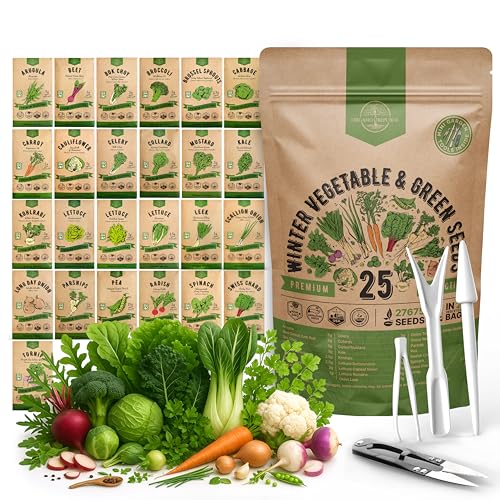
The winter set gathers 25 cold-hardy varieties for beds that keep producing into the cool months: kale, cabbage, broccoli, cauliflower, Brussels sprouts, carrots, beets, spinach, chard, and hardy greens. It holds more than 27,675 seeds in 25 individual craft packets inside a waterproof resealable bag, with per-variety counts printed on the listing. The maker germination-checks every lot and rates the sprout rate above nine in ten, sealing packets to hold for up to two years. Each packet carries a QR code that opens a free growing guide.
Specs
- 25 winter vegetable and greens varieties
- More than 27,675 non-GMO heirloom seeds
- Non-hybrid, open-pollinated; sprout rate above nine in ten
- Waterproof resealable bag with 25 craft packets
- UPC 734896921889; item weight 2.4 ounces
- Product dimensions 9.37 x 5.8 x 1.1 inches
Best for: Cool-season beds and fall sowings where frost-tolerant crops carry the garden.
Watch out for: The mix is built for cold weather, so heat-loving crops such as tomatoes, peppers, and squash are absent; pair it with a warm-season kit for a full year.
Organo Republic 55 Vegetable Seeds

The 55-variety set is the largest kit here, with more than 35,600 seeds covering artichokes, three carrots, two cucumbers, broccoli raab, endive, mache, and dozens of staples. Every variety rides in its own craft packet inside a waterproof resealable bag, and each packet carries a QR code that opens a free growing guide. The maker germination-checks lots for a sprout rate above nine in ten and seals packets to hold for up to two years. With 55 types in one box, it suits a whole season of beds without a second order.
Specs
- 55 vegetable and fruit varieties
- More than 35,600 non-GMO heirloom seeds
- Individual seed packets in a waterproof resealable bag
- QR code on each packet opens a free growing guide
- Sprout rate above nine in ten; viable up to two years
- UPC 810146964537; unit count 55
Best for: Large beds and full-season gardens that want the widest mix in a single order.
Watch out for: One crawl of the listing showed no featured offers, so confirm the listing is live before ordering; the maker’s own shop lists the 55-variety set in stock.
Which One Fits Your Situation
Your first raised bed
Pick the Gardeners Basics 35-variety kit or the Survival Garden Seeds 30-variety vault. Both print exact or dated per-variety detail, include markers or guidance, and cover the core kitchen crops a single bed can hold. Sow the strongest types first and keep the rest sealed for the next round. Both kits store well between sowings.
Several beds or a full season
Take the Organo Republic 55-variety set. Fifty-five types cover warm and cool crops alike, and the per-variety counts let you plan succession rows across several beds. Keep packets in the resealable bag between sowings so the mix stays sorted and dry. Pair it with the winter set when the warm season ends, so the beds keep producing into the cool months.
A warm-climate garden
Choose the Lush&Dew Zone 9 bank. Its 32 varieties are picked for year-round warm growing, and the wooden box with acrylic containers keeps the mix visible and dry on a shelf. Growers in cooler zones should pick the matching zone bank instead. The four tomato types and the herb rows suit beds that never rest.
Cold months and fall sowing
Take the Organo Republic winter set. Its 25 frost-tolerant varieties keep beds working after the warm crops finish, from kale and cabbage to carrots and chard. Sow in late summer or early fall and lean on the QR growing guides for timing. The cool-season focus means no tomatoes or squash, so plan a warm-season kit alongside it.
Common Mistakes
- Judging a kit by its headline seed count instead of the per-variety list.
- Sowing every variety at once instead of matching crops to the season and the bed.
- Storing packets in a damp shed instead of a cool, dry place between sowings.
- Skipping the zone match and growing warm-climate varieties in a short, cool season.
- Burying tiny seed too deep, so lettuce, celery, and carrot never break the surface.
Frequently Asked Questions
How many varieties does a raised bed need?
A single four-by-eight bed holds about a dozen crops at a time, so a 25- to 35-variety kit is plenty for a first season. Larger kits suit several beds or succession sowing, where new rows follow harvested ones. Buy for the beds you have, not the count on the box.
Do heirloom seeds grow true from saved seed?
Yes, when the variety is open-pollinated and heirloom. Seeds saved from such plants usually grow true to the parent, while hybrid seed does not. All five kits here use open-pollinated heirloom seed, so you can save seed from a strong harvest and sow it again next season.
How long do seeds in a kit stay viable?
It depends on the crop and the storage. Most seed stays viable three to five years in cool, dry storage, and some makers seal packets for up to two years while others claim far longer. Keep packets sealed, cool, and dark, and sow the oldest lots first.
Can one kit feed a family for a season?
A large kit covers the variety, but the per-variety counts set the limit. Beans, peas, corn, and squash arrive in small numbers, so one box rarely fills every meal. Treat a kit as the backbone of the garden and add extra packets of the crops your family eats most.