Key takeaways
- New to running? Compare four cushioned running shoes for new runners, with drop, width and first-fit checks that keep early miles comfortable.
A new runner’s first shoe decision is not about speed, shoes for racing, or the model a fast friend swears by. It is about protection while your body is still learning the movement. Beginners land heavier, tire sooner and swell more in the foot than experienced runners, so the purchase that matters is a cushioned shoe that forgives clumsy miles without hiding the ground completely or demanding weeks of adaptation.
This guide is written for people in their first months: couch-to-5K starters, walkers mixing in run intervals, and gym regulars moving outdoors. The four models below were taken from their Amazon listing titles and product information, each with its stated drop, weight and variant, because a beginner needs facts they can act on, not a lecture. Read the drop section carefully; it is where new runners most often buy themselves an avoidable ache.
Quick Picks
As an Amazon Associate we earn from qualifying purchases at no extra cost to you. The table gives the shortlist at a glance, and the notes under each shoe explain who should start with it and what to check in the mirror before the first run outside.
| Product | Best for | Key spec from title |
|---|---|---|
| Brooks Glycerin 22 | A balanced first pair for mixed walk-run weeks | Men’s neutral running shoe, style 110445-135 |
| ASICS Gel-Nimbus 27 | Beginners who want a calm, familiar ride | Men’s running shoe, Black/Lake Grey, style 1011B957.002 |
| New Balance Fresh Foam X More V5 | Heavier landings and wide feet | Men’s running shoe, 11 Wide variant, style MMORCB5 |
| HOKA Bondi 9 | Maximum protection for sore first-month legs | Men’s running shoe, Black/Black, style 1162011/2013/2015-BBLC |
How to Choose
Keep the drop close to what your body knows
Drop is the heel-to-forefoot height difference, and it is the spec beginners ignore at their cost. The More V5 lists 4 mm, the Nimbus 27 lists 8 mm, and both are honest shoes, yet they load your calves very differently. If you currently walk and train in ordinary trainers, a mid-range drop is the gentlest introduction. Choose a low-drop shoe only if you already spend time in flat footwear, and whatever you pick, keep the first two weeks short, because new runners cannot yet tell the difference between adaptation and injury.
Cushioning should forgive, not wobble
Early strides are uneven: you land on different parts of the foot from step to step, especially when tired. A very tall, soft shoe can amplify that wobble and make a tired beginner feel unsteady at road crossings and corners. That is why this list leads with balanced models and treats the Bondi 9 as a specialist tool rather than the default. If your plan is mostly walking with short jogs, pick steadiness. If you are heavier, or your knees complain on stairs, the extra platform of a max-cushion model becomes a fair trade.
Fit the foot you have at 6 p.m., not 9 a.m.
Feet swell during the day and swell again on a run, and beginners feel both effects more because their runs include walking breaks that let blood pool. Measure and try shoes in the evening, stand fully in them, and leave roughly a thumbnail between your longest toe and the end. Then check the width options on the listing: the More V5 variant here is an 11 Wide, and choosing width deliberately prevents the black toenails that end many first running programmes. Snug is fine at the heel; it is never fine across the toes.
Buy for pavement first, dreams later
Almost every beginner starts on roads, pavements, park paths or a treadmill belt, and all four shoes here are road models with listings to match. That is the right category, even if a trail race is the long-term fantasy. Road outsoles grip wet tarmac, the uppers breathe on a treadmill, and the cushioning is tuned for hard, flat surfaces. Gravel shoulders and school tracks are fine in these shoes. Mud, steep trails and icy paths are not, so postpone that shopping until the habit survives its first season.
The 4 Best Options
Brooks Glycerin 22

If a beginner asked for one pair and no follow-up questions, this is the safest answer in the group. The listing presents a neutral running shoe with a mesh upper, rubber sole and foam cushioning, weighing 10.2 oz, and nothing about that recipe is extreme. New runners can walk in it, jog in it and still use it when runs become continuous, which saves the second purchase that a too-specialised first shoe often forces. This men’s White/Grey/Black variant also looks like an ordinary trainer, a small mercy for anyone self-conscious starting out.
Specs
- Brand: Brooks
- Model name: Glycerin 22
- Listing title: Brooks Men’s Glycerin 22 Neutral Running Shoe
- Variant shown: White/Grey/Black
- Style number: 110445-135
- Weight: 10.2 oz / 289.2 g
- Outer material: Mesh
- Sole material: Rubber
- Insole material: Foam, synthetic
- Closure: Lace-Up
Best for: First-time buyers who want one balanced pair for walk-run training.
Watch out for: Do not confuse it with the Glycerin GTS support version on nearby listings; a neutral beginner shoe is the plain Glycerin 22.
ASIN: B0DP2Z378X
ASICS Gel-Nimbus 27

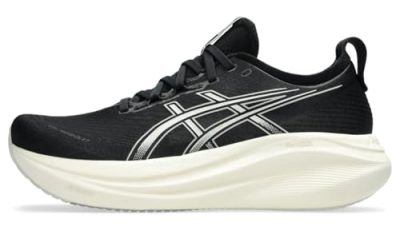
The Nimbus 27 suits the beginner who already knows running will stick and wants the long-run shoe from day one. ASICS describes cloudlike cushioning for long, calming runs in the listing, and the specification is reassuringly conventional: an 8 mm drop, a mesh upper over a knit inner, and a rubber outsole. This men’s Black/Lake Grey variant is a size 10.5. The shape and ride will feel familiar to anyone who has worn mainstream trainers, which lowers the strangeness barrier that puts some starters off their second week.
Specs
- Brand: ASICS
- Model name: Gel-Nimbus 27
- Listing title: ASICS Men’s Gel-Nimbus 27 Running Shoe
- Variant shown: Black/Lake Grey, size 10.5
- Style number: 1011B957.002
- Drop: 8 mm
- Weight: 305 g / 10.8 oz
- Outer material: Mesh
- Sole material: Rubber
- Insole material: Ethylene Vinyl Acetate
Best for: Committed starters who want a calm, cushioned shoe for building distance slowly.
Watch out for: Each ASIN is a single size, so select your own size and width on the listing rather than ordering the 10.5 attached to this one.
ASIN: B0D42CKWQK
New Balance Fresh Foam X More V5

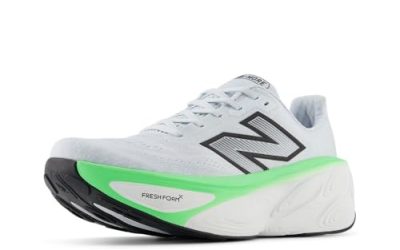
Heavier beginners, and anyone whose feet are wide, should look hard at the More V5. The listing describes a plush yet stable underfoot experience, and this variant is an 11 Wide in Ice Blue, Electric Jade and Black, so the room is built in rather than improvised by sizing up. Its Fresh Foam X midsole is the thickest-feeling here, yet the 4 mm drop keeps the foot closer to the ground than the stack suggests. That combination protects joints while asking the calves to work, which is a trade to manage, not fear.
Specs
- Brand: New Balance
- Model name: Fresh Foam X More V5
- Listing title: New Balance Men’s Fresh Foam X More V5 Running Shoe
- Variant shown: Ice Blue/Electric Jade/Black, 11 Wide
- Style number: MMORCB5
- Drop: 4 mm
- Weight: 312 g / 11 oz
- Outer material: Mesh
- Sole material: Rubber
- Insole material: Ethylene Vinyl Acetate
Best for: Wide feet and heavier landings that need real room plus real foam.
Watch out for: The 4 mm drop loads calves and Achilles tendons, so build distance slowly and keep a pair of everyday trainers for rest-day walks at first.
ASIN: B0D2BSHV64
HOKA Bondi 9

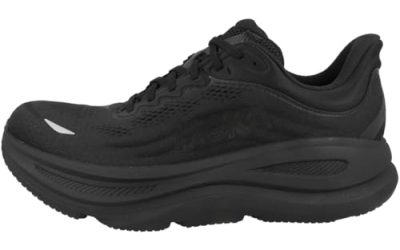
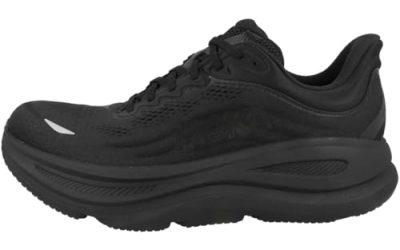
The Bondi 9 is the maximum-protection option, and for some beginners that is exactly right: if knee soreness ended your last attempt at running, the increased stack and premium foam midsole in this listing directly address the reason you stopped. The structured knit upper and 3D molded collar hold the foot on a tall platform, and the Black/Black colourway doubles as a work shoe for long shifts. The honest caution is fit and feel: a tall shoe is a new sensation, and the listing itself flags returns over tightness, so width homework is non-negotiable.
Specs
- Brand: HOKA
- Model name: Bondi 9
- Listing title: Hoka Men’s Bondi 9
- Variant shown: Black/Black
- Style number: 1162011/2013/2015-BBLC
- Outer material: Polyester
- Sole material: Ethylene Vinyl Acetate, with Durabrasion rubber in high-wear zones
- Closure: Lace-Up
- Water resistance: Not water resistant
Best for: Beginners whose joints need the softest landing available in this list.
Watch out for: Test the pair indoors first, because the tall platform feels unusual, and check width carefully given the listing’s note about returns for tight fit.
ASIN: B0D5G2Y6DD
Which One Fits Your Situation
You are starting a couch-to-5K and own no running shoes
Buy the Brooks Glycerin 22. It asks nothing unusual of your body, works for the walking intervals as well as the running ones, and will still be the right shoe when the plan ends and ordinary easy runs begin. It is the lowest-regret first purchase here.
Your last attempt ended with sore knees or shins
Try the HOKA Bondi 9 if knees were the problem, since its whole design is impact absorption. If shins and calves complained instead, the Nimbus 27 with its 8 mm drop is the gentler correction. Either way, shorten the first runs; new cushioning is not a licence to double distance in week one.
You are broad-footed and every shoe feels narrow
Go straight to the New Balance Fresh Foam X More V5 and choose the wide variant in your size on the listing. Sizing up in a standard shoe adds length without fixing the squeeze, while a true wide last gives your forefoot room to spread under the foam, which is where its comfort comes from.
You plan to run four or five days a week from the start
Choose the ASICS Gel-Nimbus 27. Its balanced drop, rubber outsole and long-run positioning suit frequent easy mileage better than a specialist max stack, and it will not feel out of place when some of those days stretch longer. Frequent beginners need durability and predictability more than novelty.
Common Mistakes
- Copying the size from everyday sneakers instead of measuring and selecting a running size on the listing.
- Jumping to the lowest drop or tallest stack because it sounds advanced, before your calves have an opinion.
- Testing a new pair on a long run first, instead of short indoor and outdoor trials while a swap is still easy.
- Buying a support or racing model by accident because the names look similar on the search page.
- Running through sharp pain in week two and blaming fitness, when the shoe’s drop or width is the real mismatch.
Frequently Asked Questions
Do new runners really need a cushioned shoe?
Most do, yes. Beginners land with less control and less leg strength than experienced runners, so foam underfoot absorbs mistakes while technique develops. Cushioning is not a substitute for gradual training, but a forgiving shoe like the Glycerin 22 or Nimbus 27 removes the most common reason early runs feel punishing, which is sore legs the next morning.
How should my first running shoes fit?
Stand in them in the evening and look for about a thumbnail of space ahead of your longest toe, a heel that stays put when you jog on the spot, and no pressure across the forefoot. Then pick that size and width on the listing itself, because each ASIN here is tied to one variant and the default shown may not be yours.
Is the Bondi 9 too much shoe for a beginner?
Not if joint soreness is your barrier, since its increased stack exists to absorb impact. It is too much shoe if you feel unsteady in it or mostly walk, because a tall platform can wobble at slow speeds. Decide with an indoor test: if you notice the height with every step, choose a lower model from this list instead.
How many pairs does a beginner need?
One good pair is enough to start, and it is better to spend the whole budget on the right cushioned trainer than to split it across two mediocre ones. Add a second pair later only if you begin running on back-to-back days, so each pair can dry and recover between sessions. Until then, fit and consistency matter far more than rotation.