Key takeaways
- Find the best weather stations for storm-ready homes, with Wi-Fi consoles, solar sensors, and clear guidance on wind, rain, and lightning alerts.
A home weather station turns a distant regional forecast into a reading from your own yard. When a storm approaches, local wind gusts, rainfall, and a falling barometer can help you decide when to bring in outdoor furniture, move a vehicle under cover, or shelter before conditions worsen. A station does not replace official warnings, and it should never be your only source during severe weather, but it adds useful context between official updates.
The stations below cover the main approaches, from a budget display-first model to premium systems with larger consoles. Each one is described from its published specifications, so you can compare what it measures and how it connects.
As an Amazon Associate, we earn from qualifying purchases.
Quick answer
For most storm-ready homes, the Ambient Weather WS-2902 is the strongest all-round choice, with wind, rain, temperature, humidity, ultraviolet light, and solar radiation in one solar-powered array plus Wi-Fi. Choose the AcuRite Iris 01512 for a simpler budget display, the Tempest for low-maintenance app-first monitoring, and the Ambient Weather WS-2000 or ECOWITT Wittboy Pro HP2564 for a larger console and wider sensor options.
Ambient Weather WS-2902 WiFi Smart Weather Station
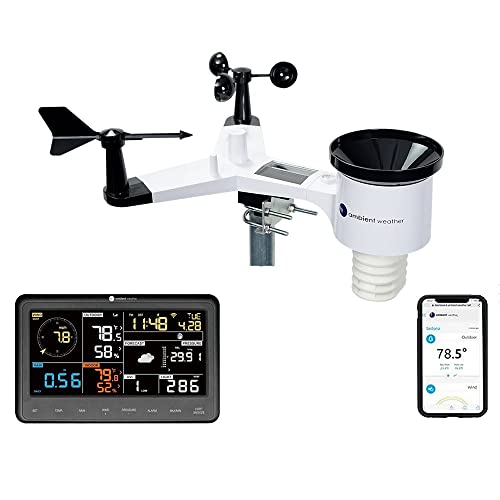
The Ambient Weather WS-2902 is a mid-range station built around a single outdoor Osprey sensor array. That array measures wind speed and direction, rainfall, outdoor temperature and humidity, ultraviolet light, and solar radiation, while the indoor console adds indoor temperature, humidity, and barometric pressure. One array keeps installation simpler for a first station.
Wi-Fi is central to the design. The console can send readings to the Ambient Weather Network and to Weather Underground, so household members can check conditions away from the console. Published specifications also describe compatibility with smart home platforms, including voice assistants.
Specs
- Measures: wind, rain, temperature, humidity, ultraviolet light, and solar radiation outdoors; temperature, humidity, and pressure indoors
- Display: color console with Wi-Fi remote monitoring, Weather Underground, and Ambient Weather Network support
- Power: solar-powered outdoor sensor array
-
Tier: mid-range
-
ASIN: B01N5TEHLI
Ambient Weather WS-2000 Smart Weather Station with WiFi Remote Monitoring and Alerts
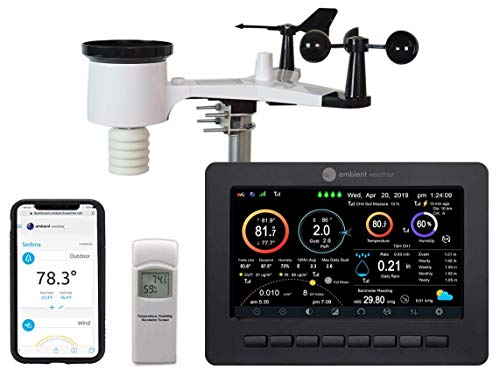
The Ambient Weather WS-2000 is a premium station that pairs an all-in-one outdoor array with a larger, more detailed console. The array measures wind speed and direction, rainfall, temperature, humidity, ultraviolet light, and solar radiation, while a separate indoor sensor reports indoor temperature, humidity, and pressure. The full-color TFT display shows more readings at once and makes historical graphs easier to read.
Wireless range is listed at up to 330 feet in open air, and up to 100 feet under most conditions, using a 915 MHz link. The console connects by Wi-Fi, can publish data online, send alerts, and work with smart home platforms. It also supports memory card export and additional sensors, such as lightning detection, soil moisture, and air quality sensors.
Specs
- Measures: wind, rain, temperature, humidity, ultraviolet light, and solar radiation outdoors; temperature, humidity, and pressure indoors
- Display: full-color TFT LCD console with historical graphs and alerts
- Wireless range: up to 330 feet in open air, and up to 100 feet under most conditions, on a 915 MHz link
- Connectivity: Wi-Fi, with online publishing, alerts, smart home support, and memory card export
-
Tier: premium
-
ASIN: B07GRBY9NP
AcuRite Iris (5-in-1) Indoor/Outdoor Wireless Weather Station for Indoor and Outdoor Temperature and Humidity, Wind Speed and Direction, and Rainfall with Digital Display (01512M)
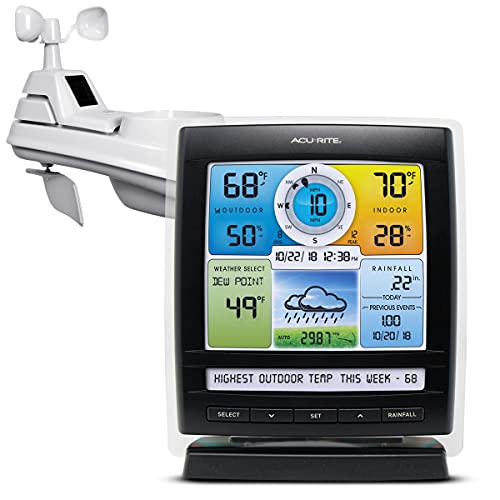
The AcuRite Iris 01512M is a budget station for households that want core wind and rain data on a clear indoor display without Wi-Fi setup. Its 5-in-1 outdoor sensor measures outdoor temperature and humidity, wind speed and direction, and rainfall, while the display adds indoor temperature and humidity, barometric pressure, and a self-calibrating forecast.
Wireless range is listed at up to 330 feet, depending on home construction materials. Updates are listed at 18 seconds for wind speed and 36 seconds for wind direction, temperature, and humidity, which is frequent enough to follow gusts during a storm. The display includes battery backup. It does not provide app access or online sharing in this configuration.
Specs
- Measures: temperature, humidity, wind, and rain outdoors; temperature, humidity, and pressure indoors
- Display: digital display with forecast, daily records, and battery backup
- Wireless range: up to 330 feet, depending on home construction materials
- Updates: wind speed every 18 seconds; wind direction, temperature, and humidity every 36 seconds
-
Tier: budget
-
ASIN: B00N1XCA9M
Tempest Weather Station with Built-in Wind Meter, Rain Gauge, and Accurate Weather Forecasts, Wireless, App and Alexa Enabled
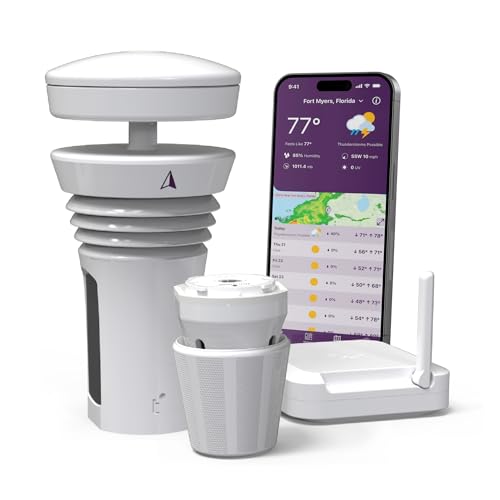
The Tempest Weather Station has no moving parts outdoors. Wind is measured sonically, rain is measured with a haptic sensor, and the single outdoor unit also measures temperature, humidity, barometric pressure, wind speed and direction, dew point, solar radiation, ultraviolet index, lightning strikes, and rainfall. That sealed design removes cups, vanes, and tipping buckets that can jam, wear, or collect leaves.
The outdoor sensor is solar powered and transmits wirelessly up to more than 1,000 feet, with real-time updates every 3 seconds listed in the published specifications. There is no conventional console in the box. Readings are viewed in the Tempest app and on the web, and the system works with Alexa and other smart home platforms. Lightning detection supports alerts that help with decisions about outdoor work and sheltering during thunderstorms.
Specs
- Measures: temperature, humidity, pressure, wind, dew point, solar radiation, ultraviolet index, lightning, and rain
- Sensor design: no moving parts, with sonic wind sensing and a haptic rain sensor
- Display: app and web dashboard, with no conventional console included
- Power: solar-powered outdoor sensor with a lithium battery
- Wireless range: more than 1,000 feet, with updates every 3 seconds
- Connectivity: Wi-Fi hub, app access, and Alexa support
-
Tier: premium
-
ASIN: B0868WY7NY
ECOWITT Wittboy Pro Weather Station HP2564

The ECOWITT Wittboy Pro HP2564 is a mid-range station built around the WS90 7-in-1 outdoor sensor and the HP2560 display console. Like the Tempest, it avoids moving parts outdoors. The WS90 uses ultrasonic sensing for wind speed and direction and a haptic sensor for rainfall, while also measuring temperature, humidity, ultraviolet light, and solar radiation. The console is a 7 inch TFT display, large enough to show a wide set of readings without opening an app.
The console supports uploads to Weather Underground, WeatherCloud, WOW, and Ecowitt servers, and it can work with the Ecowitt app for remote viewing. The radio link uses 915 MHz in the United States version. The outdoor sensor is solar powered, with battery backup. The console can also pair with additional Ecowitt sensors, including soil moisture, air quality, and leak sensors, plus a separate rain gauge.
Specs
- Measures: wind, temperature, humidity, rainfall, ultraviolet light, and solar radiation
- Sensor design: WS90 7-in-1 array with ultrasonic wind sensing and a haptic rain sensor
- Display: 7 inch HP2560 TFT display console
- Power: solar-powered outdoor sensor with battery backup, on a 915 MHz link
- Connectivity: Weather Underground, WeatherCloud, WOW, and Ecowitt servers, plus app access
- Expansion: additional Ecowitt soil moisture, air quality, and leak sensors
-
Tier: mid-range
-
ASIN: B0BM3BQ425
How to choose
Start with the measurements that matter for your home. Wind and rain are the core storm measurements, and every station here covers them. Add temperature and humidity for comfort, gardening, and freeze awareness. Add ultraviolet and solar radiation for a fuller picture of heat and sun exposure. Add lightning detection when thunderstorms are a regular concern and outdoor work needs clear stop-and-shelter signals.
Next, decide how you want to read the data. A color console is best when several people need a quick glance without a phone. A large TFT console is best for graphs, history, and many readings on one screen. An app-first station is best when you check weather away from home or want phone alerts. Check wireless range and mounting before you buy, and allow for walls, metal roofing, and trees that can shorten the link.
Consider power, upkeep, and growth. Solar-powered arrays reduce battery changes but still need sunlight and occasional cleaning. If you may later add lightning, soil, air quality, or leak sensors, choose a system with a published expansion path, such as the WS-2000 or the Wittboy Pro HP2564.
Who should skip
Skip a full weather station if you only need indoor temperature and a basic forecast, or if you live in a small apartment with no safe outdoor mounting point. A phone forecast and official alerts may cover those needs. Skip an app-only station if you want a display that works without a phone, or if your internet connection is unreliable during storms.
Skip a haptic rain sensor as your only rain gauge if exact rainfall totals are essential for drainage, irrigation, or farm records. In that case, choose a station with a conventional tipping bucket, or add a separate rain gauge sensor where the system supports one. Also skip any station with a mounting location you cannot reach safely for cleaning and battery checks.
FAQ
Do I need Wi-Fi for a home weather station?
No. A console-first station can show local readings without Wi-Fi, and it remains useful during an internet outage if it has power or battery backup. Wi-Fi adds remote viewing, online sharing, alerts, and smart home links, so it is worth having when you want to check conditions away from home.
Where should I mount the outdoor sensor?
Mount the sensor in an open spot with clear exposure to wind and rain, away from overhangs, walls, and heat sources such as vents and air conditioning units. Keep it level, secure it against strong gusts, and place it where you can reach it safely for cleaning and battery checks. A higher mounting point usually gives cleaner wind readings.
How accurate are home weather stations?
Accuracy varies by sensor design, placement, and calibration. Published specifications describe the intended ranges and tolerances for each model, and good placement matters as much as the sensor itself. A station sheltered by a building or mounted over a hot roof will read differently from one in open air.
Can a weather station replace official storm warnings?
No. A home station measures conditions at your address, but it does not issue warnings, track a storm system across a region, or replace guidance from the National Weather Service and local emergency officials. Use your station for local context and timing, and rely on official warnings and alerts for evacuation, sheltering, and other safety decisions.
Final verdict
For most storm-ready homes, the Ambient Weather WS-2902 offers the best balance of sensor coverage, Wi-Fi access, and a readable console at a mid-range tier. It covers wind, rain, temperature, humidity, ultraviolet light, and solar radiation in one array, which is enough to follow most storms as they pass your home. Choose the AcuRite Iris 01512M for a simple budget display, the Tempest for low maintenance and app-first lightning alerts, and the ECOWITT Wittboy Pro HP2564 for a large console and sensor expansion. Choose the Ambient Weather WS-2000 for a larger TFT console, detailed history, and wider expansion support at a premium tier.