Key takeaways
- Compare the best tow straps for vehicle recovery, from flat polyester straps to kinetic ropes, with maker-rated break strengths and sizing tips.
- Top Pick: Rhino USA Recovery Tow Strap, 3 Inch by 30 Foot
- Runner-up: GearAmerica Tow Strap, 3 Inch by 20 Foot
- Also consider: USWAY GEAR Recovery Tow Strap, 3 Inch by 30 Foot
A vehicle stuck in mud, sand, or a snow-filled ditch after a storm is one of the most common roadside problems a prepared driver can solve without waiting hours for a tow truck. A rated tow strap or kinetic recovery rope, kept in the trunk or behind the seat, turns a stranded vehicle into a short, controlled pull — provided the strap is matched to the weight of the vehicles involved and connected only to proper recovery points.
The five products below cover the main styles a driver is likely to carry: flat polyester tow straps in 20- and 30-foot lengths, a shorter strap that doubles as a tree saver and winch extension, and two nylon kinetic ropes that stretch to soften the pull. Every strength figure quoted is the maker’s own published rating, and every pick uses loop ends rather than open metal hooks.
As an Amazon Associate, we earn from qualifying purchases.
Quick answer
For most trucks and SUVs, a 3-inch by 30-foot flat strap rated around 30,000 pounds or more, such as the Rhino USA or USWAY GEAR picks below, covers everyday recovery. If your stuck situations usually involve mud or sand, a kinetic rope from Rhino USA or ALL-TOP adds stretch that softens the pull. Whatever you choose, match the maker’s rating to the heavier vehicle and use rated recovery points only.
Rhino USA Recovery Tow Strap, 3 Inch by 30 Foot

Rhino USA is a family-owned American brand that built its reputation on recovery gear, and this flat strap is its core product. The webbing is polyester, which stretches very little compared with nylon, so it suits steady towing pulls and winching extensions where you do not want extra give. The maker rates the strap at 31,518 pounds of break strength and finishes both ends with triple-reinforced loops rather than hooks, so connections rely on shackles or rated recovery points.
The 30-foot length is the practical sweet spot for roadside work: long enough for the pulling vehicle to stay on firm ground, short enough to coil into the included storage bag. Rhino USA states the webbing is weather resistant and backs the strap with a lifetime warranty against defects. For a driver who wants one strap for a full-size truck or SUV, this is the premium-tier default.
Specs:
- Size: 3 inches wide by 30 feet long
- Maker-rated break strength: 31,518 pounds
- Material: polyester webbing
- Ends: triple-reinforced loop ends, no hooks
- Model number: TOWSTRAP-330
- Extras: storage bag included; maker-stated lifetime warranty
GearAmerica Tow Strap, 3 Inch by 20 Foot

GearAmerica’s 3-inch strap is the versatile middle option. At 20 feet it is shorter than the full-length recovery straps here, which makes it easy to store, and the maker also rates it for use as a tree saver and winch line extension, two jobs where a shorter, very strong strap is exactly what is needed. The published break strength is 35,053 pounds, the highest figure among the flat straps in this roundup.
The loops are triple reinforced and the polyester webbing is weather resistant, per the maker. Because the same strap can anchor a winch line to a tree or extend a winch cable that falls a few feet short, it earns its place in winch kits. Drivers who only pull stuck vehicles straight out may prefer a 30-foot strap, but as a multi-role piece of gear this one is hard to beat in the mid-range tier.
Specs:
- Size: 3 inches wide by 20 feet long
- Maker-rated break strength: 35,053 pounds
- Material: polyester webbing
- Ends: triple-reinforced loop ends, no hooks
- Model number: GAMTS
- Roles stated by the maker: tow strap, tree saver, winch extension
USWAY GEAR Recovery Tow Strap, 3 Inch by 30 Foot
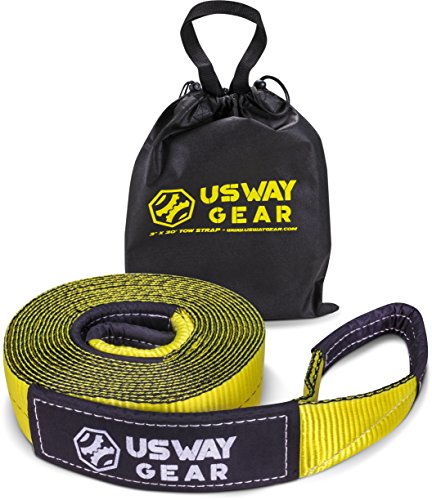
USWAY GEAR’s strap is the budget-tier way to get a full 30-foot, 3-inch strap with the details that matter. The maker rates it at 30,000 pounds of capacity and builds the ends as triple-reinforced loops, the same connection style as the premium picks. Protective sleeves slide over the webbing at contact points to reduce abrasion where the strap passes around a recovery point or frame member.
A storage bag is included, which matters more than it sounds: a strap that lives loose in a cargo area picks up grit, while a bagged strap stays clean and ready. This is a sensible pick for a second vehicle or anyone building an emergency kit on a budget who still wants a maker-rated strap rather than an unrated hardware-store rope with open hooks.
Specs:
- Size: 3 inches wide by 30 feet long
- Maker-rated capacity: 30,000 pounds
- Material: polyester webbing
- Ends: triple-reinforced loop ends with protective sleeves
- Model number: TS3x30
- Extras: storage bag included
Rhino USA Kinetic Recovery Rope, 1 Inch by 30 Foot

A kinetic rope solves a different problem from a flat strap. Instead of a nearly static pull, the double-braided nylon rope stretches under load — the maker describes elongation of up to 30 percent — storing energy and releasing it gradually, which reduces the shock load on both vehicles when one is buried in mud or sand. Rhino USA publishes a break strength of 34,370 pounds for this 1-inch by 30-foot size and suggests it for vehicles in the mid-weight range such as Jeeps, SUVs, and half-ton trucks.
The rope has spliced loop eyes at both ends, meant for soft shackles or rated steel shackles. Because it stretches, it needs more room to work than a strap and is not the right tool for a simple flat tow down the road. For storm-season mud, beach sand, and snowbank extractions, though, the softer pull is exactly why off-road drivers carry one.
Specs:
- Size: 1 inch diameter by 30 feet long
- Maker-rated break strength: 34,370 pounds
- Material: double-braided nylon
- Maker-stated stretch: up to 30 percent elongation
- Ends: spliced loop eyes
- Model number: KINETIC-ROPES
ALL-TOP Kinetic Recovery Rope Kit, 1 Inch by 20 Foot

ALL-TOP sells this kinetic rope as a complete kit: the 1-inch by 20-foot rope, two soft shackles, and a storage bag. The rope is Nylon 66 with a maker-rated break strength of 48,000 pounds and a stated work load limit of 16,000 pounds, and the maker advertises elasticity above 30 percent. Soft shackles are a thoughtful inclusion because they connect a rope to a recovery point without adding a heavy steel link that could become a projectile if something fails.
The 20-foot length keeps the kit compact for smaller vehicles and tighter trails, though drivers recovering full-size trucks on open ground may want the extra working room of a 30-foot rope. ALL-TOP’s own sizing advisory, printed with the listing, is worth following: the rope’s minimum breaking strength should be between two and three times the gross weight of the vehicle being recovered, and the setup should be sized to the lighter of the two vehicles involved.
Specs:
- Size: 1 inch diameter by 20 feet long
- Maker-rated break strength: 48,000 pounds
- Maker-stated work load limit: 16,000 pounds
- Material: Nylon 66, double braid
- Maker-stated stretch: above 30 percent elasticity
- Kit contents: rope, two soft shackles, storage bag
How to choose
Start with weight. Makers advise choosing a strap or rope whose minimum break strength is roughly two to three times the gross weight of the vehicle being recovered, and sizing the whole setup to the lighter of the two vehicles. A compact car needs far less strap than a loaded diesel truck, and an undersized strap is the one failure you can prevent on paper before you ever leave home.
Next, decide between a flat strap and a kinetic rope. Flat polyester straps stretch very little, store flat, and suit steady pulls, towing, and winch-extension duty. Kinetic nylon ropes stretch substantially, which softens shock loads in mud, sand, and snow, but they cost more, are bulkier, and are not meant for ordinary road towing. Many prepared drivers carry one of each.
Then check the details. Loop ends are the correct connection style for recovery; avoid straps with open metal hooks. Length matters too: 30 feet gives the pulling vehicle room to stay on solid ground, while 20 feet stores smaller and works as a tree saver. Finally, follow the maker’s guidance on connections — attach only to factory or rated recovery points, never to a tow ball or suspension part, and inspect the webbing before every use, retiring any strap that shows damage.
Who should skip
Skip these products if your vehicle has no accessible rated recovery points and no safe way to add them; a strong strap connected to a weak point helps no one. Drivers who only face paved-road breakdowns are better served by a roadside assistance plan than by recovery gear they will never rig correctly. If you need to lift loads, hold cargo down, or tow with a rigid connection, look at rated tie-downs, chains, or a proper tow bar instead — recovery straps are for pulling stuck vehicles, not lifting or securing freight. And if your stuck scenarios involve a winch, you may only need the tree saver strap rather than a full recovery set.
FAQ
What break strength do I need for my vehicle?
Follow the maker guidance shared by several brands in this roundup: choose a strap or rope with a minimum break strength between two and three times the gross weight of the vehicle being recovered, and size the setup to the lighter of the two vehicles. When in doubt, the heavier-duty option within your budget tier is the safer paper choice.
Is a kinetic rope better than a flat tow strap?
Neither is better overall; they do different jobs. A kinetic rope stretches to soften the pull when a vehicle is stuck in mud, sand, or snow, which reduces shock loads. A flat strap gives a steadier, more controlled pull for general towing and doubles as a winch extension or tree saver. Many drivers carry both.
Can I attach a tow strap to a trailer hitch ball?
No. Makers and recovery guides consistently warn against connecting a strap to a tow ball, because the ball is not rated for recovery loads and can shear off. Use the vehicle’s factory recovery points or a rated hitch-mounted shackle receiver instead, and check the vehicle manual for the approved points before you need them.
How should I store and care for a tow strap?
Keep it clean, dry, and out of direct sunlight in its storage bag, and rinse off mud and grit after a recovery. Inspect the full length before each use for cuts, frayed stitching, and abrasion, especially around the loops. Makers advise retiring a strap or rope that shows visible damage rather than trusting a weakened one.
Final verdict
For a single do-everything pick, the Rhino USA 3-inch by 30-foot strap pairs a strong maker rating with reinforced loops and easy storage. The GearAmerica strap is the smartest add-on for winch owners, the USWAY GEAR strap covers the basics at a budget tier, and the two kinetic ropes handle the mud-and-sand work where stretch matters. Whichever you choose, size it to your vehicle, connect it only to rated recovery points, and inspect it before the day you actually need it.