Key takeaways
- Five sleeping bags for emergency kits compared by temperature rating, insulation, packed size and fit, from budget rectangular bags to down mummy bags.
- Top Pick: Coleman Brazos 20°F Sleeping Bag
- Runner-up: TETON Sports Celsius XXL 0°F Sleeping Bag
- Also consider: Coleman North Rim 0°F Sleeping Bag
An emergency kit sleeping bag has a different job from a backpacking bag. It may sit in a closet, a car trunk or a shelter bin for months, then need to work on the coldest night of the year, possibly indoors on a floor, in a vehicle, or under a tarp after a storm. Warmth per stored inch, a temperature rating you can trust, and a shape that fits every family member matter more than shaving grams.
The five bags below cover the main emergency-kit strategies: roomy rectangular bags that double as spare bedding, oversized cold-weather bags for unheated spaces, and compact down mummies that store small in a go-bag. Every temperature figure is the maker’s own published rating, and the guide notes where a rating follows the ISO standard and where it is simply the brand’s own number, because those two kinds of figures are not directly comparable.
As an Amazon Associate, we earn from qualifying purchases.
Quick answer
For most home emergency kits, start with the Coleman Brazos for a budget rectangular bag or the TETON Sports Celsius XXL for serious cold. The Coleman North Rim adds a hooded mummy shape for tall sleepers, the Kelty Cosmic 20 packs smallest for go-bags, and the Naturehike CWM400 suits mild climates and layering. Match the rating to your coldest expected night, and pair any bag with an insulated pad.
Coleman Brazos 20°F Sleeping Bag

The Brazos is the classic budget rectangular bag, and its shape is exactly why it works in a home kit: it unzips fully to serve as a blanket for guests or for layering over another bag, and two Brazos bags can zip together into one double bag. Coleman rates it to 20 degrees Fahrenheit under its own rating system, with no ISO or EN standard named on the listing, so treat that figure as a brand rating rather than a lab-tested comfort limit.
Specs
- Temperature rating: 20°F (Coleman maker rating, no test standard named)
- Shape: Rectangular, fits sleepers up to 5 ft 11 in
- Dimensions: 75 x 33 in
- Insulation: ColeTherm hollow polyester fill
- Shell and liner: Polyester shell, soft tricot liner
- Features: Thermolock zipper draft tube, Fiberlock construction to keep fill in place, no-snag zipper
- Care: Machine washable, stuff sack included
- Weight: About 5.3 lb
- Tier: Budget
For a house kit that may shelter neighbors or relatives, the Brazos is easy to store, easy to wash after use, and roomy enough that nobody feels trapped. Its bulk is the trade-off: it is a closet or car bag, not a backpack bag.
TETON Sports Celsius XXL 0°F Sleeping Bag

The Celsius XXL is the heavy-duty cold option. TETON Sports rates this oversized bag to 0 degrees Fahrenheit, and the XXL cut gives broad sleepers and restless sleepers far more shoulder and hip room than a standard mummy. A mummy-style hood, full-length zipper draft tube and double-layer offset stitching are all aimed at keeping warm air inside during long, cold nights without power.
Specs
- Temperature rating: 0°F (TETON Sports maker rating)
- Shape: Oversized rectangular-mummy hybrid with hood, left-zip version listed
- Dimensions: 90 x 39 in
- Insulation: SuperLoft Elite hollow fiber synthetic fill
- Shell: Durable taffeta shell with soft liner
- Features: Adjustable mummy hood, zipper and shoulder draft tubes, interior storage pocket
- Includes: Compression sack
- Weight: About 7 lb
- Tier: Mid-range
This is the bag to keep for winter outages in cold climates, where an unheated house can drop toward outdoor temperatures over several days. The size that makes it warm also makes it the bulkiest pick here even in its compression sack, so plan shelf space accordingly.
Coleman North Rim 0°F Sleeping Bag
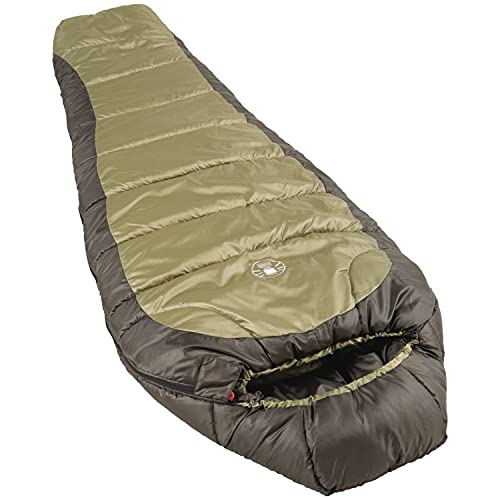
The North Rim takes the opposite approach to the Celsius: a true mummy shape that wraps close to the body, which reduces the air your body must heat. Coleman rates it to 0 degrees Fahrenheit under its own rating system, again with no ISO or EN standard named, and the big-and-tall cut fits sleepers up to 6 ft 2 in, which makes it a useful designated bag for the tallest person in the household.
Specs
- Temperature rating: 0°F (Coleman maker rating, no test standard named)
- Shape: Mummy with adjustable hood
- Dimensions: 82 x 32 in, fits sleepers up to 6 ft 2 in
- Insulation: ColeTherm hollow polyester fill
- Shell: Diamond ripstop polyester
- Features: No-snag zipper, zipper draft tube, contoured hood with cordlock adjustment
- Includes: Stuff sack
- Care: Machine washable
- Tier: Budget to mid-range
Because a mummy bag’s efficiency depends on a close fit, it suits people who sleep on their backs and stay fairly still. Side sleepers who toss and turn may prefer the roomier Celsius XXL above, even at the same headline rating.
Kelty Cosmic 20 Down Sleeping Bag

The Cosmic 20 is the premium, packable pick. Its 550 fill-power down compresses far smaller than any synthetic bag here, which matters when the emergency kit has to live in a backpack or a small car kit. Kelty publishes ISO-tested ratings for this line, with the 20-degree figure reflecting the ISO limit rating, so plan on it as a three-season bag rather than a deep-winter one, and note that down loses insulating value when wet, so it must be stored and sheltered dry.
Specs
- Temperature rating: 20°F (ISO limit rating published by Kelty)
- Shape: Mummy
- Insulation: 550 fill-power down, responsibly sourced per Kelty
- Shell: Recycled 20D nylon taffeta with PFAS-free durable water repellent finish
- Features: Draft collar, trapezoidal baffle construction, dual zipper pulls
- Includes: Compression stuff sack
- Weight: About 2 lb 11 oz in regular length
- Tier: Premium
For an evacuation go-bag, where the kit may need to be carried on foot, the Cosmic 20 is the strongest choice on this list. For a damp basement shelter or a kit that might get wet, a synthetic bag is the safer store-and-forget option.
Naturehike CWM400 Down Sleeping Bag
The CWM400 fills the mild-climate and layering role. It carries 400 grams of 650 fill-power white duck down in a light 20D nylon shell, and Naturehike rates it for comfort at about 43 degrees Fahrenheit, with lower limit and extreme figures published under the EN system. That makes it a three-season bag for warmer regions, a summer outage bag, or an overbag layered on top of a rectangular bag to extend its range in a cold snap.
Specs
- Temperature rating: Comfort about 43°F (Naturehike maker rating, EN-based figures published)
- Shape: Hooded envelope style, opens flat as a quilt
- Insulation: 400 g of 650 fill-power white duck down
- Shell: 20D ripstop nylon
- Zipper: Two-way YKK zipper
- Weight: About 2 lb total in the larger size
- Includes: Compression storage sack
- Tier: Mid-range
Households in the South or coastal regions, where winter nights rarely fall below freezing, may find this is all the bag they need, and its small packed size leaves room in the kit for water and food storage instead.
How to choose
Start with your coldest realistic night, not the average. A winter outage in an unheated house, a car stranded overnight, or an evacuation to an unheated shelter can each push indoor temperatures close to the outdoor low. Choose a bag whose maker-stated rating sits below that low, and remember that brand ratings without a named test standard, like the Coleman figures above, are usually closer to a limit than a comfort figure. ISO and EN ratings publish separate comfort and limit numbers, so compare comfort to comfort where the data exists.
Next, match insulation to storage conditions. Synthetic fills such as ColeTherm and SuperLoft Elite keep working when damp and tolerate years of compressed storage in a hall closet, which is why they anchor most home kits. Down packs smaller and lighter for the same warmth, which is why it wins in go-bags, but it must be kept dry and ideally stored loosely.
Then check fit and shape. Rectangular bags double as blankets and suit restless sleepers and spare-bed duty. Mummy bags are warmer per ounce but feel restrictive. Oversized cuts like the Celsius XXL and the big-and-tall North Rim exist so that taller or broader sleepers are not forced into a bag that compresses its own insulation at the shoulders.
Finally, never judge a bag alone. On a cold floor, an insulated sleeping pad underneath matters as much as the bag itself, because your body weight crushes the insulation beneath you. Pair any of these bags with the insulated pad already in your shelter kit, and add a liner or spare blanket for the coldest nights rather than trusting a single headline rating.
Who should skip
Skip full sleeping bags entirely if your kit is only for short daytime outages and you already store quality wool or fleece blankets for every household member; in mild climates that may be the more flexible system. Skip down bags if your storage space is damp, such as an unfinished basement without a sealed bin, because moisture quietly degrades down over time. Skip mummy bags for young children who may find the hood and narrow cut distressing during an already stressful night; a rectangular bag is calmer and doubles as bedding. And skip the coldest-rated oversized bags if your kit must be carried any distance on foot, since their stored bulk and weight crowd out water, food and lighting.
FAQ
How warm a sleeping bag does an emergency kit need?
Plan around the coldest night your household could face indoors without heat. In cold-winter regions, a maker-rated 0-degree bag is a sensible target; in mild regions, a 20 to 40-degree bag paired with blankets is usually enough. When a rating has no named test standard, assume it describes a limit rather than all-night comfort.
Can I store a sleeping bag compressed in its stuff sack?
Synthetic bags tolerate compressed storage better, though loft slowly declines over years either way. Down bags should be stored loose in a large cotton sack or hung up, then compressed only when the kit is packed to move. Rotating and airing stored bags once or twice a year helps any fill recover loft.
Do I still need a sleeping pad indoors?
Yes. Floors, cots and air mattresses pull heat from the compressed insulation under your body. An insulated pad under the bag is what makes the bag’s rating achievable in practice, especially on concrete basement or garage floors.
How many sleeping bags should a household kit hold?
One per person, sized to that person, plus one spare rectangular bag if you can store it. The spare covers guests, replaces a damaged bag, and unzips into a shared blanket, which makes it the most flexible extra piece in the kit.
Final verdict
For a single all-round home kit, the Coleman Brazos is the budget workhorse and the TETON Sports Celsius XXL is the cold-weather anchor. The Coleman North Rim covers tall sleepers in a mummy cut, the Kelty Cosmic 20 is the go-bag choice where packed size matters, and the Naturehike CWM400 handles mild climates and layering. Whichever you choose, confirm the rating basis on the product page, pair the bag with an insulated pad, and store it dry so it is ready the night the power fails.