Key takeaways
- Compare the best radon detectors for home monitoring, from battery and Wi-Fi monitors to plug-in alarms, with specs, accuracy notes and buying tips.
- Top Pick: Airthings Corentium Home (Model 223)
- Runner-up: Ecosense RadonEye RD200
- Also consider: Airthings Wave Radon (Model 2950)
Radon is a naturally occurring radioactive gas that forms in soil and rock and can enter a home through foundation cracks, floor joints and sump openings. It has no color, smell or taste, so the only way to know a home’s level is to measure it. Levels also change constantly: weather, season, ventilation and even rainfall can push readings up or down from one day to the next, which is why a single short test only tells part of the story.
A continuous electronic monitor solves that problem by sampling the air around the clock and building short-term and long-term averages over weeks and months. This guide compares five radon detectors with different approaches: a battery-powered standalone unit, two fast ion-chamber monitors, a Wi-Fi model built for remote checking, and a plug-in detector with a built-in alarm. Each is described from its published specifications.
As an Amazon Associate, we earn from qualifying purchases.
Quick answer
For most homes, the Airthings Corentium Home is the simplest place to start: it runs for years on batteries, needs no app or outlet, and shows daily, weekly and long-term averages on its own screen. If you want faster feedback, the Ecosense RadonEye RD200 reports within minutes, and the EcoQube adds Wi-Fi remote access.
Airthings Corentium Home (Model 223)

The Corentium Home is a standalone digital radon detector built around a passive diffusion chamber. It asks almost nothing of the owner: set it in the room you want to track, and it samples continuously, displaying a one-day average, a seven-day average and a long-term average that builds for up to a year. Because it runs on three AAA batteries with a maker-stated life of up to two years, it needs no outlet or phone connection.
That simplicity is also its limit. There is no app, no data export and no alert if levels climb; you read the numbers by walking up to the screen. The maker states precision within ten percent after seven days of sampling, and accuracy improves the longer the unit runs. It sits in the mid-range tier of this group.
Specs
- Sensor type: passive diffusion chamber with alpha spectrometry
- Readings: 1-day and 7-day short-term averages, long-term average up to 1 year
- Display: built-in LCD screen
- Power: 3 AAA batteries (included), maker-stated life up to 2 years
- Connectivity: none, fully standalone
- Units: pCi/L on the US version
Ecosense RadonEye RD200

The RadonEye RD200 uses a pulsed ion chamber, the same sensing approach found in professional instruments, and it is built for speed. Ecosense states a sensitivity of 30 counts per hour per pCi/L and a first reading about ten minutes after power is connected, with values refreshing as new counts accumulate. An OLED screen on the front shows the current level, and a Bluetooth connection to the Ecosense app adds hourly trend charts so you can see how levels swing between day and night or with the seasons.
The trade-off is power: the RD200 plugs in with its included adapter and has no battery, so placement depends on outlet access. Ecosense states measurement accuracy within ten percent, and the stated range runs from 0.2 to 99.9 pCi/L. It is a mid-range to premium pick for people who want quick feedback after sealing foundation gaps or adjusting a mitigation fan.
Specs
- Sensor type: pulsed ion chamber
- Sensitivity: 30 counts per hour per pCi/L (maker-stated)
- First reading: about 10 minutes after power-on (maker-stated)
- Display: OLED screen on the device
- Connectivity: Bluetooth to the Ecosense app with hourly trend charts
- Power: plug-in adapter (included), no battery
- Measurement range: 0.2 to 99.9 pCi/L (maker-stated)
Airthings Wave Radon (Model 2950)

The Wave Radon adds temperature and humidity sensing alongside radon, and moves the detailed numbers into the Airthings app. The round unit has no numeric screen; instead, waving a hand in front of it triggers a color-coded light ring that shows whether the recent average sits in the low, moderate or elevated band, while the app holds the graphs, history and daily, weekly and yearly averages over Bluetooth.
It runs on two AA batteries, so like the Corentium Home it can sit on a table or mount on a wall almost anywhere. Airthings notes the Wave Radon is no longer sold through its own store but remains available through retailers, with app support continuing. Choose it if you want an at-a-glance signal in the room plus full data on your phone. It sits in the mid-range tier.
Specs
- Sensor type: passive diffusion chamber
- Measures: radon, temperature and humidity
- Display: color-coded indicator light on the device, full data in the app
- Connectivity: Bluetooth to the Airthings app (iOS and Android)
- Power: 2 AA batteries (included)
- Mounting: tabletop or wall mount
Ecosense EcoQube (Model EQ100)
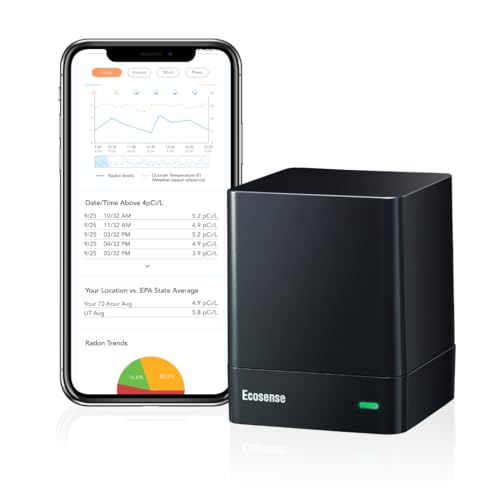
The EcoQube takes the app-first idea further with Wi-Fi. It uses the same pulsed ion chamber technology as the RadonEye, sampling every ten minutes and reporting a 60-minute moving average, but it sends results over a 2.4 GHz home network so levels can be checked from anywhere and alerts set for chosen thresholds. That suits a second home, a rental property, or a monitor in a basement you rarely visit.
There is no screen at all, only a three-color status light, and the app is required for setup and readings, so this is the wrong choice for anyone who wants numbers on the device itself. Ecosense states precision under ten percent at 10 pCi/L after ten hours, and lists a range of 0.2 to 99.9 pCi/L. The unit plugs in with a 5-volt adapter and must stay powered. It falls in the budget to mid-range tier of this group.
Specs
- Sensor type: pulsed ion chamber
- Sensitivity: 30 counts per hour per pCi/L (maker-stated)
- Update cycle: new reading every 10 minutes, reported as a 60-minute moving average
- Display: none, three-color status light only
- Connectivity: 2.4 GHz Wi-Fi and Bluetooth setup, Ecosense app with remote access and alerts
- Power: plug-in 5-volt adapter (included)
- Measurement range: 0.2 to 99.9 pCi/L (maker-stated)
Safety Siren Pro Series 3 (Model HS71512)

The Safety Siren Pro Series 3 is the oldest design in this group and the most appliance-like: it plugs into a standard wall outlet on an attached cord and behaves like a dedicated alarm. Its digital display toggles between a short-term average covering the most recent seven days and a long-term average, updating hourly, and an audible alarm sounds when the long-term average reaches the EPA action level of 4 pCi/L. The alarm can be muted, and the manual describes a user calibration routine for long-term ownership.
Family Safety Products describes the unit as evaluated under the EPA’s radon measurement proficiency program, a claim the maker has carried for many years. There is no app, no Bluetooth and no data history beyond the two averages. It sits in the budget tier and suits a single-room, set-and-forget installation where an audible warning matters more than graphs.
Specs
- Sensor type: ionization chamber
- Readings: short-term average (most recent 7 days) and long-term average, updated hourly
- Alarm: audible alarm at a long-term average of 4 pCi/L, mutable
- Display: digital readout on the device
- Connectivity: none
- Power: plugs into a standard 120-volt outlet, attached cord
- Measurement range: 0.0 to 999.9 pCi/L (per the manual)
How to choose
Start with placement, because it decides which power style works. Radon is heaviest at the lowest lived-in level of the home, so the detector belongs in a regularly used basement room or ground-floor space, set in the breathing zone away from exterior doors, windows, drafts, direct sunlight and high humidity spots such as laundry sinks. A battery model like the Corentium Home or Wave Radon can go exactly where it should; plug-in models like the RadonEye, EcoQube and Safety Siren need an outlet near that spot.
Next, decide how you will actually read the results. A screen on the device suits a room you pass daily. Bluetooth models hold history in an app but only sync when your phone is in range. Wi-Fi, offered here only by the EcoQube, supports remote properties and threshold alerts. Finally, think in averages rather than single readings: radon fluctuates hour to hour, so give a new unit at least a week, ideally much longer, before drawing conclusions. The EPA action level is 4 pCi/L, meaning the agency recommends fixing a home at or above that long-term level and considering action between 2 and 4 pCi/L.
Who should skip
Skip continuous monitors entirely if you need a certified result for a real-estate transaction or a mitigation contract; those situations call for a test performed or verified by a licensed measurement professional, not a consumer device. Renters who cannot control the lowest level of the building may get more value from a single lab test kit agreed with the landlord. And if you will never open an app, skip the EcoQube and Wave Radon: their numbers live on the phone, so a screen-based model will serve you better.
FAQ
Where should a radon detector be placed?
Place it in the lowest level of the home that is regularly occupied, such as a finished basement or ground-floor bedroom, roughly in the breathing zone and away from exterior walls, doors, windows, heating vents and sources of humidity. Keep it out of kitchens and bathrooms, and leave it in one spot, since moving it restarts the averages.
How long before the readings are trustworthy?
Electronic monitors show a first indication quickly, sometimes within minutes or a day, but the short-term average settles over the first week and the long-term average keeps improving for months. Radon varies with weather and season, so the EPA notes that a test lasting at least 90 days gives a better picture of a home’s year-round level than a short screening.
What radon level calls for action?
The EPA action level is 4 pCi/L: at or above that level, the agency recommends fixing the home, typically with a vent pipe and fan system installed by a qualified mitigation contractor. Between 2 and 4 pCi/L, the EPA says fixing should be considered. After mitigation work, retest to confirm levels stay down, a job a continuous monitor handles well.
Do I still need a lab test kit if I own a monitor?
A monitor covers ongoing tracking, seasonal changes and post-mitigation checks, which a one-time kit cannot. A lab-analyzed test still has a place when you need a documented result from an accredited laboratory, for example during a home purchase. Many owners use both: a kit for an initial documented baseline, then a monitor for everything after.
Final verdict
Each of these five detectors measures the same invisible gas, and the right choice is mostly about how you want to live with the numbers. The Airthings Corentium Home is the easiest recommendation for a first monitor: battery power, an on-device screen and long-term averages with zero maintenance. The RadonEye RD200 answers fastest and shows its work in hourly charts, while the EcoQube is the pick for checking a home from somewhere else. The Wave Radon suits app-comfortable households that also want temperature and humidity, and the Safety Siren Pro Series 3 remains a simple plug-in alarm for a single room. Pick the format you will actually check, and let the long-term average guide any next step.