Key takeaways
- Compare the best camping lanterns for power outages, from AA battery two-packs to rechargeable LED lanterns with phone charging, and pick the right light.
- Top Pick: Vont 2-Pack LED Camping Lantern
- Runner-up: Etekcity 2-Pack LED Camping Lantern
- Also consider: UST 30-Day Duro LED Lantern
When the lights go out, a good camping lantern lights a kitchen table and marks a hallway so nobody trips. The best camping lanterns for power outages run for many hours on a low setting, switch on easily in the dark, and keep working with no wall outlet in sight.
This guide covers portable camping lanterns you can carry from room to room or pack into a car. It is not about screw-in rechargeable emergency light bulbs, which fit into a lamp socket and stay in one place. The five picks below cover the main options: two AA battery two-packs, one long-running D battery lantern, and two rechargeable lanterns with phone charging. For each pick, the specs list light output in lumens and the power source first.
As an Amazon Associate, we earn from qualifying purchases.
Quick answer
For most households, the BioLite AlpenGlow 500 is the best all-round choice, with 500 lumens, a large rechargeable battery, and phone charging. If you want simple battery power, the Vont 2-Pack is the best budget pick. For the longest runtime, the UST 30-Day Duro runs on D batteries for up to 30 days on low.
1. Vont 2-Pack LED Camping Lantern
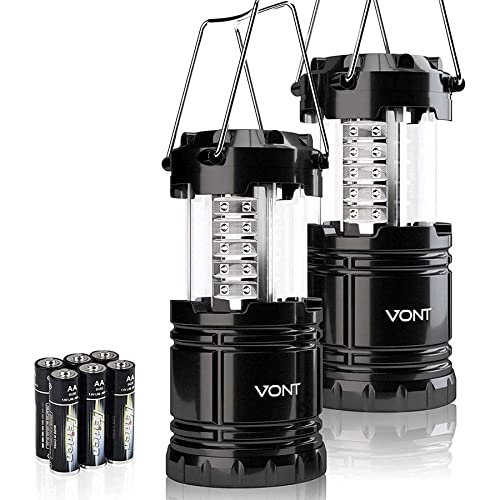
The Vont 2-Pack is the simplest lantern in this guide, and that simplicity is the point. Each lantern collapses flat for storage, pulls open to switch on, and runs on three AA batteries, with six batteries included. The two-pack format fits an outage plan well: keep one lantern in the living room and one in a bedroom, or keep one at home and one in a car kit. At 140 lumens, the 360-degree glow lights a single room for reading or cooking.
Specs
- Light output: 140 lumens
- Power source: 3 AA batteries per lantern, 6 AA batteries included
- Runtime: up to 90 hours on the listing
- LEDs: 30 LEDs per lantern
- Design: collapsible, 360-degree light
- Pack: 2 lanterns
- Tier: budget
- ASIN: B018L2WM86
2. Etekcity 2-Pack LED Camping Lantern

The Etekcity 2-Pack, model CL10, is the slightly brighter of the two battery two-packs here. Each lantern has 30 LEDs and a pull-up design: pull the top up to switch it on, and adjust how far it extends to change the brightness. Pushed fully closed, it switches off and shrinks for storage. Three AA batteries power each lantern, and six are included. The published lumen figure has varied between manual versions, with the current manual listing up to 154 lumens, so treat the headline number as approximate.
Specs
- Light output: up to 154 lumens
- Power source: 3 AA batteries per lantern, 6 AA batteries included
- Runtime: up to 50 hours
- LEDs: 30 LEDs per lantern
- Design: collapsible, brightness adjusts by how far the top is pulled up
- Water resistance: water resistant, not for submersion
- Warranty: 2 years
- Pack: 2 lanterns
- Tier: budget
- ASIN: B00XM8HTIS
3. UST 30-Day Duro LED Lantern

The UST 30-Day Duro is the marathon runner of this guide. It runs on three D batteries and is built to keep a usable light going for weeks, not hours. On low, the published runtime is up to 30 days of continuous light. On high, it puts out 700 lumens for up to 22 hours, with a medium setting rated at up to 106 hours in between. The rubberized body is rated IPX4 for splashes, the power button glows in the dark, and a flashing SOS mode is included. D batteries are not included, so buy them with the lantern and store a spare set with it.
Specs
- Light output: 700 lumens
- Power source: 3 D batteries, not included
- Runtime: up to 30 days on low, up to 106 hours on medium, up to 22 hours on high
- Modes: high, medium, low, SOS flashing
- Water resistance: IPX4 splash resistant
- Design: rubberized housing, glow-in-the-dark power button, removable globe, hanging hook
- Size: 7.2 inches tall
- Tier: mid-range
- ASIN: B00ABUSWM2
4. BioLite AlpenGlow 500 Lantern

The BioLite AlpenGlow 500 is the best all-round lantern here for a household that wants one light to do most jobs. It puts out 500 lumens on high for 5 hours, or up to 200 hours on its 5-lumen low setting, from a sealed 6,400 mAh rechargeable battery. A USB-A output lets the battery top up a phone, which matters when an outage also takes out phone charging. Charging in is by micro USB, in about 3 hours. It offers warm white and cool white settings, plus single-color and multicolor modes, and its ChromaReal LEDs carry a published color rendering index of 90. Check the delivery estimate on the listing before counting on it for a trip, because availability has varied.
Specs
- Light output: 500 lumens on high, 5 lumens on low
- Power source: 6,400 mAh sealed rechargeable lithium-ion battery
- Runtime: 5 hours on high, up to 200 hours on low
- Charging: micro USB input, about 3 hours; USB-A output for charging phones
- Light modes: warm white, cool white, single color, multicolor; CRI 90
- Water resistance: IPX4 splash resistant
- Weight: 13.4 ounces
- Tier: premium
- ASIN: B08Z6294Y5
5. Goal Zero Lighthouse 600 Lantern

The Goal Zero Lighthouse 600 is the lantern to buy when you want more than one way back from an empty battery. It charges by USB, from a Goal Zero Nomad 10 solar panel, or from a built-in hand crank, so it can keep going through an outage that lasts longer than its battery. The sealed 5,200 mAh battery powers two sides that light independently, so you can light one side to save power or both sides for full brightness. On high with both sides lit, it puts out up to 600 lumens for about 2.5 hours; with one side on low, the published runtime stretches to 320 hours. A USB-A output can top up a phone. Goal Zero publishes no water-resistance rating for this model, so keep it sheltered in wet weather.
Specs
- Light output: up to 600 lumens
- Power source: 5,200 mAh sealed rechargeable lithium-ion battery; USB, solar panel, or hand crank charging
- Runtime: about 2.5 hours both sides on high, up to 320 hours one side on low
- Charging: USB input; compatible with Goal Zero Nomad 10 solar panel; built-in hand crank
- USB output: USB-A, 5V up to 1.5A, for charging phones and small devices
- Design: two independently lit sides, fold-out legs, carry handle, dimmer knob
- Water resistance: no published rating
- Weight: 1.1 pounds
- Tier: premium
- ASIN: B08HRM4J8Y
How to choose
Start with the power source, because it decides how you keep the lantern running when the outage drags on. Battery lanterns that take AA or D cells work as long as you have spare cells stored with them, and they never need a wall outlet. Rechargeable lanterns are cheaper to run over time and can charge a phone, but they need to be charged before the outage, or recharged from a power bank, a car, or a solar panel. A household with no other backup power should still own at least one battery lantern.
Next, match lumens to the room. A lantern in the 120 to 160 lumen range lights one small room well enough for reading and cooking. A lantern in the 500 to 700 lumen range lights a larger room or an open living area. Brighter is not always better: a very bright lantern on high drains its battery fast, so check the runtime on low as well as on high. For a multi-day outage, the low-setting runtime is the number that matters most. Also check the practical details: a collapsible body stores easily, and a hook or handle lets you hang the lantern where the light falls best.
Who should skip
Skip the rechargeable lanterns if you have no way to recharge them during a long outage and no power bank, car charger, or solar panel to fall back on. A sealed battery that starts empty stays empty until the power returns, so a battery lantern with spare cells is the safer choice. The same applies if you plan to store a lantern untouched for years: disposable batteries can be stored separately and fitted when needed, while a sealed battery slowly loses charge in storage.
Skip the brightest lanterns if you mainly need a night light for a bedroom or a tent. Skip the hand-crank and solar options if you want the simplest possible light: a crank adds moving parts and takes real effort for a small return, and solar charging only helps in daylight. And if you need light that stays fixed in one place, such as a lamp that comes on by itself when the power fails, a screw-in rechargeable emergency bulb or a plug-in power-failure light fits that job better than any portable lantern.
FAQ
How many lumens do I need in a camping lantern for a power outage?
For one small room, 120 to 160 lumens is enough for reading and cooking. For a larger living room, look for 500 lumens or more. The low setting matters as much as the headline number, because a lantern that runs for days on low beats a brighter one that runs for a few hours on high.
Should I choose a rechargeable lantern or one that takes disposable batteries?
Choose disposable batteries if you want a lantern that works after years in storage with spare cells beside it, and if you have no way to recharge during an outage. Choose rechargeable if you want lower running costs and a USB output for charging a phone. Many households keep one of each.
How long will a camping lantern last during an outage?
It depends on the brightness setting. The lanterns in this guide range from about 5 hours on high to up to 30 days on low, so the setting you use matters more than the lantern itself. Running a lantern on low overnight stretches any battery through a multi-day outage.
Can a camping lantern charge a phone?
Some can. The BioLite AlpenGlow 500 and the Goal Zero Lighthouse 600 both have a USB-A output that can top up a phone from their internal batteries. The Vont, Etekcity, and UST models have no USB output, so they cannot charge a phone.
Final verdict
For most households, the BioLite AlpenGlow 500 is the best camping lantern for power outages. It balances brightness, runtime, and phone charging in a single lantern.
If your budget is tighter, or you want light in two rooms at once, the Vont 2-Pack is the best budget pick, with the Etekcity 2-Pack close behind as a slightly brighter alternative. If you are preparing for a long outage, the UST 30-Day Duro is the pick, with up to 30 days on low from three D cells. And if you want the most ways to recharge, including a hand crank and a solar panel, the Goal Zero Lighthouse 600 is the most flexible lantern here. Whichever you choose, keep it charged or keep spare batteries with it before the next storm.